onion - Master This Word
Master this word with our 5-step learning method – Learn English in English
Train English Through Brain Routes, Not Translation.
This page helps you stop memorizing isolated translations and start understanding a word through its shared mental image, native-style thinking, and practical training steps.
Master this word with our 5-step learning method – Learn English in English
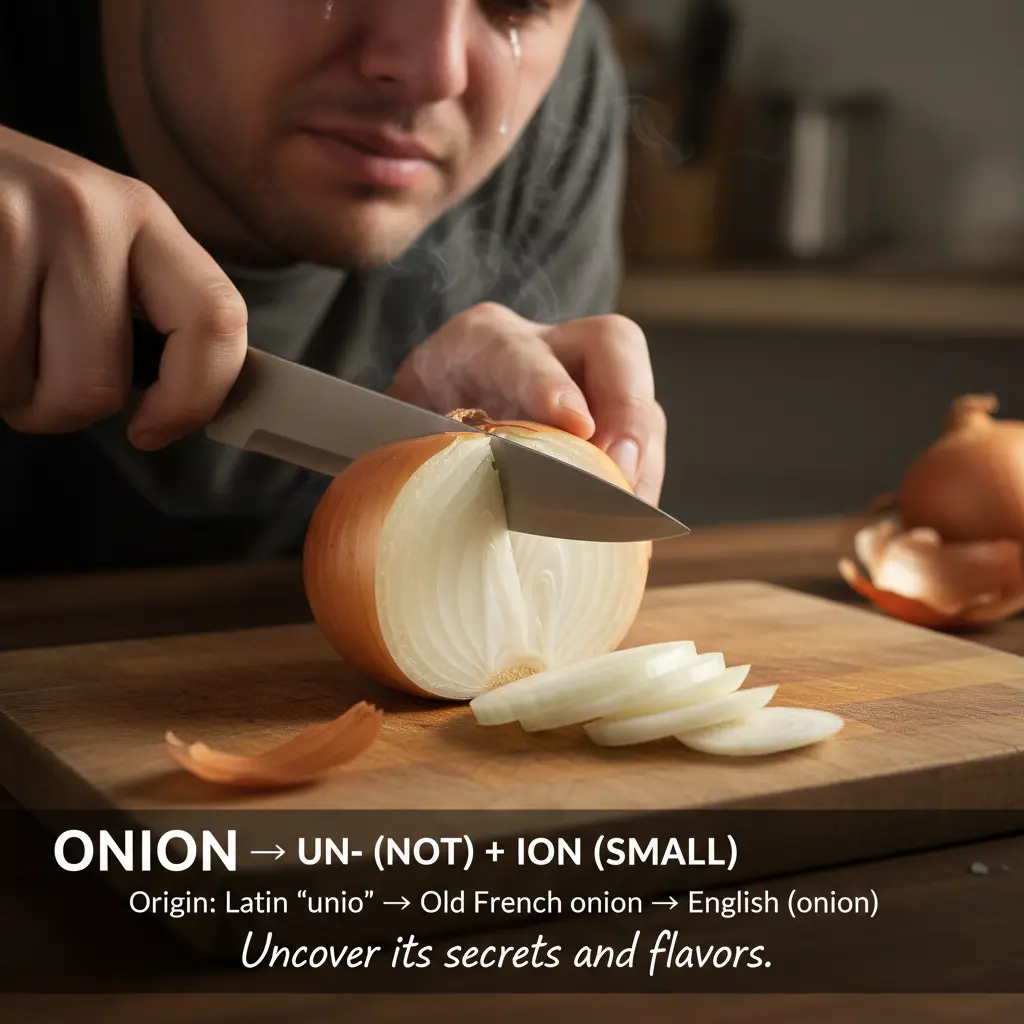
Example sentences are the start of understanding. Don't rush to memorize. First feel how the word works in a sentence.
onion = un- (not) + ion (small). Origin: Latin 'unio' → Old French 'onion' → English 'onion'. Image: Imagine cutting into an onion, revealing its many layers, each one making you cry as you uncover its secrets and flavors.
Note 1: These definitions and etymologies are not standard dictionary definitions, but extended explanations provided to help with memorization and understanding of the actual application of words. Through this background information, we strive to make words more vivid and easier to understand, and help you remember their meanings in real life.
Note 2: LexiTalk designs the learning flow around the linguistics principle of “Comprehensible Input.” When learners encounter material that is slightly above their level but still understandable from context, the brain naturally absorbs the language. That’s why we keep every word inside authentic contexts, using examples and associations to help you understand it and use it flexibly.
Read the FAQ explanation of Comprehensible InputI pick up an onion and place it on the cutting board, holding it steady. I move the knife through the skin, and the pungent scent fills the air as each layer loosens. I adjust my grip and slow down when the eyes start to sting, pushing ahead bite by bite. With every slice, the onion reveals its many layers, and I learn to cook with patience and care, one careful move at a time.
Onion is a bulbous vegetable used worldwide, known for its sharp aroma and the way cutting it can bring tears to the eyes. In cooking, onions anchor many dishes, providing sweetness when caramelized and bite when raw. The word onion covers several senses: the actual vegetable, a common ingredient in recipes, and a metaphor for complexity with its many layers. Learners often confuse onions with similar vegetables such as garlic, or mispronounce the o sound in unstressed syllables. Understanding its polarity—pungent when raw, mellow when cooked—helps learners navigate both vocabulary and cultural contexts around food.
In English, onion is treated as both a concrete food item and a flexible metaphor for layered complexity. Learners often project a simple, vertical structure onto the idea of layers and may underuse or misinterpret common idioms about peeling back layers.
What is the meaning of the word 'onion'?
In which of the following dishes is an onion commonly used?
Which of the following is a similar word to 'onion'?
What could be an opposite word to 'onion' in terms of taste?
In which of the following scenarios would you most likely use an onion?
Download LexiTalk app for personalized learning experience
Download AppCookies
We use cookies for essential site functions, analytics, and ads. You can accept, reject, or manage preferences. Privacy Policy