organic - Master This Word
Master this word with our 5-step learning method – Learn English in English
Train English Through Brain Routes, Not Translation.
This page helps you stop memorizing isolated translations and start understanding a word through its shared mental image, native-style thinking, and practical training steps.
Master this word with our 5-step learning method – Learn English in English
Example sentences are the start of understanding. Don't rush to memorize. First feel how the word works in a sentence.
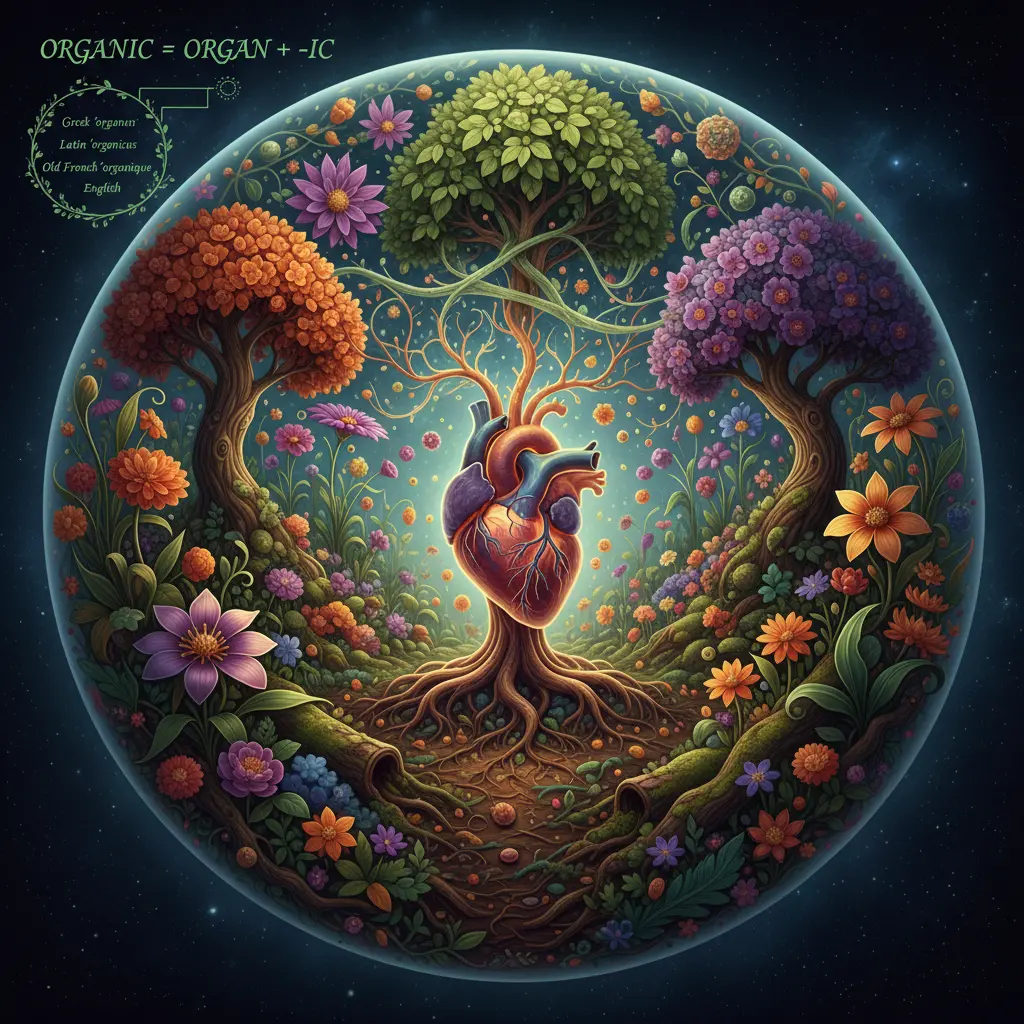
organic = organ + -ic (relating to an organ); Origin: Greek 'organon' → Latin 'organicus' → Old French 'organique' → English. Memory image: visualize a vibrant garden where everything grows naturally and intricately connected.
Note 1: These definitions and etymologies are not standard dictionary definitions, but extended explanations provided to help with memorization and understanding of the actual application of words. Through this background information, we strive to make words more vivid and easier to understand, and help you remember their meanings in real life.
Note 2: LexiTalk designs the learning flow around the linguistics principle of “Comprehensible Input.” When learners encounter material that is slightly above their level but still understandable from context, the brain naturally absorbs the language. That’s why we keep every word inside authentic contexts, using examples and associations to help you understand it and use it flexibly.
Read the FAQ explanation of Comprehensible InputI reach for a tomato, move it in my hand, and feel its warm, irregular surface that says it's alive. I turn it to catch the light, adjust my grip, and notice how its scent and texture are simple and real, not slick with chemicals. The whole moment makes me think of the difference between something grown and something made, and I keep that sense when I shop and cook. Let this feeling guide my choices as I shop and cook, keeping meals close to living matter.
Organic is an English adjective with several closely related senses. In science, it means relating to living matter or to carbon-based compounds studied in organic chemistry. In everyday speech, organic often describes foods or products produced without artificial chemicals, a label popularized by organic farming. A broader, more philosophical sense describes something with a structure or organization that resembles a living system, integrated and evolving rather than purely mechanical. For learners, the key distinction is between scientific usage (organic chemistry) and consumer labeling (organic foods), and between implying vitality and implying naturalness.
In English, organic spans science, labeling, and philosophy. Learners must track context cues to avoid mixing scientific terms (organic chemistry) with consumer labels (organic food).
What is the meaning of the word 'organic'?
Which sentence uses the word 'organic' correctly?
Which word is most similar to 'organic'?
What is the opposite of 'organic'?
Can you give an example of a real-life scenario involving 'organic'?
English Learning Listening Content
Listen NowDownload LexiTalk app for personalized learning experience
Download AppCookies
We use cookies for essential site functions, analytics, and ads. You can accept, reject, or manage preferences. Privacy Policy