ourselves - Master This Word
Master this word with our 5-step learning method – Learn English in English
Train English Through Brain Routes, Not Translation.
This page helps you stop memorizing isolated translations and start understanding a word through its shared mental image, native-style thinking, and practical training steps.
Master this word with our 5-step learning method – Learn English in English
Example sentences are the start of understanding. Don't rush to memorize. First feel how the word works in a sentence.
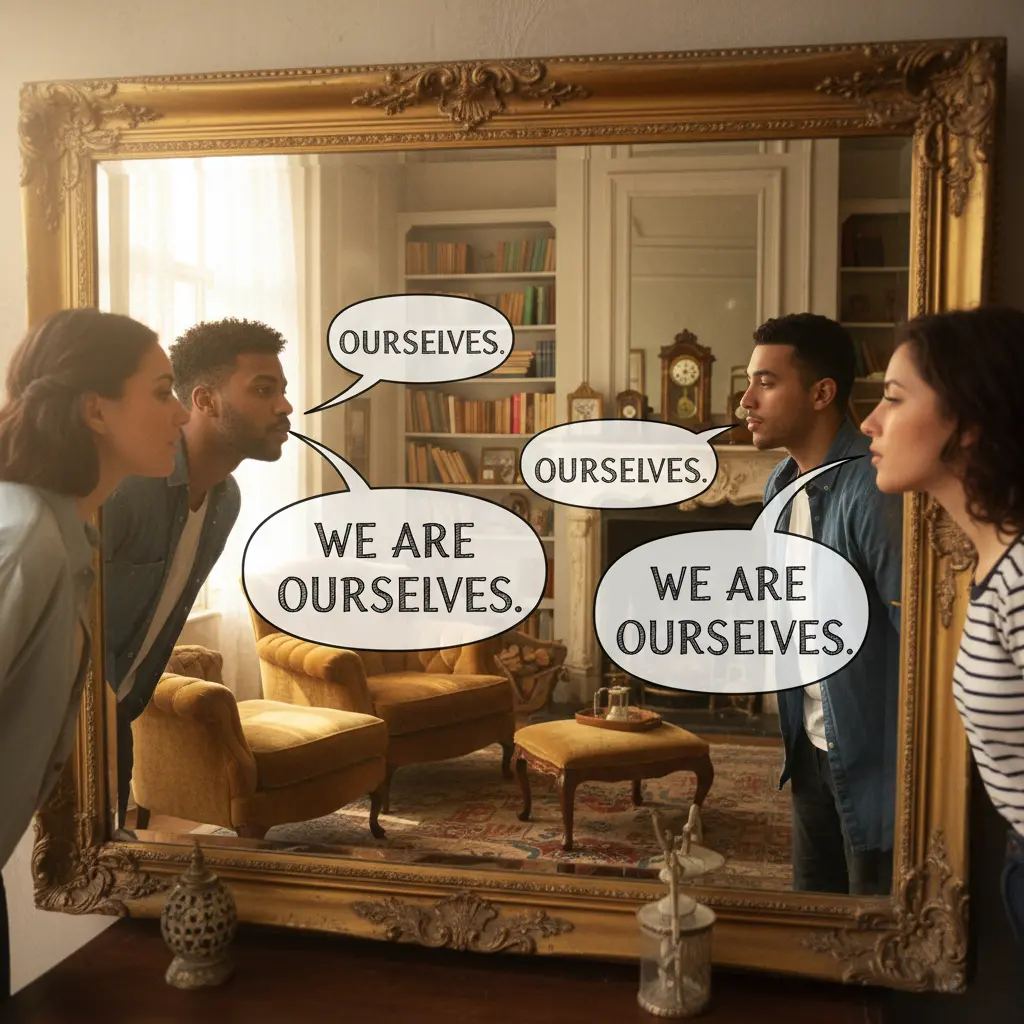
ourselves = our + selves; historically from Old English 'ūre' (our) + 'self'; imagine a group of friends looking at their reflections, each seeing themselves and saying 'we are ourselves.'
Note 1: These definitions and etymologies are not standard dictionary definitions, but extended explanations provided to help with memorization and understanding of the actual application of words. Through this background information, we strive to make words more vivid and easier to understand, and help you remember their meanings in real life.
Note 2: LexiTalk designs the learning flow around the linguistics principle of “Comprehensible Input.” When learners encounter material that is slightly above their level but still understandable from context, the brain naturally absorbs the language. That’s why we keep every word inside authentic contexts, using examples and associations to help you understand it and use it flexibly.
Read the FAQ explanation of Comprehensible InputFirst I shift my weight, letting my breath slow as I move toward the idea that we share the action. I pull the focus toward us, adjust how we see who is steering, and hold the moment that the group acts together. The scene changes as we decide what to do next, and I feel our sense of self grow in that shared action—ourselves.
ourselves is a reflexive pronoun used to refer to the speaker and others in the same group, and to add emphasis on the subject or the group performing the action. It often appears after verbs or prepositions, in phrases like we did it ourselves, by ourselves, or for ourselves, signaling self-reliance, collective identity, or mutual involvement. It contrasts with we as a subject pronoun or our as possessive determiner, by providing a reflexive or emphatic focus. Learners frequently confuse it with ourselves being a subject complement, or mistakenly place it after an object that does not require reflexive emphasis. The historical note: it comes from our + selves in Old English, illustrating group self-reference in English.
English uses ourselves as a reflexive and emphatic pronoun tied to the subject group; learners often misuse it as a plain object or misplace it after non-reflexive verbs, and may overemphasize in places where a simple 'we' would suffice.
What is the meaning of the word 'ourselves'?
Which sentence uses the word 'ourselves' correctly?
Which word is most similar to 'ourselves'?
What is the opposite of 'ourselves'?
Can you think of a real-life context where we use the word 'ourselves'?
Download LexiTalk app for personalized learning experience
Download AppCookies
We use cookies for essential site functions, analytics, and ads. You can accept, reject, or manage preferences. Privacy Policy