
overrule - Master This Word
Master this word with our 5-step learning method – Learn English in English
Train English Through Brain Routes, Not Translation.
This page helps you stop memorizing isolated translations and start understanding a word through its shared mental image, native-style thinking, and practical training steps.
Master this word with our 5-step learning method – Learn English in English
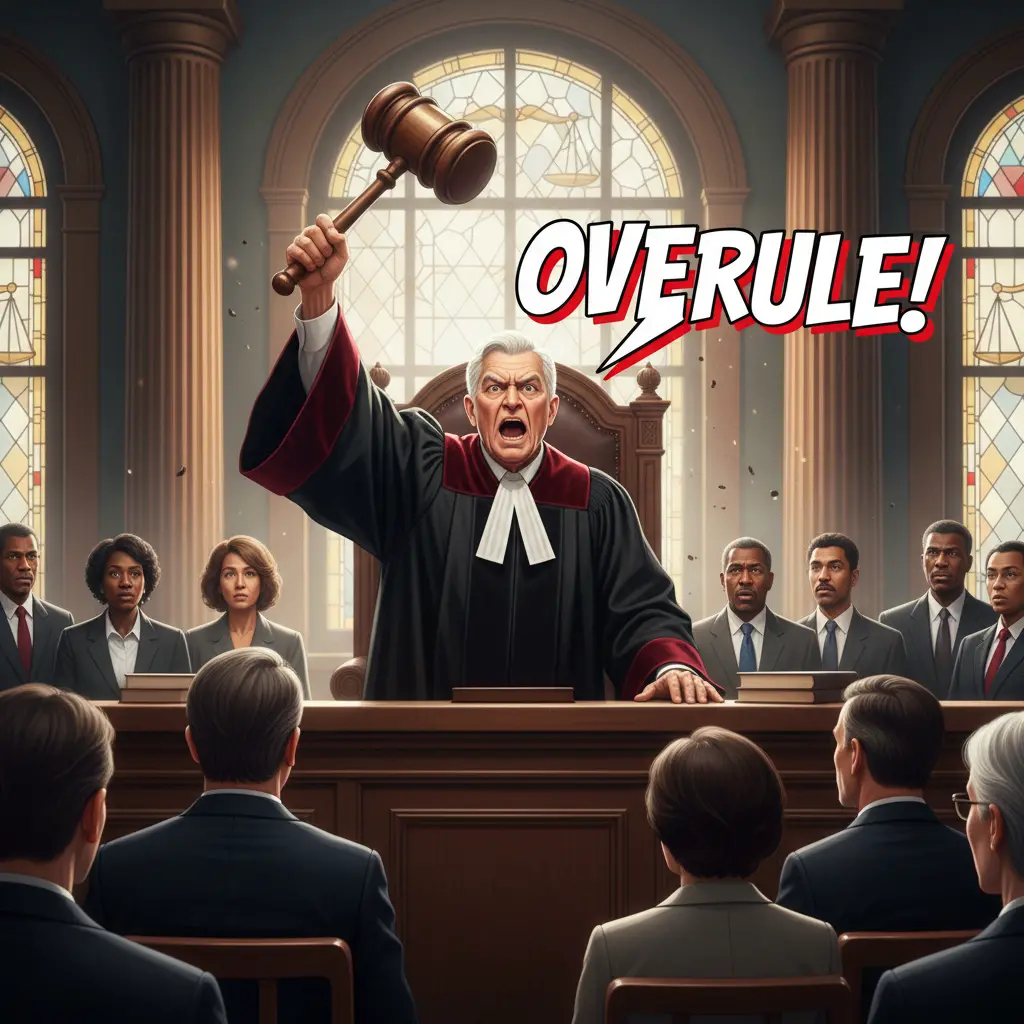
Example sentences are the start of understanding. Don't rush to memorize. First feel how the word works in a sentence.
Overrule: over (prefix) + rule (root). Origin: Latin 'super-regulare' → Old French 'overrouler' → English 'overrule'. Imagine a powerful judge in a courtroom raising their gavel, shouting 'overrule!' to reject an opposing argument, demonstrating authority and control.
Note 1: These definitions and etymologies are not standard dictionary definitions, but extended explanations provided to help with memorization and understanding of the actual application of words. Through this background information, we strive to make words more vivid and easier to understand, and help you remember their meanings in real life.
Note 2: LexiTalk designs the learning flow around the linguistics principle of “Comprehensible Input.” When learners encounter material that is slightly above their level but still understandable from context, the brain naturally absorbs the language. That’s why we keep every word inside authentic contexts, using examples and associations to help you understand it and use it flexibly.
Read the FAQ explanation of Comprehensible InputOverrule is a strong verb used when a decision is rejected or reversed, often by someone with authority: a judge can overrule a lower court ruling, a supervisor can overrule a team decision, and a parent might overrule a child's choice in certain contexts. The word carries a sense of authority and finality; it implies that the overruling party has the power to set aside a prior conclusion. In courtroom talk, overrule is common in phrases like The judge overruled the objection, while in everyday life you might say the manager overruled the team’s suggestion. It can feel aggressive, so learners usually reserve it for formal or decisive moments.
In English, overrule foregrounds formal authority and finality. Learners often conflate it with simply disagreeing or vetoing, but overrule implies an explicit power to reverse a prior decision. Common mistakes include using it for casual disagreements or confusing it with override, which can mean bypassing a rule rather than overturning a ruling.
What is the definition of 'overrule'?
Which of the following sentences uses 'overrule' correctly?
Which word is most similar to 'overrule'?
What is the opposite of 'overrule'?
Can you think of a real-life context where someone might need to overrule a decision?
Download LexiTalk app for personalized learning experience
Download AppCookies
We use cookies for essential site functions, analytics, and ads. You can accept, reject, or manage preferences. Privacy Policy