
overtire - Master This Word
Master this word with our 5-step learning method – Learn English in English
Train English Through Brain Routes, Not Translation.
This page helps you stop memorizing isolated translations and start understanding a word through its shared mental image, native-style thinking, and practical training steps.
Master this word with our 5-step learning method – Learn English in English
Example sentences are the start of understanding. Don't rush to memorize. First feel how the word works in a sentence.
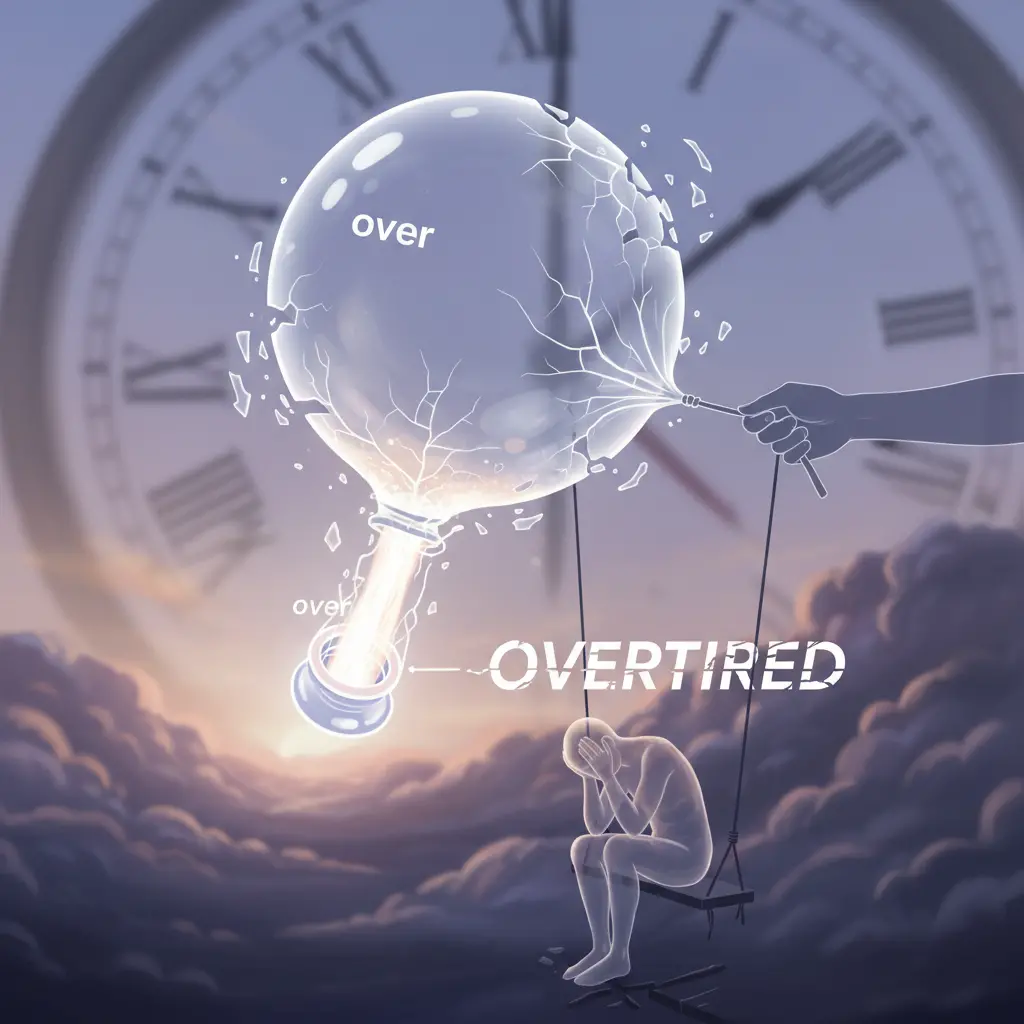
Root: 'over' (excessively) + 'tire' (to exhaust). Origin: Latin 'over' + Old French 'tirer' (to pull) to Middle English 'overtire'. Memory image: Imagine a balloon being filled with too much air until it pops; similarly, when someone is overtired, they are pushed beyond their limits.
Note 1: These definitions and etymologies are not standard dictionary definitions, but extended explanations provided to help with memorization and understanding of the actual application of words. Through this background information, we strive to make words more vivid and easier to understand, and help you remember their meanings in real life.
Note 2: LexiTalk designs the learning flow around the linguistics principle of “Comprehensible Input.” When learners encounter material that is slightly above their level but still understandable from context, the brain naturally absorbs the language. That’s why we keep every word inside authentic contexts, using examples and associations to help you understand it and use it flexibly.
Read the FAQ explanation of Comprehensible InputOvertire is a formal way to say you cause someone to become extremely tired, beyond what would normally be expected. It emphasizes pushing a person past ordinary fatigue, often through long, strenuous work, stress, or lack of rest. In practice you might say a demanding schedule overtired the staff, or a marathon overtime shift overtired the worker. Unlike simple tired, overtire carries a stronger sense of depletion and strain, and the subject can remain overtired even after a short break. It is less common in everyday speech and is more likely found in writing or formal critique. Learners should note its passive participle overtired, and remember it is a transitive verb requiring an object.
In English, overtire reads as a formal critique or clinical description of fatigue, emphasizing an intensity beyond normal tiredness and often used in writing. Learners may overgeneralize it to casual speech or confuse it with simple tiredness.
What is the meaning of 'overtire'?
Which sentence uses 'overtire' correctly?
Which word is most similar to 'overtire'?
What is the opposite of 'overtire'?
Can you think of a real-life context where someone might feel overtired?
Download LexiTalk app for personalized learning experience
Download AppCookies
We use cookies for essential site functions, analytics, and ads. You can accept, reject, or manage preferences. Privacy Policy