petulance - Master This Word
Master this word with our 5-step learning method – Learn English in English
Train English Through Brain Routes, Not Translation.
This page helps you stop memorizing isolated translations and start understanding a word through its shared mental image, native-style thinking, and practical training steps.
Master this word with our 5-step learning method – Learn English in English
Example sentences are the start of understanding. Don't rush to memorize. First feel how the word works in a sentence.
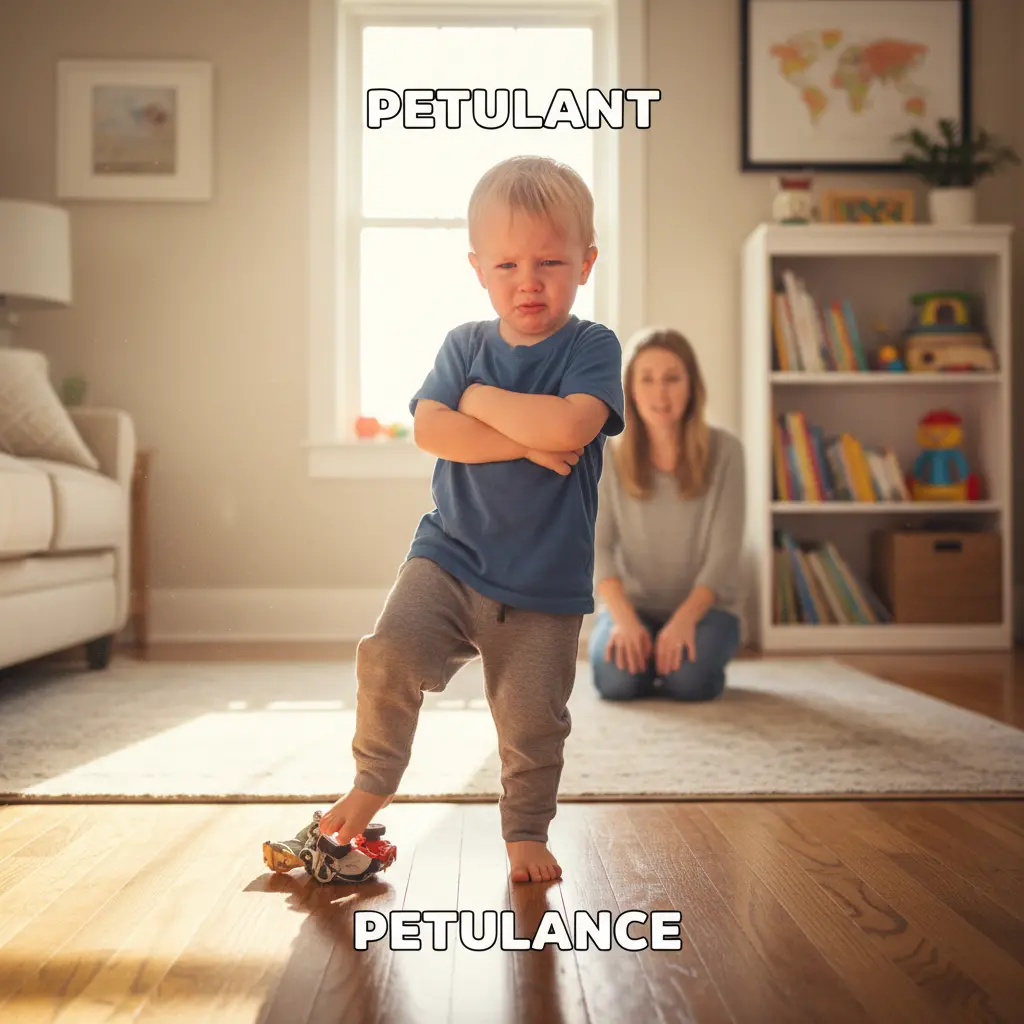
Root decomposition: root petul- with suffixes -ant for the adjective and -ance for the noun, with no prefix. Historical origin: Latin petulans insolent, via Old French pétulant, to English petulant; petulance from pétulance. Memory image: imagine a child stomping feet and pouting when annoyed.
Note 1: These definitions and etymologies are not standard dictionary definitions, but extended explanations provided to help with memorization and understanding of the actual application of words. Through this background information, we strive to make words more vivid and easier to understand, and help you remember their meanings in real life.
Note 2: LexiTalk designs the learning flow around the linguistics principle of “Comprehensible Input.” When learners encounter material that is slightly above their level but still understandable from context, the brain naturally absorbs the language. That’s why we keep every word inside authentic contexts, using examples and associations to help you understand it and use it flexibly.
Read the FAQ explanation of Comprehensible InputPetulance is the quality of being irritable and sulky, as if a momentary mood swing defines a person. It describes a peevish, easily annoyed attitude that can flare up at small provocations and often shows itself as sulking, pouting, or snapping at others. The term implies not just a mood, but a recurring pattern: a display of childish impatience that colors reactions in conversations, responses to delays, or perceived slights. In writing, petulance carries a mild, almost whimsical judgment, signaling that the behavior is petty rather than deep. The related adjective petulant is commonly used to describe such behavior in a slightly judgmental way.
Petulance in English carries a literary, slightly judgmental tone; learners often confuse it with generic irritability or moodiness and may overuse petulant in casual speech. Remember it implies a pattern, not a one-off incident, and tends to appear in writing and critique rather than everyday conversation.
Which option best defines the word 'petulance'?
Which sentence uses the word 'petulance' correctly?
Which word is most similar in meaning to 'petulance'?
Which word is an opposite (antonym) of 'petulance'?
Which example best illustrates the trait described by 'petulance' (choose the one that shows the behavior, without using the word)?
Download LexiTalk app for personalized learning experience
Download AppCookies
We use cookies for essential site functions, analytics, and ads. You can accept, reject, or manage preferences. Privacy Policy