planets - Master This Word
Master this word with our 5-step learning method – Learn English in English
Train English Through Brain Routes, Not Translation.
This page helps you stop memorizing isolated translations and start understanding a word through its shared mental image, native-style thinking, and practical training steps.
Master this word with our 5-step learning method – Learn English in English
Example sentences are the start of understanding. Don't rush to memorize. First feel how the word works in a sentence.
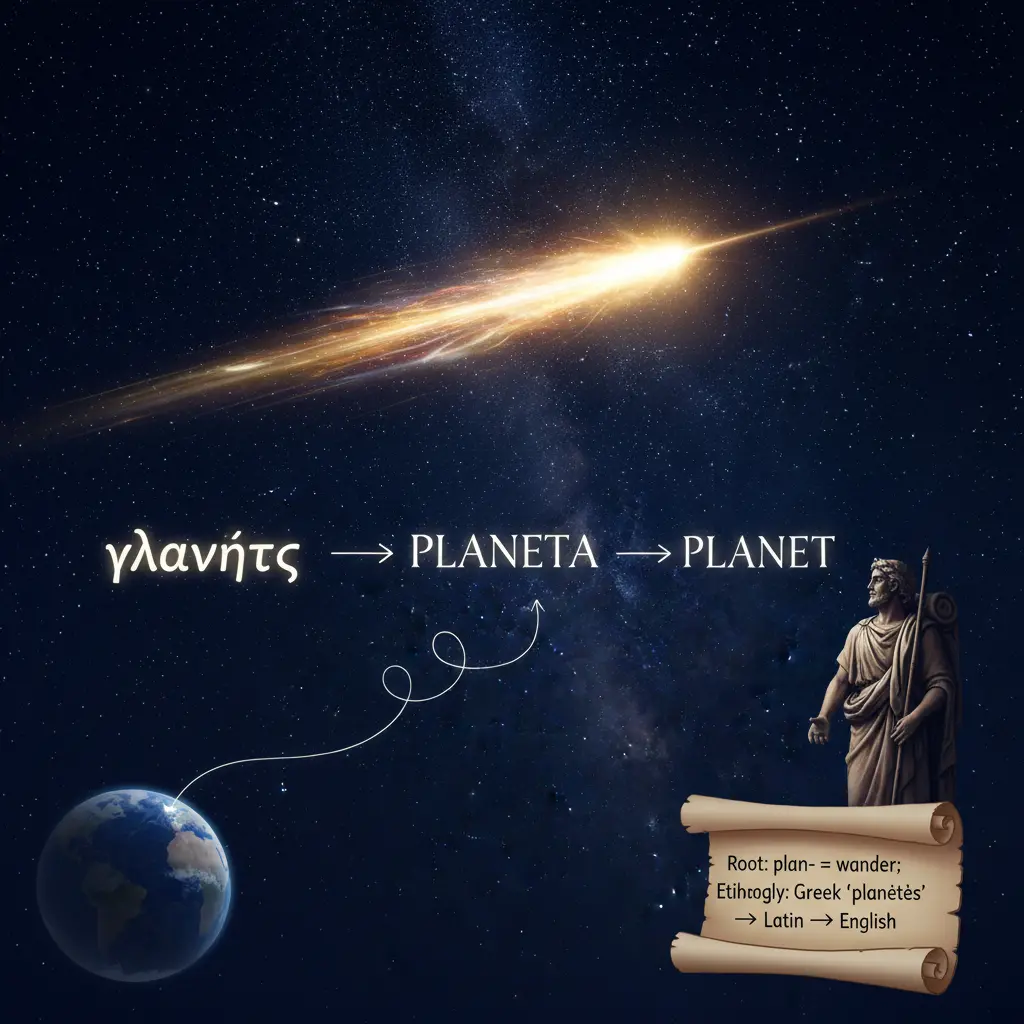
Root: plan- = wander; etymology: Greek 'planētēs' → Latin 'planeta' → English 'planet'. Memory image: Imagine a bright star wandering across the night sky, representing a planet's movement.
Note 1: These definitions and etymologies are not standard dictionary definitions, but extended explanations provided to help with memorization and understanding of the actual application of words. Through this background information, we strive to make words more vivid and easier to understand, and help you remember their meanings in real life.
Note 2: LexiTalk designs the learning flow around the linguistics principle of “Comprehensible Input.” When learners encounter material that is slightly above their level but still understandable from context, the brain naturally absorbs the language. That’s why we keep every word inside authentic contexts, using examples and associations to help you understand it and use it flexibly.
Read the FAQ explanation of Comprehensible InputI set a small ball on the desk and push it in a slow arc, watching it move like a tiny planet circling a sun. I shift the lamp, adjust the glow, and place the ball again to keep the orbit clear. As I repeat the motion, the idea settles: a planet can be that bright body in the night sky or a person who matters in a story. This hands-on pace—hold, turn, and let the scene guide me—shows how the word can fit real life moments.
A planet is a celestial body that orbits a star and has cleared its orbital path of debris. In our solar system, eight planets are recognized: Mercury, Venus, Earth, Mars, Jupiter, Saturn, Uranus, and Neptune. Planets vary in size, composition, atmospheres, and distance from the Sun. The term planet comes from the Greek planētēs, meaning wanderer, reflecting how planets move against the background stars. In everyday English, planet can also be used metaphorically to refer to something of great importance or a person with worldwide influence. Learners should distinguish planet from satellite and moon in scientific contexts.
Native English speakers often rely on direct scientific phrasing; learners may over-literalize metaphors or mix up planet with star concepts.
Download LexiTalk app for personalized learning experience
Download AppCookies
We use cookies for essential site functions, analytics, and ads. You can accept, reject, or manage preferences. Privacy Policy