
programming - Master This Word
Master this word with our 5-step learning method – Learn English in English
Train English Through Brain Routes, Not Translation.
This page helps you stop memorizing isolated translations and start understanding a word through its shared mental image, native-style thinking, and practical training steps.
Master this word with our 5-step learning method – Learn English in English
Example sentences are the start of understanding. Don't rush to memorize. First feel how the word works in a sentence.
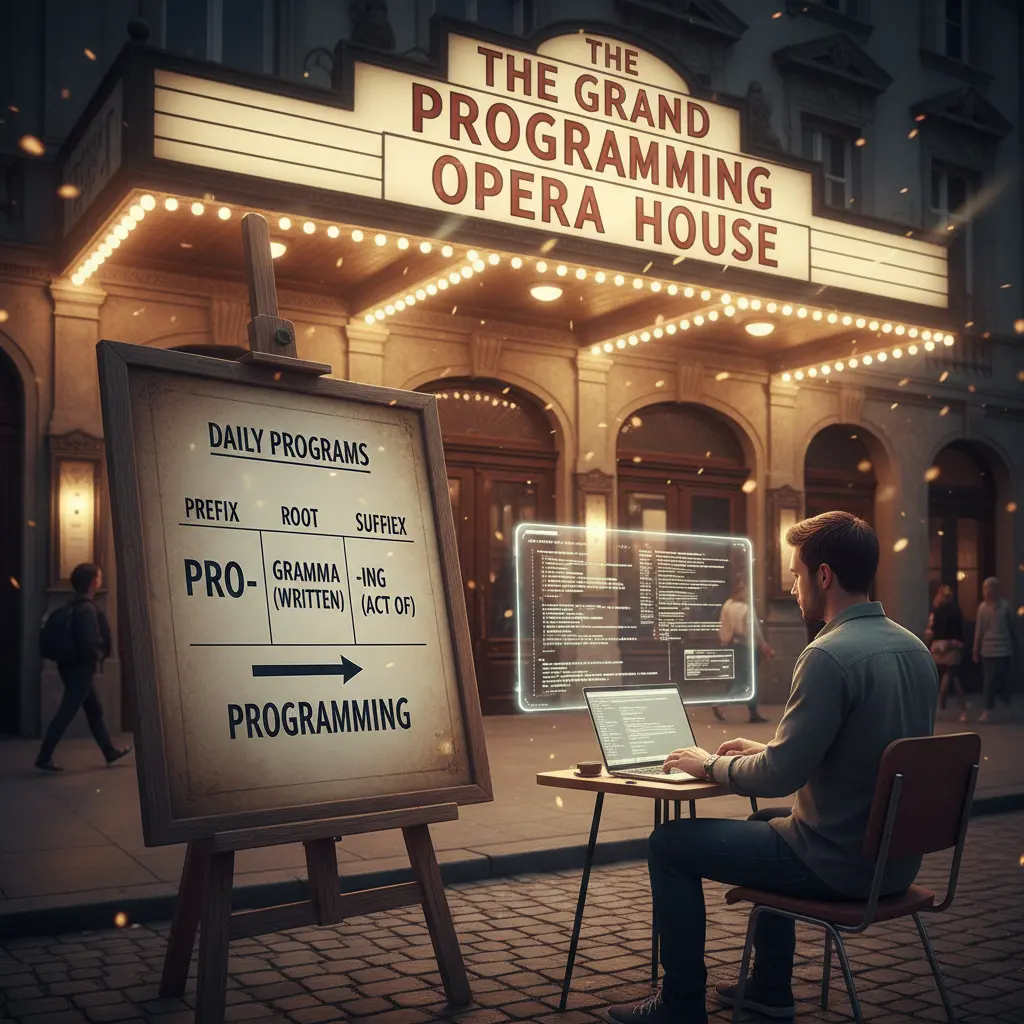
Root decomposition: prefix pro- + root gram (from Greek grámma meaning 'something written') + suffix -ming. Historical origin: Greek prográmma → Latin programma → Old French programme → English, originally meaning 'a written plan' and later extended to the act of programming. Memory image: imagine a theater entrance with a posted program schedule and a programmer following that plan to instruct a computer.
Note 1: These definitions and etymologies are not standard dictionary definitions, but extended explanations provided to help with memorization and understanding of the actual application of words. Through this background information, we strive to make words more vivid and easier to understand, and help you remember their meanings in real life.
Note 2: LexiTalk designs the learning flow around the linguistics principle of “Comprehensible Input.” When learners encounter material that is slightly above their level but still understandable from context, the brain naturally absorbs the language. That’s why we keep every word inside authentic contexts, using examples and associations to help you understand it and use it flexibly.
Read the FAQ explanation of Comprehensible InputI place my hands on the keyboard, then I push keys and move lines of code, tweaking one line after another. I feel the screen change as errors blink away and the run shows progress; a slight strain but a rhythm. Each fix pulls in a new idea, I adjust the logic, I keep the loop running until it behaves. In real use, this habit grows into building apps and shaping software day by day.
Programming is the act of writing instructions that a computer can execute. It encompasses coding in languages such as Python, Java, and C++, and includes debugging, testing, and maintaining software. Beyond the craft, programming is also used to refer to the broader field of software development, including design, architecture, and collaboration in teams. A third sense appears in non-computing contexts: programming can mean planning content or events, such as TV programming schedules, or configuring devices by setting parameters. Learners should note the noun form 'programming' is uncountable when referring to the activity, but can appear in phrases like 'a programming language' or 'programming concepts'.
For English speakers, programming is often framed as a technical, future-facing activity tied to problem-solving and career paths; learners may overemphasize jargon or think of it only as writing code.
What is the meaning of the word 'programming'?
Which of the following is a correct usage of the word 'programming'?
What is a synonym for the word 'programming'?
What is an antonym for the word 'programming'?
In what real-life context would you encounter the word 'programming'?
Download LexiTalk app for personalized learning experience
Download AppCookies
We use cookies for essential site functions, analytics, and ads. You can accept, reject, or manage preferences. Privacy Policy