
prohibit - Master This Word
Master this word with our 5-step learning method – Learn English in English
Train English Through Brain Routes, Not Translation.
This page helps you stop memorizing isolated translations and start understanding a word through its shared mental image, native-style thinking, and practical training steps.
Master this word with our 5-step learning method – Learn English in English
Example sentences are the start of understanding. Don't rush to memorize. First feel how the word works in a sentence.
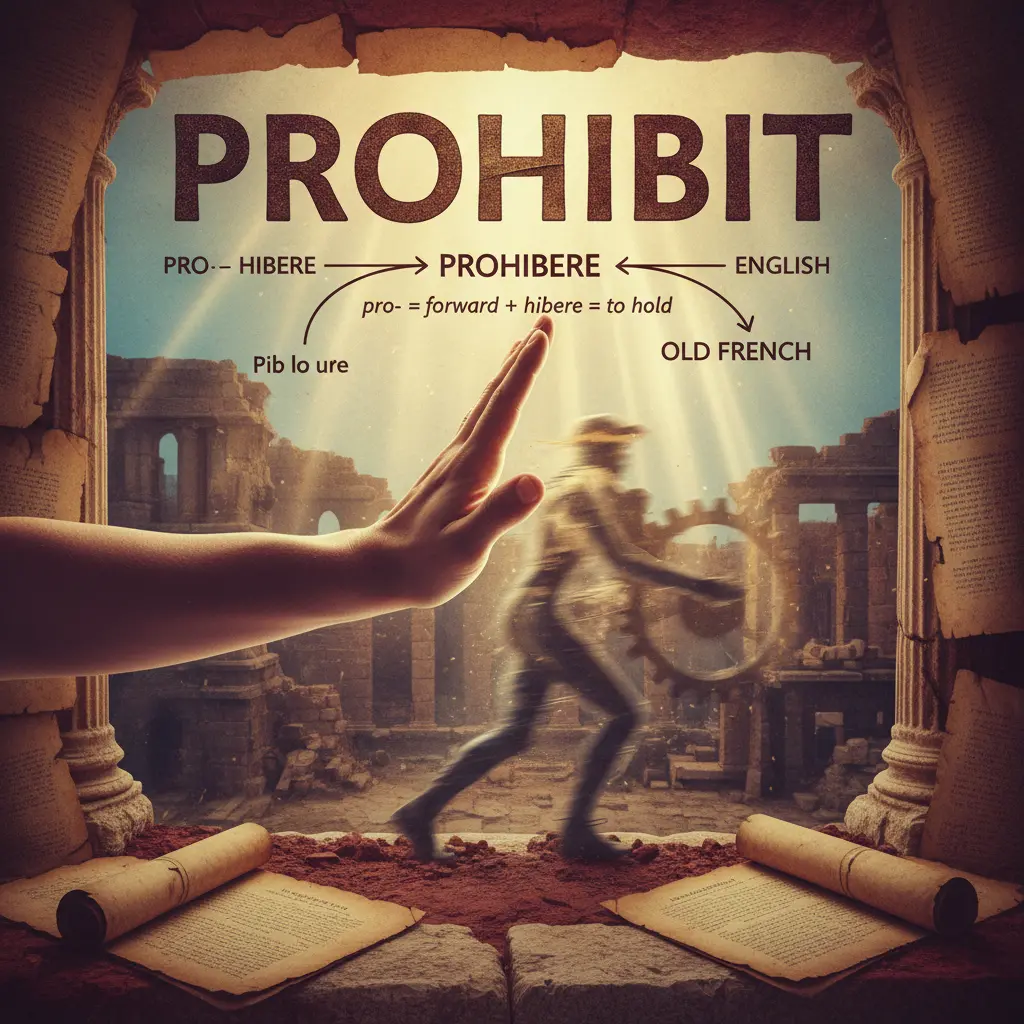
pro- = forward + hibere = to hold. Originated from Latin, passed through Old French to English. Imagine someone holding up a hand to stop an action, signifying prohibition.
Note 1: These definitions and etymologies are not standard dictionary definitions, but extended explanations provided to help with memorization and understanding of the actual application of words. Through this background information, we strive to make words more vivid and easier to understand, and help you remember their meanings in real life.
Note 2: LexiTalk designs the learning flow around the linguistics principle of “Comprehensible Input.” When learners encounter material that is slightly above their level but still understandable from context, the brain naturally absorbs the language. That’s why we keep every word inside authentic contexts, using examples and associations to help you understand it and use it flexibly.
Read the FAQ explanation of Comprehensible InputI place my hand on the door and push gently. I turn the knob and the room breathes—then I pause, deciding not to advance. The effort tightens my chest as I hold the line, resisting the urge to step through. In that small moment, a rule grows: steps that start here won’t be allowed past this point.
Prohibit is a formal verb meaning to forbid something by rule, law, or authority. It signals that a certain action or condition is not allowed, often with penalties for breaking the rule. In policy and legal contexts you will see phrases like 'The city prohibits smoking in all indoor public spaces' or 'The school prohibits electronic device use during exams.' Prohibit is usually followed by from + -ing form or by a direct object with a passive construction: The rule prohibits parking here; Parking is prohibited here. The related noun is prohibition. In everyday speech people may use ban or forbid, but prohibit carries a more official tone.
English speakers tend to reserve prohibit for formal, rule-based contexts (law, policy, official guidelines). Learners often confuse it with ban or forbid in casual speech, which can sound stiff or odd in everyday conversation. Remember the typical grammar: prohibit someone from doing something, or prohibit something from happening; this helps avoid awkward bare infinitives.
What does the word 'prohibit' mean?
Which of the following sentences use 'prohibit' correctly?
Which of the following words is most similar to 'prohibit'?
What is the opposite of 'prohibit'?
Can you give an example of a real-life scenario where certain activities are restricted?
Download LexiTalk app for personalized learning experience
Download AppCookies
We use cookies for essential site functions, analytics, and ads. You can accept, reject, or manage preferences. Privacy Policy