
propaganda - Master This Word
Master this word with our 5-step learning method – Learn English in English
Train English Through Brain Routes, Not Translation.
This page helps you stop memorizing isolated translations and start understanding a word through its shared mental image, native-style thinking, and practical training steps.
Master this word with our 5-step learning method – Learn English in English
Example sentences are the start of understanding. Don't rush to memorize. First feel how the word works in a sentence.
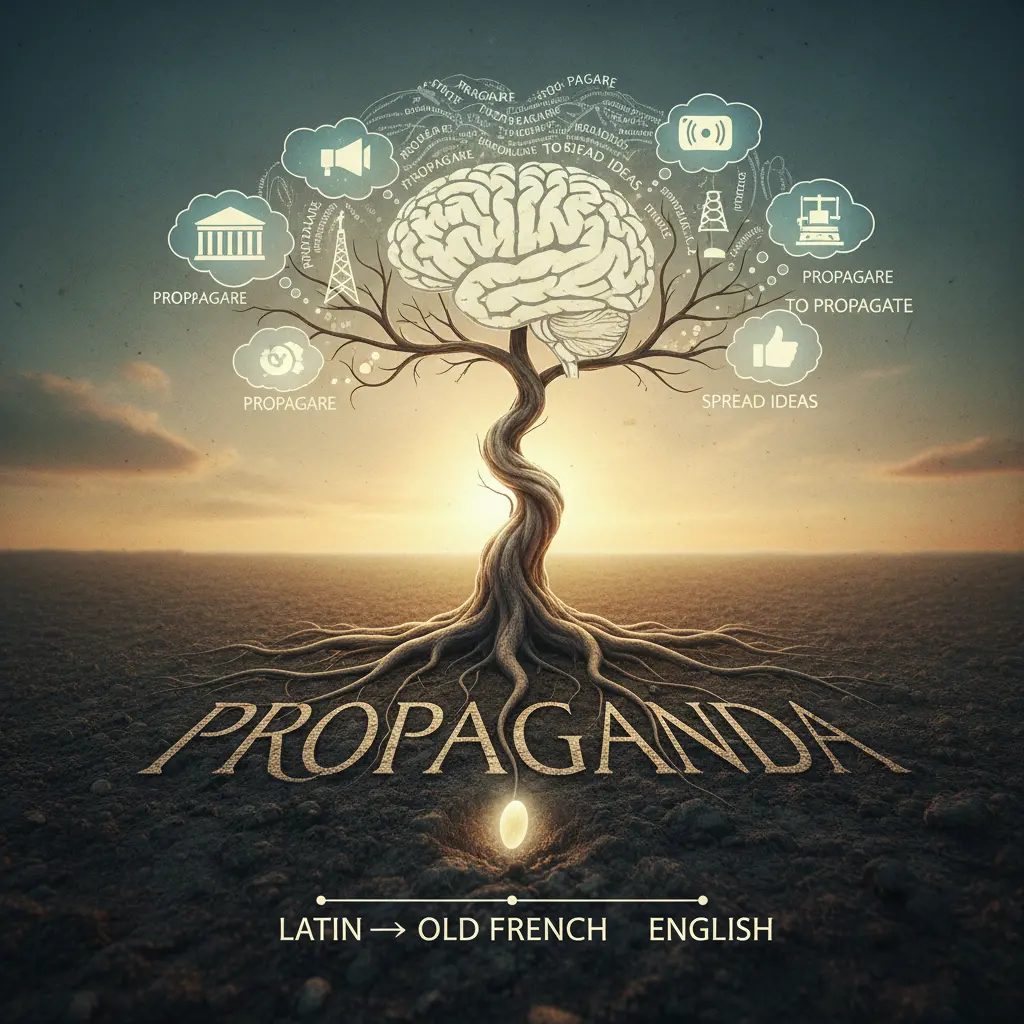
propaganda is derived from Latin 'propagare' (to propagate), with 'pro-' (forward) and 'pagare' (to fasten or lay flat). It entered English through Old French. Imagine a seed being planted and nurtured to grow into a strong tree, representing the spread of ideas.
Note 1: These definitions and etymologies are not standard dictionary definitions, but extended explanations provided to help with memorization and understanding of the actual application of words. Through this background information, we strive to make words more vivid and easier to understand, and help you remember their meanings in real life.
Note 2: LexiTalk designs the learning flow around the linguistics principle of “Comprehensible Input.” When learners encounter material that is slightly above their level but still understandable from context, the brain naturally absorbs the language. That’s why we keep every word inside authentic contexts, using examples and associations to help you understand it and use it flexibly.
Read the FAQ explanation of Comprehensible InputI lean forward and press play on the screen. Propaganda slides into view, a bold wave of words and images that move my eyes toward one side. I pause to adjust my posture, hold back a quick judgment, and feel the voice shift my mood. Later I notice how I might decide to share, question, or simply sit with what I have seen.
Propaganda is information, ideas, or rumors spread to promote a particular political cause or point of view. It relies on persuasive techniques, selective facts, emotional appeals, and repetition to shape public opinion. In everyday usage, propaganda often carries a negative nuance, signaling bias or manipulation, though some contexts distinguish official public information from manipulative messaging. Learners should note that propaganda can be part of legitimate information campaigns but becomes propaganda when it omits counterarguments, presents a one‑sided narrative as if it were objective truth, or uses fear, patriotism, or outrage to drive a response. Recognizing propaganda helps readers critically evaluate media, speeches, and campaigns rather than accepting claims at face value.
Propaganda is often perceived as a negative tool in English-speaking cultures, highlighted by terms like 'biased information' and 'manipulation.' Learners should watch for subtle connotations and distinguish it from official information or public messaging.
What is the meaning of the word 'propaganda'?
Which sentence uses the word 'propaganda' correctly?
Which word is most similar to 'propaganda'?
What is the opposite of 'propaganda'?
Can you give an example of a real-life context where 'propaganda' is often used?
Download LexiTalk app for personalized learning experience
Download AppCookies
We use cookies for essential site functions, analytics, and ads. You can accept, reject, or manage preferences. Privacy Policy