false - Master This Word
Master this word with our 5-step learning method – Learn English in English
Train English Through Brain Routes, Not Translation.
This page helps you stop memorizing isolated translations and start understanding a word through its shared mental image, native-style thinking, and practical training steps.
Master this word with our 5-step learning method – Learn English in English
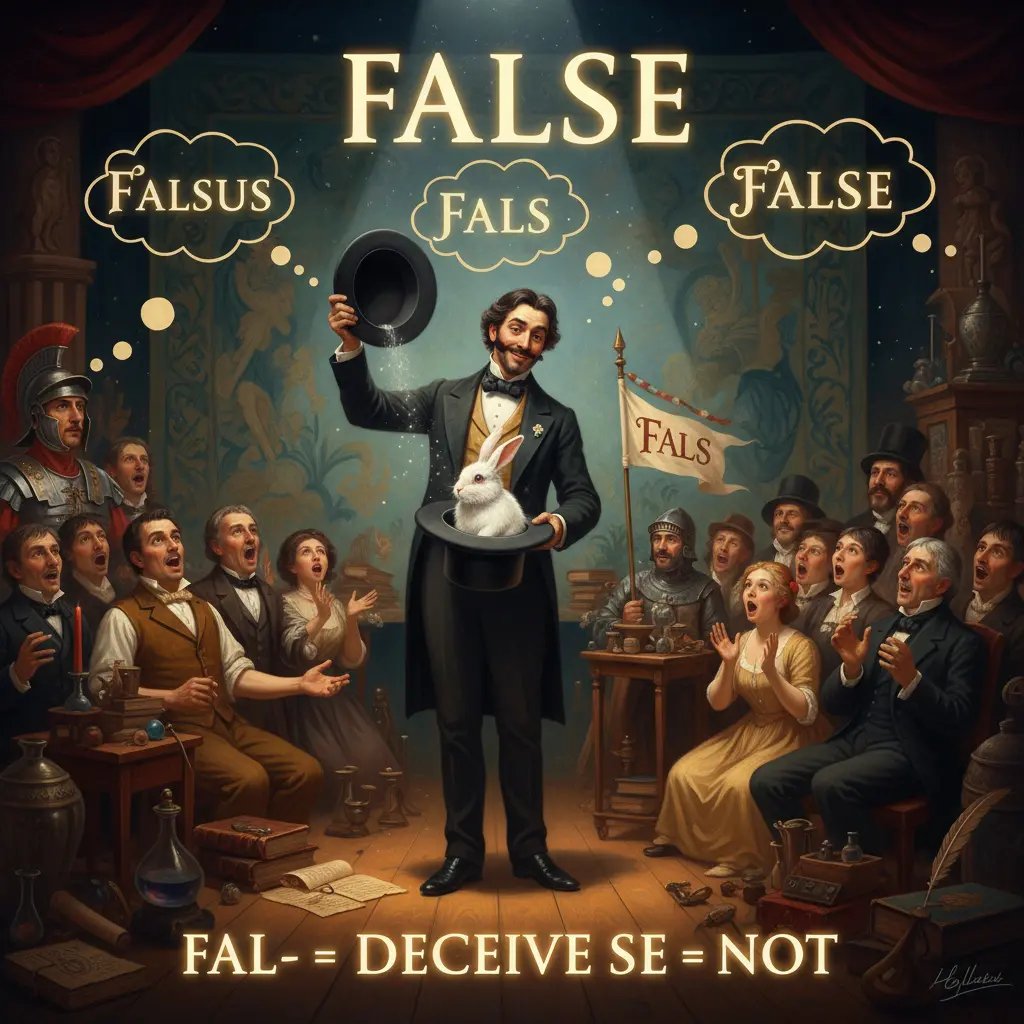
Example sentences are the start of understanding. Don't rush to memorize. First feel how the word works in a sentence.
fal- = deceive + se = not; Historical origin: Latin 'falsus' → Old French 'fals' → English 'false'. Memory image: Imagine a magician pulling a rabbit out of an empty hat, deceiving the audience.
Note 1: These definitions and etymologies are not standard dictionary definitions, but extended explanations provided to help with memorization and understanding of the actual application of words. Through this background information, we strive to make words more vivid and easier to understand, and help you remember their meanings in real life.
Note 2: LexiTalk designs the learning flow around the linguistics principle of “Comprehensible Input.” When learners encounter material that is slightly above their level but still understandable from context, the brain naturally absorbs the language. That’s why we keep every word inside authentic contexts, using examples and associations to help you understand it and use it flexibly.
Read the FAQ explanation of Comprehensible InputI move a note on the desk, turning it edge to edge to test what it says. I watch as the lines fail to line up, a shift that makes the story feel off, and I adjust my gaze to follow the gaps. The effort is steady, like guiding a small boat, as I push questions until the claim no longer sits right. I place trust in what I can verify, and the moment settles into a clear sense: this one doesn’t hold up.
False describes something not true or correct, and it can modify nouns (a false statement) or function as an adverb (he spoke falsely). It can carry implications of intentional deception or simple error, depending on context. When something is false, it fails to align with fact or reality. The term is common in discussions of science, law, media, and everyday conversation about opinions, beliefs, or appearances. Unlike 'fake' or 'lie', 'false' often signals a discrepancy with evidence rather than an outright moral judgment. The memory image of a magician pulling a rabbit from an empty hat helps you imagine the illusion of truth. In literature, 'false' can set a skeptical tone or highlight unreliability.
English often marks false as a neutral assessment of truth value, whereas some languages map false more to error or deception. Learners should note that false can describe statements, events, or appearances, but rarely applies directly to people. false is common with evidence-based contexts like science and journalism.
Which sentence below correctly uses the word 'false'?
Which word is most similar to 'false'?
What is the opposite of 'false'?
Can you think of a real-life scenario where the concept of 'false' applies?
Technology & Social Media
Listen NowTechnology & Social Media
Listen NowDownload LexiTalk app for personalized learning experience
Download AppCookies
We use cookies for essential site functions, analytics, and ads. You can accept, reject, or manage preferences. Privacy Policy