random - Master This Word
Master this word with our 5-step learning method – Learn English in English
Train English Through Brain Routes, Not Translation.
This page helps you stop memorizing isolated translations and start understanding a word through its shared mental image, native-style thinking, and practical training steps.
Master this word with our 5-step learning method – Learn English in English
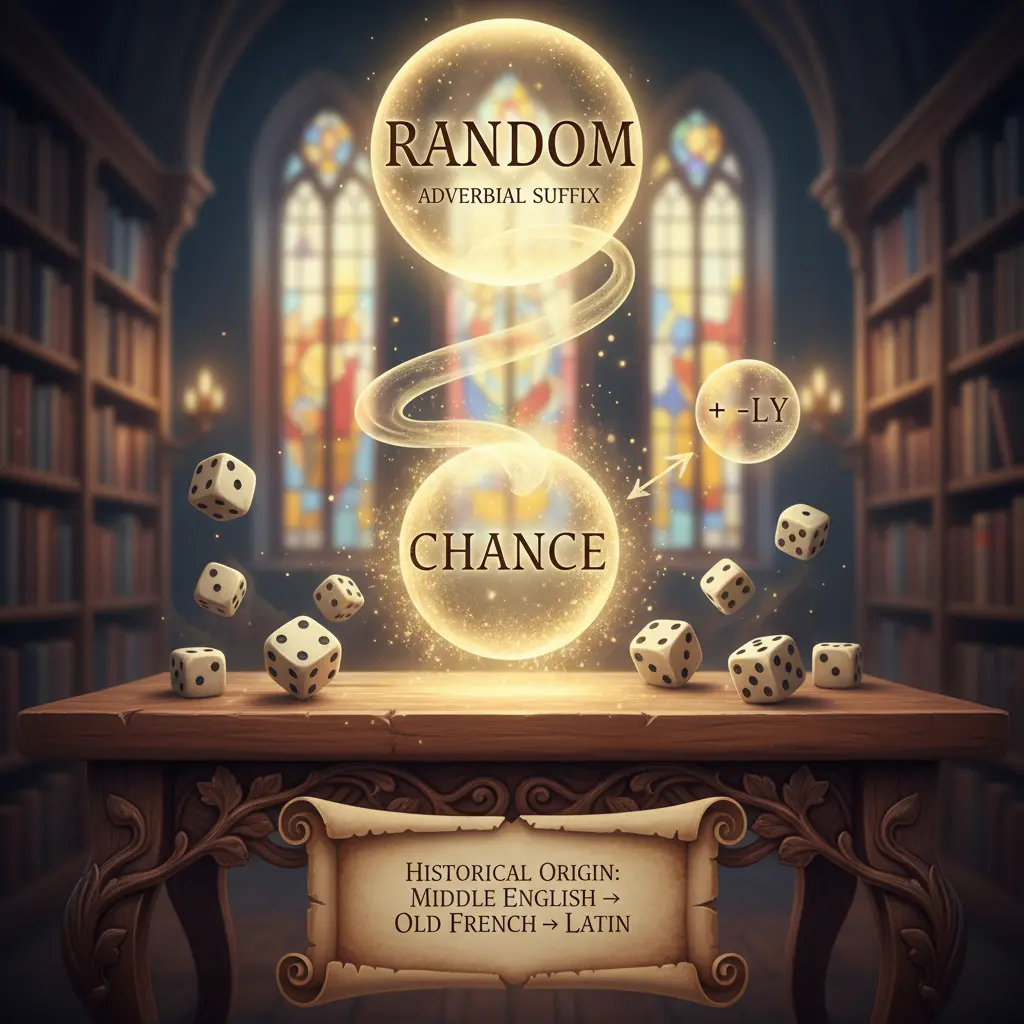
Example sentences are the start of understanding. Don't rush to memorize. First feel how the word works in a sentence.
random = chance + -ly = adverbial suffix. Historical origin: Middle English → Old French → Latin. Memory image: Picture a game of dice where the result is unpredictable, emphasizing the element of chance and spontaneity.
Note 1: These definitions and etymologies are not standard dictionary definitions, but extended explanations provided to help with memorization and understanding of the actual application of words. Through this background information, we strive to make words more vivid and easier to understand, and help you remember their meanings in real life.
Note 2: LexiTalk designs the learning flow around the linguistics principle of “Comprehensible Input.” When learners encounter material that is slightly above their level but still understandable from context, the brain naturally absorbs the language. That’s why we keep every word inside authentic contexts, using examples and associations to help you understand it and use it flexibly.
Read the FAQ explanation of Comprehensible InputI reach for a handful of cards and move them around the table, not following a plan. The pile keeps shifting as I pick one card at a time, turning it over with a light push of the wrist. It feels loose, a little messy, like I’m not in full control of the moment. I keep going and let my choices unfold randomly, a small taste of chance slipping into everyday action.
Random as an adverb describes actions performed without a plan or by chance, conveying a lack of method or purpose and a hazy, spontaneous feel. It is often used in phrases like 'at random' or its adverbial form 'randomly' to indicate how a choice was made, rather than describing the thing itself. The etymology links to chance plus an adverbial suffix -ly, with historical roots in Middle English through Old French to Latin. A clear memory image is a dice game where the roll is unpredictable and the process seems spontaneous. Remember that 'random' is primarily an adjective; the adverb form is 'randomly', while 'at random' is a fixed expression.
English often reserves random for fixed phrases or the adverb form 'randomly', whereas many languages prefer direct equivalents like 'randomly' or 'aleatoriamente' as standard adverbs; learners frequently overuse 'random' as an adverb or mistranslate 'at random'.
What is the meaning of the word 'random'?
Which of the following sentences uses 'random' correctly?
Choose the synonym for 'random':
In what situation would you use the word 'random'?
Reflect on a real-life scenario where 'random' applies.
Download LexiTalk app for personalized learning experience
Download AppCookies
We use cookies for essential site functions, analytics, and ads. You can accept, reject, or manage preferences. Privacy Policy