relative - Master This Word
Master this word with our 5-step learning method – Learn English in English
Train English Through Brain Routes, Not Translation.
This page helps you stop memorizing isolated translations and start understanding a word through its shared mental image, native-style thinking, and practical training steps.
Master this word with our 5-step learning method – Learn English in English
Example sentences are the start of understanding. Don't rush to memorize. First feel how the word works in a sentence.
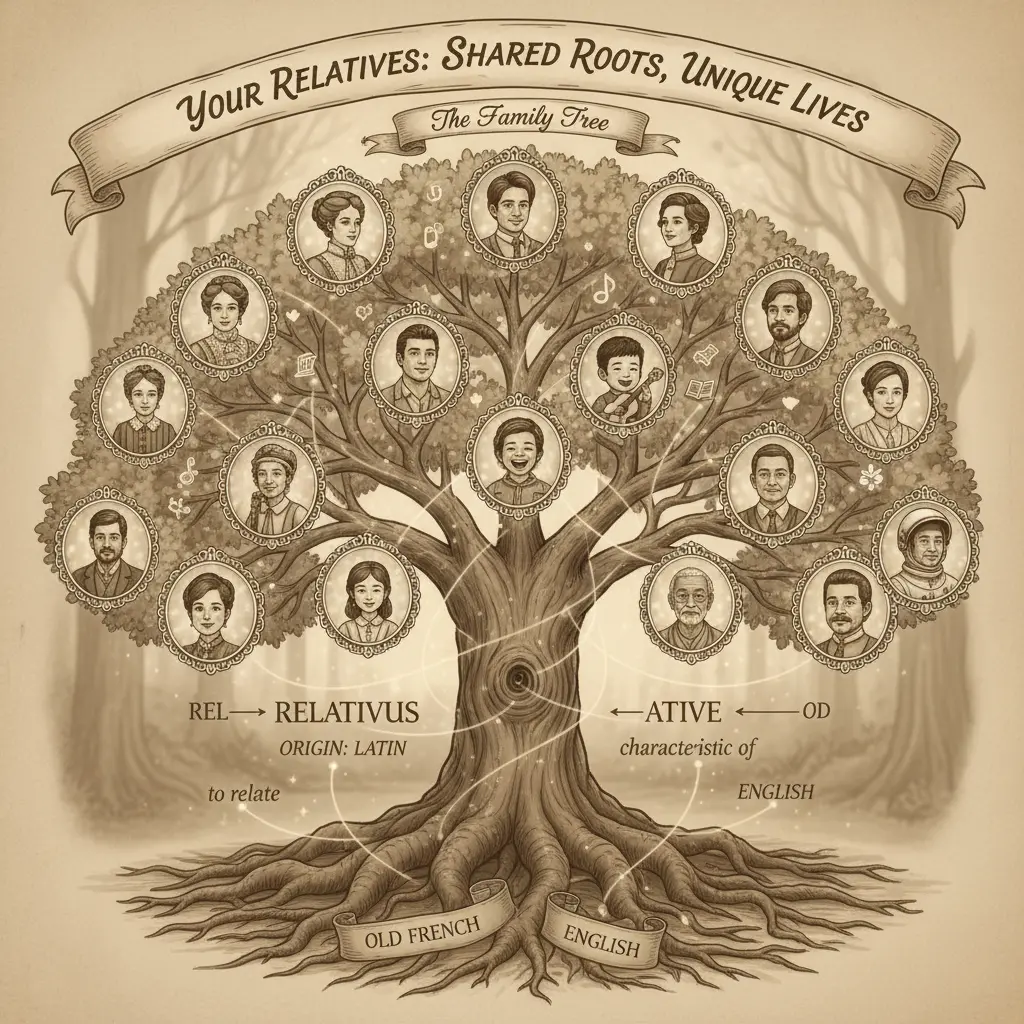
Rel- = to relate, -ative = characteristic of. Originated from Latin 'relativus' through Old French into English. Imagine a family tree connecting different people - your relatives share roots but branch out into unique lives.
Note 1: These definitions and etymologies are not standard dictionary definitions, but extended explanations provided to help with memorization and understanding of the actual application of words. Through this background information, we strive to make words more vivid and easier to understand, and help you remember their meanings in real life.
Note 2: LexiTalk designs the learning flow around the linguistics principle of “Comprehensible Input.” When learners encounter material that is slightly above their level but still understandable from context, the brain naturally absorbs the language. That’s why we keep every word inside authentic contexts, using examples and associations to help you understand it and use it flexibly.
Read the FAQ explanation of Comprehensible InputStanding, I move a chair closer to the wall and push a frame a fraction to the left. I set two portraits of relatives side by side and adjust their spacing, watching how one figure sits in relation to the other. It feels like tuning a small scene, holding the line between them and shifting as the story unfolds. Then the idea of relative slips from the page into my mind, not as a rule but as how people connect, depend on each other, and belong in one shared space.
Relative can refer to a person connected by blood or marriage, such as a mother, cousin, or in‑law, or it can function as an adjective meaning 'in relation to something else' or 'dependent on something else.' You’ll see it in phrases like relative to or relative importance, where value changes depending on the reference point. The idea is comparison or connection rather than an absolute value. Etymologically, it comes from Latin relativus, through Old French into English, emphasizing relation and context. In everyday use, it covers both a family member and a kind of relational or contextual qualifier, so learners must pay attention to whether it signals a person or a relationship to something else.
In English, relative is flexible: it can name a person or describe a relation to something else. Learners often assume relatives must be people, or mix up relative with relation. English uses a preposition (relative to) to anchor the relation, which Chinese or Japanese handle with different particles or context. Kids may translate directly or misplace the word in comparisons.
What is the meaning of the word 'relative'?
Which of the following sentences uses the word 'relative' correctly?
Which word is most similar to the word 'relative'?
What is the opposite of the word 'relative'?
Can you give an example of a real-life scenario of 'relative'?
Download LexiTalk app for personalized learning experience
Download AppCookies
We use cookies for essential site functions, analytics, and ads. You can accept, reject, or manage preferences. Privacy Policy