rise - Master This Word
Master this word with our 5-step learning method – Learn English in English
Train English Through Brain Routes, Not Translation.
This page helps you stop memorizing isolated translations and start understanding a word through its shared mental image, native-style thinking, and practical training steps.
Master this word with our 5-step learning method – Learn English in English
Example sentences are the start of understanding. Don't rush to memorize. First feel how the word works in a sentence.
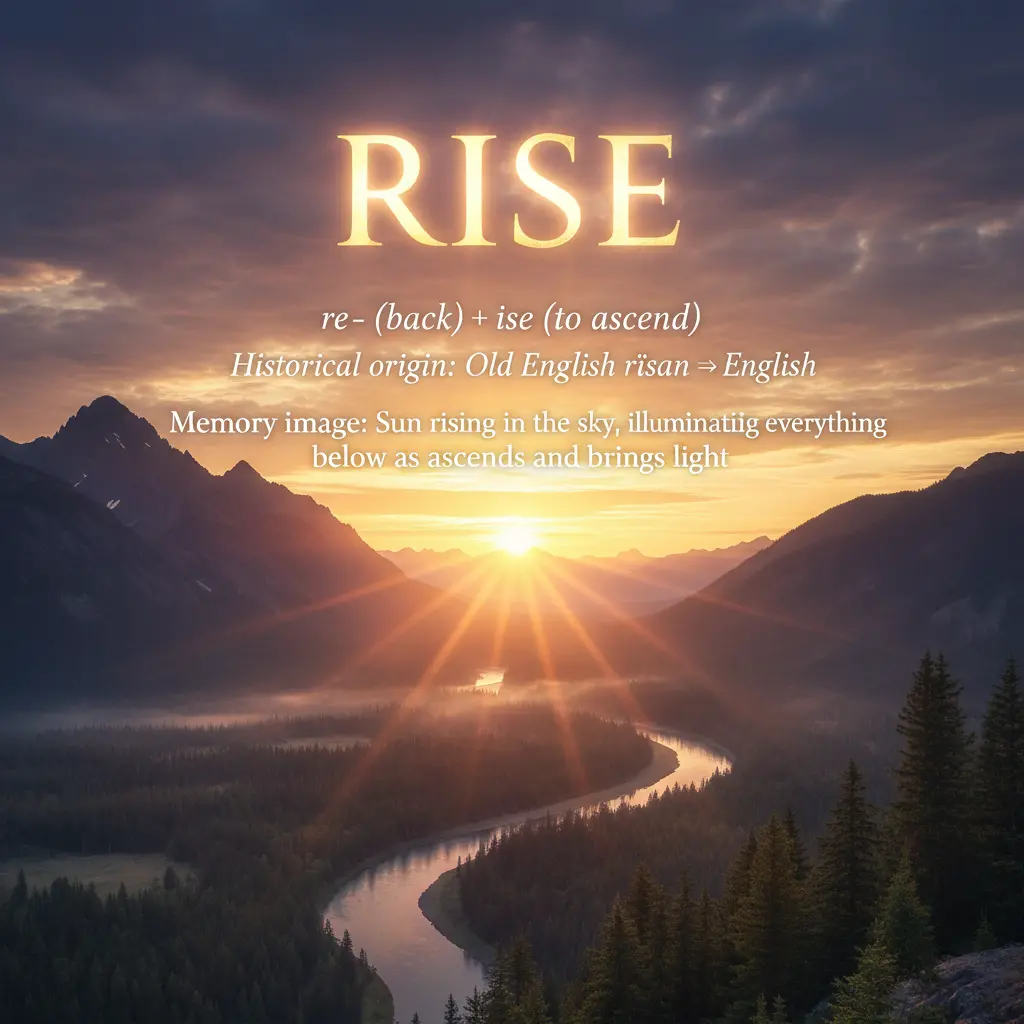
rise = re- (back) + ise (to ascend). Historical origin: Old English rīsan → English. Memory image: Picture a sun rising in the sky, illuminating everything below as it ascends and brings light.
Note 1: These definitions and etymologies are not standard dictionary definitions, but extended explanations provided to help with memorization and understanding of the actual application of words. Through this background information, we strive to make words more vivid and easier to understand, and help you remember their meanings in real life.
Note 2: LexiTalk designs the learning flow around the linguistics principle of “Comprehensible Input.” When learners encounter material that is slightly above their level but still understandable from context, the brain naturally absorbs the language. That’s why we keep every word inside authentic contexts, using examples and associations to help you understand it and use it flexibly.
Read the FAQ explanation of Comprehensible InputHinges of the knees creak as I push up from the chair and rise, a small, steady motion that starts the day. My eyes move, my breath settles, and I keep control as energy shifts from rest to action. I adjust my posture, place my feet firmly on the floor, and rise again to meet the height of a new task. This simple lift feels like a decision, signaling the day’s momentum in motion.
Rise is an intransitive verb meaning to move upward or to increase in level, and it can also mean to get up from bed. It contrasts with raise, which is transitive and takes a direct object. Common collocations include prices rise, temperatures rise, the sun rises, and people rise from bed. The past tense is rose, and the past participle is risen. Phrases like rise to the occasion and rise up are common. Learners should note that rise is often used for natural, gradual movement rather than deliberate causing something to go up.
For English learners, rise is about movement or increase without an agent causing it; avoid treating it as a causative verb like 'raise'.
What is the meaning of the word 'rise'?
Which sentence uses the word 'rise' correctly?
Which word is most similar to 'rise'?
What is the opposite of the word 'rise'?
Can you provide an example of a real-life context where 'rise' could be used?
English Learning Listening Content
Listen NowDownload LexiTalk app for personalized learning experience
Download AppCookies
We use cookies for essential site functions, analytics, and ads. You can accept, reject, or manage preferences. Privacy Policy