satellites - Master This Word
Master this word with our 5-step learning method – Learn English in English
Train English Through Brain Routes, Not Translation.
This page helps you stop memorizing isolated translations and start understanding a word through its shared mental image, native-style thinking, and practical training steps.
Master this word with our 5-step learning method – Learn English in English
Example sentences are the start of understanding. Don't rush to memorize. First feel how the word works in a sentence.
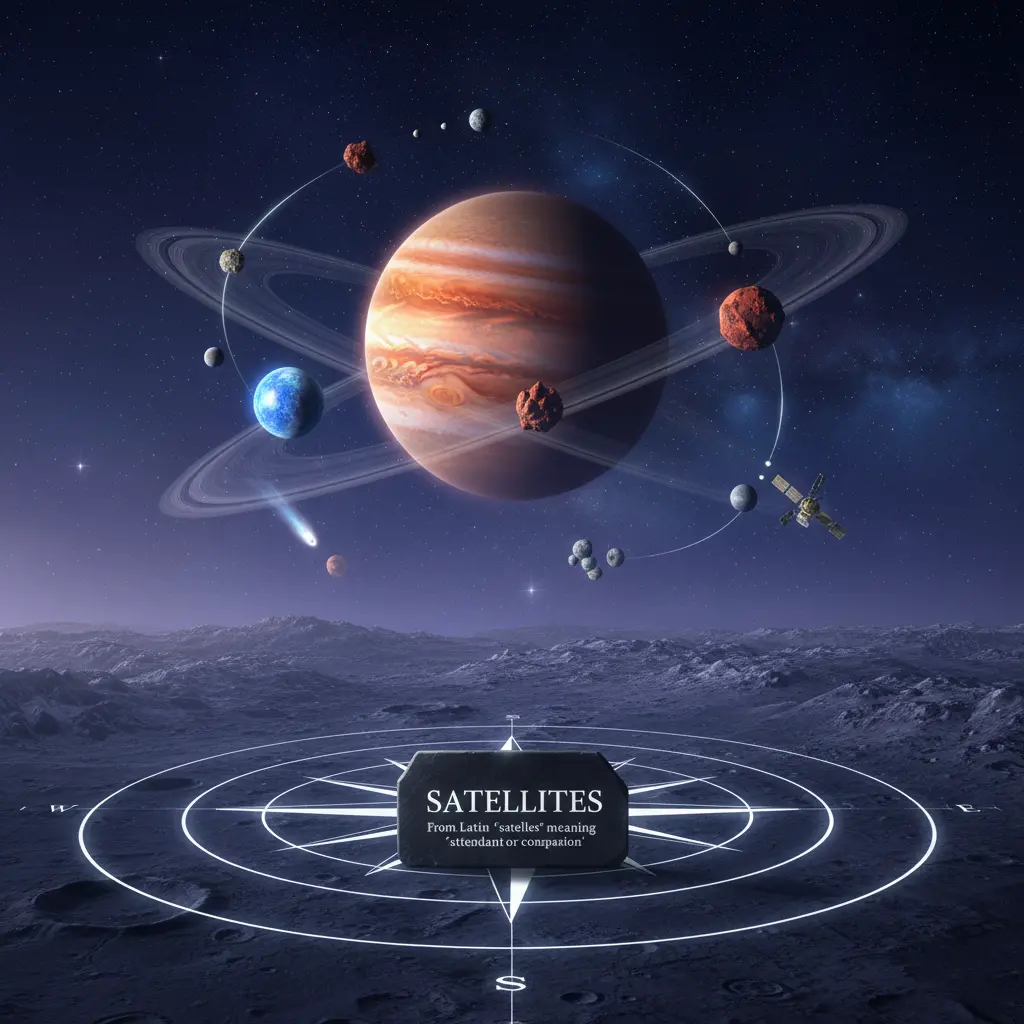
From Latin 'satelles' meaning 'attendant or companion'. Imagining a moonscape with various bodies shining in the night, orbiting gracefully.
Note 1: These definitions and etymologies are not standard dictionary definitions, but extended explanations provided to help with memorization and understanding of the actual application of words. Through this background information, we strive to make words more vivid and easier to understand, and help you remember their meanings in real life.
Note 2: LexiTalk designs the learning flow around the linguistics principle of “Comprehensible Input.” When learners encounter material that is slightly above their level but still understandable from context, the brain naturally absorbs the language. That’s why we keep every word inside authentic contexts, using examples and associations to help you understand it and use it flexibly.
Read the FAQ explanation of Comprehensible InputI lift the binoculars and, with a slow turn, track a tiny satellite sliding across the night sky. I nudge the focus, push and pull the image until the dot holds steady and bright. The thing feels like a patient partner up there, a dependent agent that quietly keeps watching and feeding back what it sees. The more I adjust and keep track, the more the idea of its role as a helper settles in, not a showy star but a practical guide.
Satellites cover three related ideas in English: a natural celestial body that orbits a planet, an artificial object placed in orbit to collect data or relay signals, and a figurative sense of something dependent or secondary in a larger system. In astronomy, describing the Moon or other moons as satellites helps learners see orbiting relationships. In technology, talking about satellites often pairs with dishes, ground stations, and remote sensing. The metaphorical use invites learners to recognize a subsidiary or dependent unit, such as a satellite campus or a satellite office, without implying literal space travel. This helps learners avoid mixing up natural and artificial senses in sentences.
English learners often treat satellite as a single, space-focused term and mix up the metaphorical sense with the physical object; emphasize the three senses and common collocations to prevent this.
Download LexiTalk app for personalized learning experience
Download AppCookies
We use cookies for essential site functions, analytics, and ads. You can accept, reject, or manage preferences. Privacy Policy