
saturate - Master This Word
Master this word with our 5-step learning method – Learn English in English
Train English Through Brain Routes, Not Translation.
This page helps you stop memorizing isolated translations and start understanding a word through its shared mental image, native-style thinking, and practical training steps.
Master this word with our 5-step learning method – Learn English in English
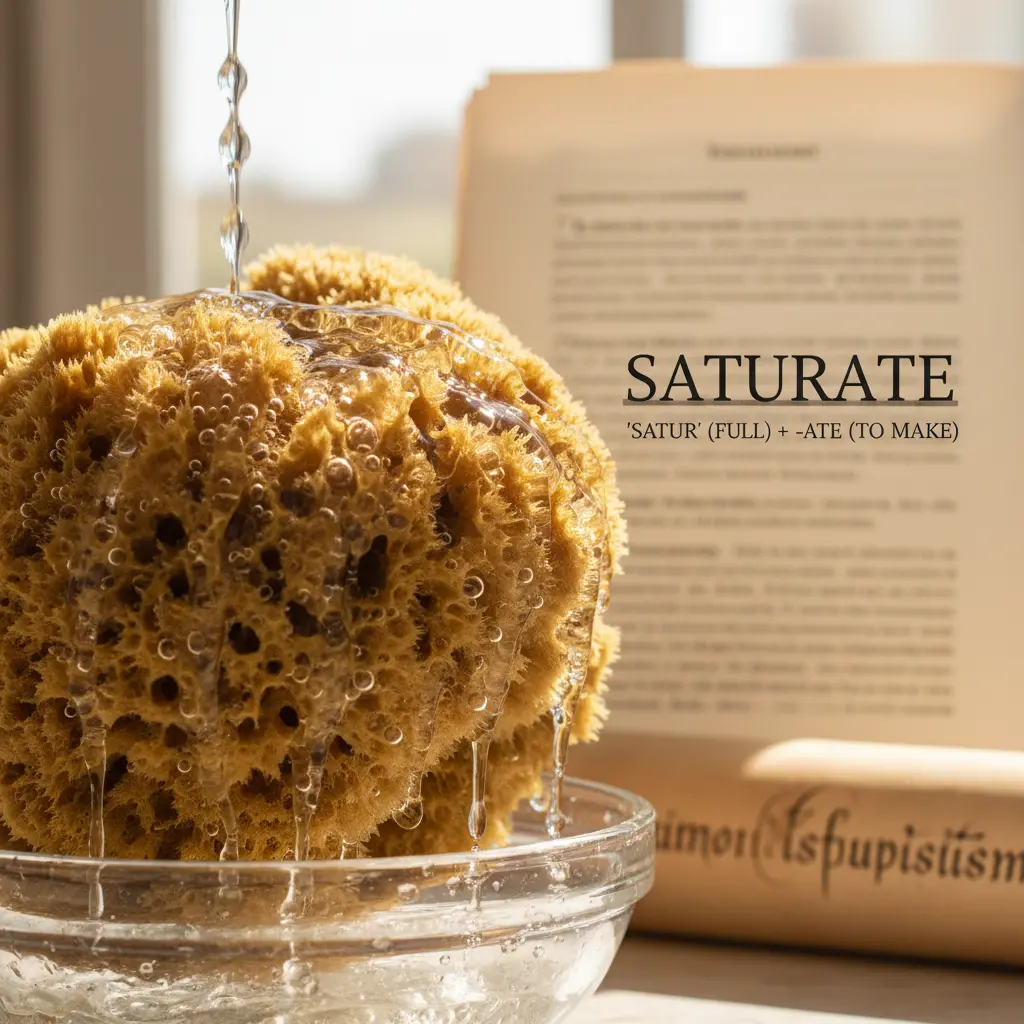
Example sentences are the start of understanding. Don't rush to memorize. First feel how the word works in a sentence.
saturate is derived from 'satur' (full) + '-ate' (to make). Historical origin: Latin → Old French → English. Imagine a sponge fully soaked with water, holding as much as it possibly can, exactly representing the meaning.
Note 1: These definitions and etymologies are not standard dictionary definitions, but extended explanations provided to help with memorization and understanding of the actual application of words. Through this background information, we strive to make words more vivid and easier to understand, and help you remember their meanings in real life.
Note 2: LexiTalk designs the learning flow around the linguistics principle of “Comprehensible Input.” When learners encounter material that is slightly above their level but still understandable from context, the brain naturally absorbs the language. That’s why we keep every word inside authentic contexts, using examples and associations to help you understand it and use it flexibly.
Read the FAQ explanation of Comprehensible InputTo saturate is to soak something completely or to fill it to capacity, leaving no room for more liquid or content. In everyday use, you might saturate a sponge by dipping it in water until it cannot hold any more moisture, or saturate a solution by adding a solute until the solvent has reached its maximum dissolved amount. Figuratively, people talk about markets, media, or emotions becoming saturated when they are full or overwhelmed, making change or growth difficult. Common collocations include saturated with, saturated fat, and saturation as a noun. The verb emphasizes full absorption, while saturation focuses on the resulting state.
English often treats saturation as a state resulting from an action, with clear noun forms (saturation) and a distinct adjective (saturated). Learners struggle with when to use saturated vs saturate and how to pair with with/in.
What does 'saturate' mean?
In which sentence is 'saturate' used correctly?
Which word is an antonym of 'saturate'?
In what real-life context would you saturate something?
Reflect on a situation where saturating something is necessary.
Download LexiTalk app for personalized learning experience
Download AppCookies
We use cookies for essential site functions, analytics, and ads. You can accept, reject, or manage preferences. Privacy Policy