scope - Master This Word
Master this word with our 5-step learning method – Learn English in English
Train English Through Brain Routes, Not Translation.
This page helps you stop memorizing isolated translations and start understanding a word through its shared mental image, native-style thinking, and practical training steps.
Master this word with our 5-step learning method – Learn English in English
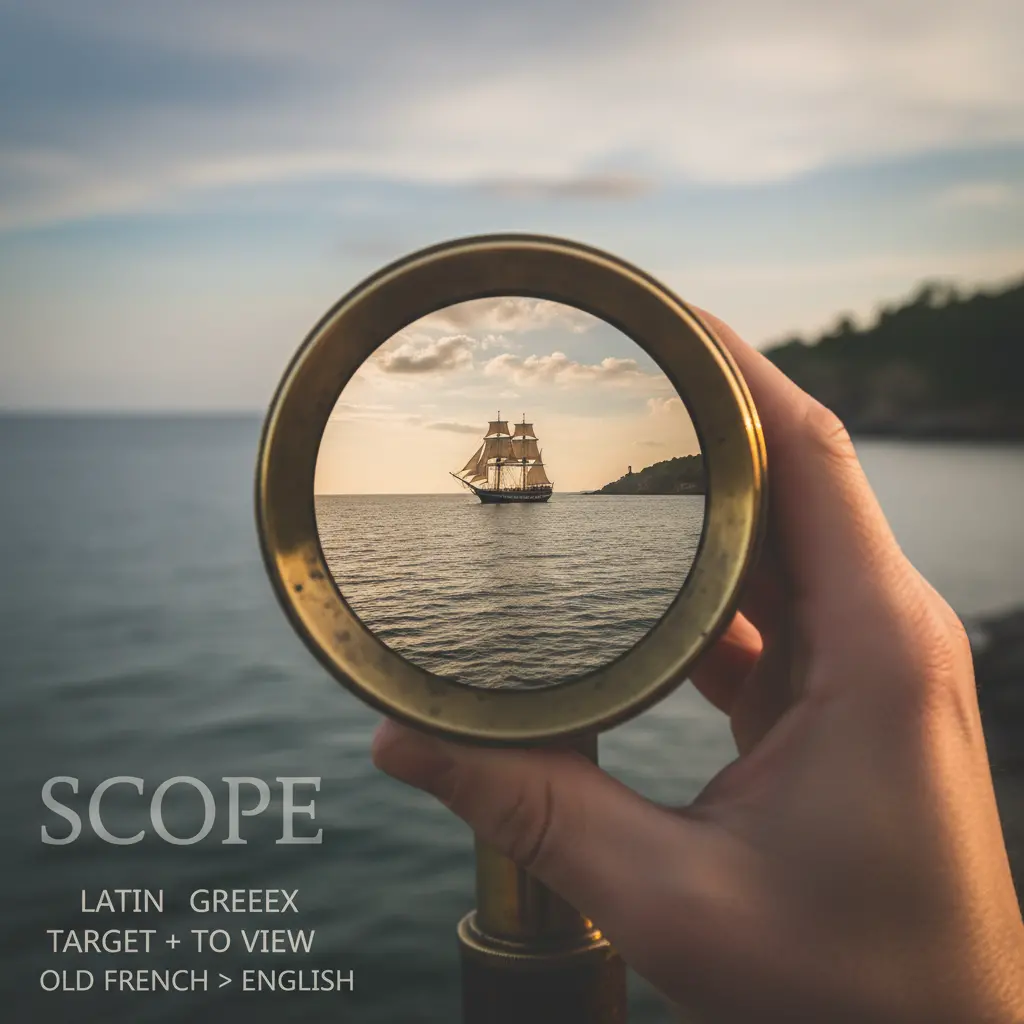
Example sentences are the start of understanding. Don't rush to memorize. First feel how the word works in a sentence.
Scope: from Latin 'scopos' (to view) + Greek 'skopos' (target) > Old French > English. Imagine using a telescope to see a ship far away on the horizon, the focus sharpens the distant image.
Note 1: These definitions and etymologies are not standard dictionary definitions, but extended explanations provided to help with memorization and understanding of the actual application of words. Through this background information, we strive to make words more vivid and easier to understand, and help you remember their meanings in real life.
Note 2: LexiTalk designs the learning flow around the linguistics principle of “Comprehensible Input.” When learners encounter material that is slightly above their level but still understandable from context, the brain naturally absorbs the language. That’s why we keep every word inside authentic contexts, using examples and associations to help you understand it and use it flexibly.
Read the FAQ explanation of Comprehensible InputI place my hands on the camera and hold steady, then push the lens forward to find the angle. I turn the knobs and adjust the focus, watching the scene grow into its full scope. I keep breathing steady as I shift a bit, balancing distance and detail. When I set the frame and let the subjects fall where they may, the scope of what I notice becomes clear.
Scope is a flexible word in English. As a noun it means the range or extent of something, such as the scope of a project, the scope of a debate, or the field of view for a lens. It can also refer to the visible area or domain of your attention when studying or planning. As a verb, to scope something out means to inspect or investigate it in order to determine what is involved and what decisions are needed. Understanding scope helps you describe boundaries, goals, and responsibilities, and prevents overpromising by keeping work within clearly defined limits. The word is versatile and often collocates with within scope, outside the scope, broad scope, or narrow scope.
English tends to load scope with both boundaries and intent, so learners must distinguish what is included (scope) from why it matters (purpose).
What is the meaning of the word 'scope'?
In which of the following sentences is 'scope' used correctly?
Which of the following is a similar word to 'scope'?
What is the opposite of 'scope'?
How is the word 'scope' used in a real-life context?
Download LexiTalk app for personalized learning experience
Download AppCookies
We use cookies for essential site functions, analytics, and ads. You can accept, reject, or manage preferences. Privacy Policy