separates - Master This Word
Master this word with our 5-step learning method – Learn English in English
Train English Through Brain Routes, Not Translation.
This page helps you stop memorizing isolated translations and start understanding a word through its shared mental image, native-style thinking, and practical training steps.
Master this word with our 5-step learning method – Learn English in English
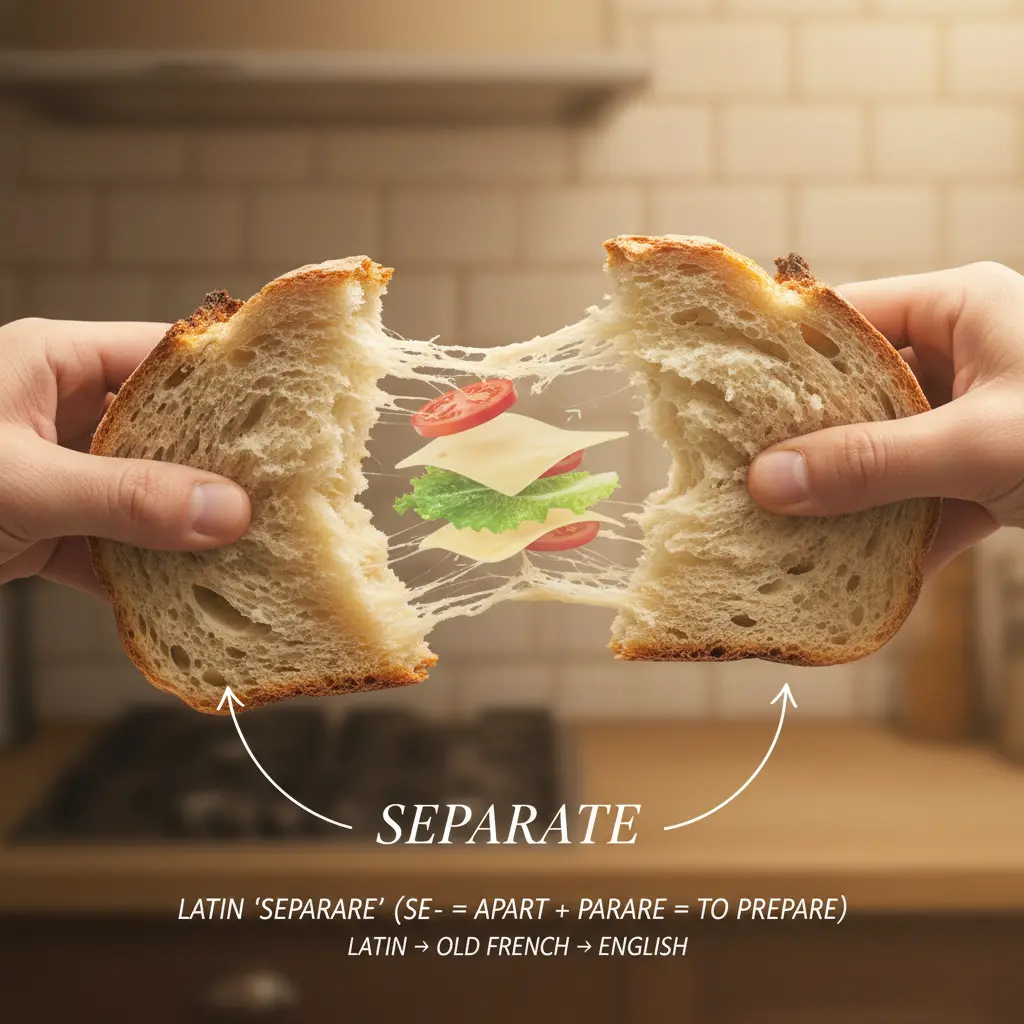
Example sentences are the start of understanding. Don't rush to memorize. First feel how the word works in a sentence.
From Latin 'separare' (se- = apart + parare = to prepare). Originated from Latin → Old French → English. Imagine two pieces of bread that are pulled apart, creating a sandwich — that's how you separate things.
Note 1: These definitions and etymologies are not standard dictionary definitions, but extended explanations provided to help with memorization and understanding of the actual application of words. Through this background information, we strive to make words more vivid and easier to understand, and help you remember their meanings in real life.
Note 2: LexiTalk designs the learning flow around the linguistics principle of “Comprehensible Input.” When learners encounter material that is slightly above their level but still understandable from context, the brain naturally absorbs the language. That’s why we keep every word inside authentic contexts, using examples and associations to help you understand it and use it flexibly.
Read the FAQ explanation of Comprehensible InputFirst I pick up two pieces on the desk and push them apart, watching the gap grow. I adjust my grip and turn my wrists a little to keep the distance steady. The move makes it clear they belong apart, each with its own space. In real use, I separate tasks into steps and separate colors and sounds in a design, letting each thing stand alone.
Separate is a versatile word in English, used as a verb and an adjective to describe splitting something into parts, keeping things apart, or distinguishing one thing from another. When you separate items, you physically move them into different groups, as in separating groceries into perishable and non‑perishable bags. As an adjective, separate often describes things that are not joined or connected, such as two separate projects or two separate rooms. The nuance can shift with phrases like set apart, apart from, or separate out: you might separate fact from opinion, or separate duties among team members. Learners should watch collocations and prepositions, because 'separate from' and simply 'separate' can have different uses.
For English speakers, separate is a flexible tool that blends physical division with abstract distinction; learners often mix up when to use separate from or separate into, and may assume it always means emotional distance.
What is the meaning of 'separates'?
Which sentence uses 'separates' correctly?
What is a synonym for 'separates'?
What is the opposite of 'separates'?
Can you think of a real-life situation where something is divided?
Banking Basics
Listen NowDownload LexiTalk app for personalized learning experience
Download AppCookies
We use cookies for essential site functions, analytics, and ads. You can accept, reject, or manage preferences. Privacy Policy