series - Master This Word
Master this word with our 5-step learning method – Learn English in English
Train English Through Brain Routes, Not Translation.
This page helps you stop memorizing isolated translations and start understanding a word through its shared mental image, native-style thinking, and practical training steps.
Master this word with our 5-step learning method – Learn English in English
Example sentences are the start of understanding. Don't rush to memorize. First feel how the word works in a sentence.
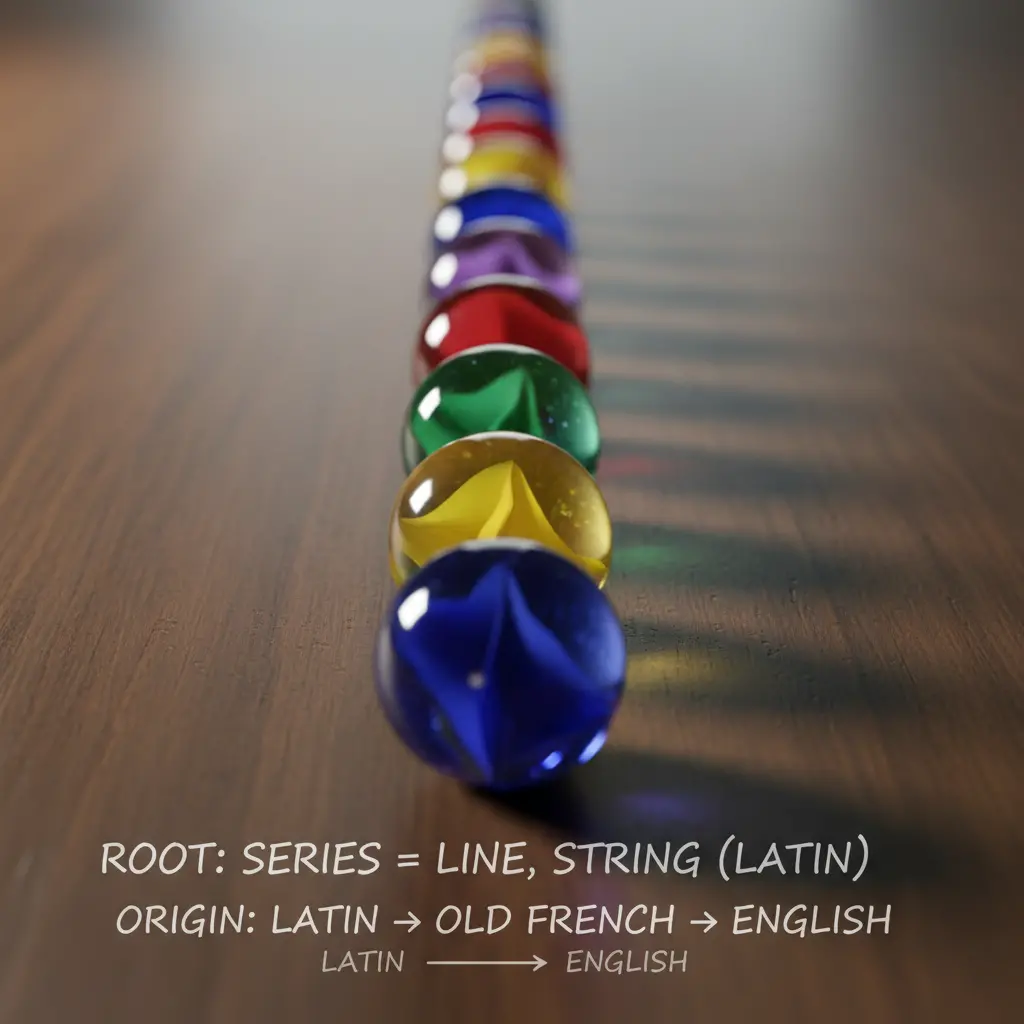
Root: serie = line, string (Latin); Origin: Latin → Old French → English. Memory Image: Imagine a line of marbles placed in a row, perfectly aligned; each marble represents a member of a series.
Note 1: These definitions and etymologies are not standard dictionary definitions, but extended explanations provided to help with memorization and understanding of the actual application of words. Through this background information, we strive to make words more vivid and easier to understand, and help you remember their meanings in real life.
Note 2: LexiTalk designs the learning flow around the linguistics principle of “Comprehensible Input.” When learners encounter material that is slightly above their level but still understandable from context, the brain naturally absorbs the language. That’s why we keep every word inside authentic contexts, using examples and associations to help you understand it and use it flexibly.
Read the FAQ explanation of Comprehensible InputHands rest on a line of cards, and I move the first forward, then the next, one by one. I push with a careful grip, feeling the rhythm shift a little as I adjust. The cards slide in a simple, connected flow, each following the one before. Soon the line feels like its own small group, tight and ready to be used together.
A series is a set of items or events that follow one another in a fixed order or share a common theme. It can describe a numbered sequence, such as a TV series, a mathematical series, or a group of related books or articles. In everyday use, you might talk about a series of events, a series of questions on a test, or a film series that spans several installments. The meaning depends on context: a sequence, a connected group, or a collection with a common topic. Note that series is both singular and plural in English and takes no -es.
For English speakers, series often sits on a spectrum from order (sequence) to themed groupings (collection). Learners may confuse it with sequence or set, or worry that it must change form for singular/plural use, which English does not. The key is matching the sense to context: order, topic, or a connected group.
What does the word 'series' mean?
How is the word 'series' used in a sentence?
Which word is similar to 'series'?
What is the opposite of 'series'?
Can you provide a real-life context for the word 'series'?
English Learning Listening Content
Listen NowDownload LexiTalk app for personalized learning experience
Download AppCookies
We use cookies for essential site functions, analytics, and ads. You can accept, reject, or manage preferences. Privacy Policy