species - Master This Word
Master this word with our 5-step learning method – Learn English in English
Train English Through Brain Routes, Not Translation.
This page helps you stop memorizing isolated translations and start understanding a word through its shared mental image, native-style thinking, and practical training steps.
Master this word with our 5-step learning method – Learn English in English
Example sentences are the start of understanding. Don't rush to memorize. First feel how the word works in a sentence.
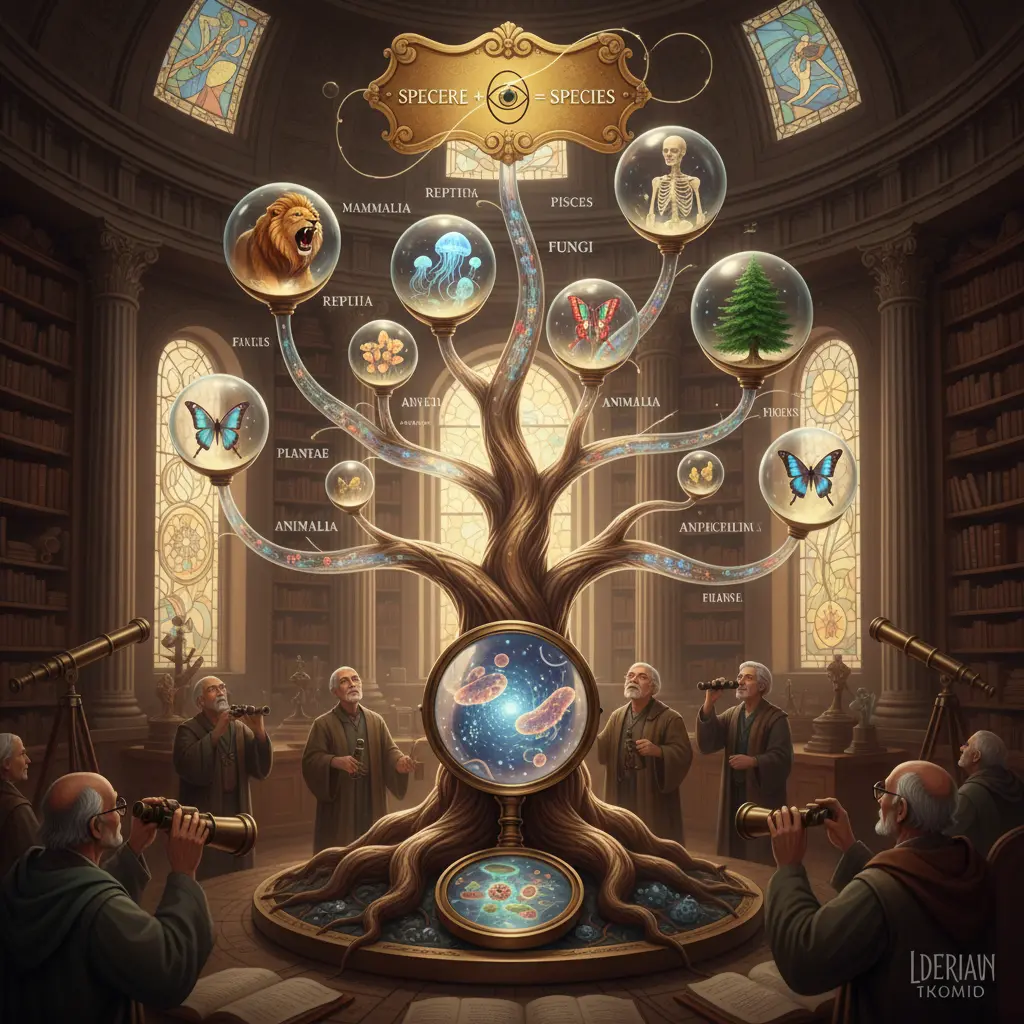
species = specere (to look) + -ies (plural marker). Origin: Latin → Old French → English. Imagine a 'species' as a family tree where you can look up different branches of life, each with its unique traits.
Note 1: These definitions and etymologies are not standard dictionary definitions, but extended explanations provided to help with memorization and understanding of the actual application of words. Through this background information, we strive to make words more vivid and easier to understand, and help you remember their meanings in real life.
Note 2: LexiTalk designs the learning flow around the linguistics principle of “Comprehensible Input.” When learners encounter material that is slightly above their level but still understandable from context, the brain naturally absorbs the language. That’s why we keep every word inside authentic contexts, using examples and associations to help you understand it and use it flexibly.
Read the FAQ explanation of Comprehensible InputI hold a handful of cards and move one toward the edge of the table, then pull it back. I line up several cards and adjust their order, watching how they shift as I compare colors and shapes. The word species sits there as I turn the stack again, letting my instincts tell me which group feels similar and which feels different. I keep at it until the idea settles, like choosing neighbors for a quiet, living map.
Species is a basic biological category that groups together living organisms that share common features and can interbreed to produce fertile offspring under natural conditions. In ordinary English, people use the word both in scientific sense and more loosely to mean a kind or type, as in 'a species of tree' or 'an endangered species.' Remember that species is both singular and plural: you say one species and two species. Some scientists distinguish several species concepts, such as biological, morphological, or phylogenetic, which can change how many species are counted in a region. Learners often confuse species with genus, variety, or individual specimens; focus on shared traits and reproductive compatibility.
In English, learners often focus on pluralizing with -s or -es, even though species keeps the same form in plural; also the distinction between scientific and casual uses can be subtle.
What does the word 'species' refer to?
Which of the following is an example of a species?
What is the opposite of 'species'?
In biology, 'species' is a fundamental unit in classification. Can you think of a real-life example where understanding different species is important?
How would you explain the concept of 'species' to someone who is unfamiliar with the term?
Download LexiTalk app for personalized learning experience
Download AppCookies
We use cookies for essential site functions, analytics, and ads. You can accept, reject, or manage preferences. Privacy Policy