
suspension - Master This Word
Master this word with our 5-step learning method – Learn English in English
Train English Through Brain Routes, Not Translation.
This page helps you stop memorizing isolated translations and start understanding a word through its shared mental image, native-style thinking, and practical training steps.
Master this word with our 5-step learning method – Learn English in English
Example sentences are the start of understanding. Don't rush to memorize. First feel how the word works in a sentence.
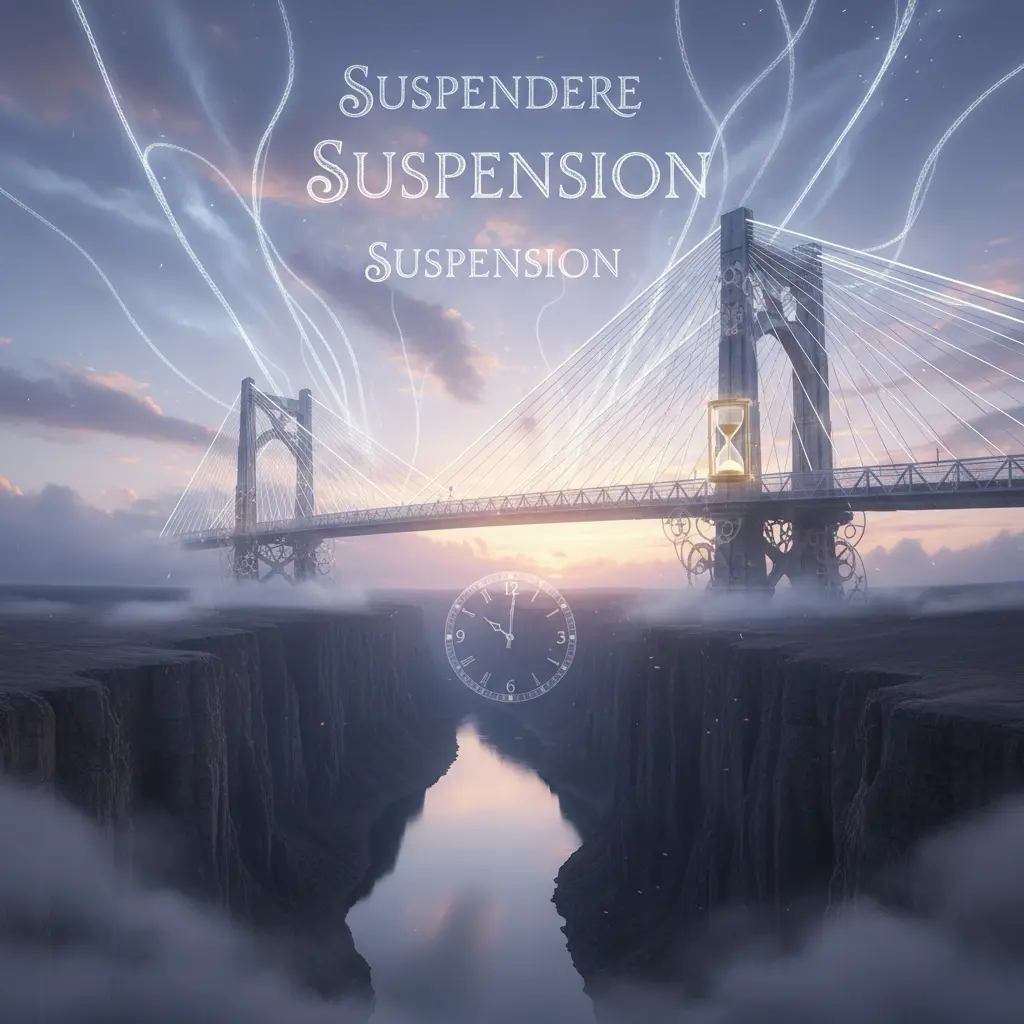
suspend (Latin: suspendere = to hang up) + -ion (suffix indicating action or condition). Originated from Latin → Old French → English. Imagine a bridge that is suspended in the air, held up by cables, symbolizing something that is temporarily put on hold.
Note 1: These definitions and etymologies are not standard dictionary definitions, but extended explanations provided to help with memorization and understanding of the actual application of words. Through this background information, we strive to make words more vivid and easier to understand, and help you remember their meanings in real life.
Note 2: LexiTalk designs the learning flow around the linguistics principle of “Comprehensible Input.” When learners encounter material that is slightly above their level but still understandable from context, the brain naturally absorbs the language. That’s why we keep every word inside authentic contexts, using examples and associations to help you understand it and use it flexibly.
Read the FAQ explanation of Comprehensible InputI push off and feel the bike respond as the suspension moves with every bump. I shift my weight, pull the handlebars, and keep my pace as the road changes under me. On a rough stretch I notice how the system holds me up, how a pause in a plan can come when I least expect it. By the end I sense that this small push and hold, this adjustment under pressure, is what lets motion continue without breaking.
Suspension is a noun with several related meanings. First, it denotes the act of temporarily preventing something from continuing, such as the suspension of a service, a rule, or a process, often while an investigation or decision is pending. Second, it refers to the state of being hung or supported in the air, as when a chandelier is suspended from a ceiling or a bridge is suspended by cables. Third, it is the name for a car’s suspension system, the set of springs, shock absorbers, and linkages that cushion the ride and keep the wheels in contact with the road. These senses share the core idea of blocking progress, supporting weight, or absorbing motion.
English tends to separate formal pauses (suspension) from casual delays; learners often confuse suspension with suspense or pause in everyday talk. Emphasize collocations like 'suspension of service' vs 'suspension of disbelief'.
What is the meaning of 'suspension'?
Which sentence uses 'suspension' correctly?
What is a synonym for 'suspension'?
What is an opposite (antonym) for 'suspension'?
In what real-life context would you find 'suspension'?
Download LexiTalk app for personalized learning experience
Download AppCookies
We use cookies for essential site functions, analytics, and ads. You can accept, reject, or manage preferences. Privacy Policy