teenage - Master This Word
Master this word with our 5-step learning method – Learn English in English
Train English Through Brain Routes, Not Translation.
This page helps you stop memorizing isolated translations and start understanding a word through its shared mental image, native-style thinking, and practical training steps.
Master this word with our 5-step learning method – Learn English in English
Example sentences are the start of understanding. Don't rush to memorize. First feel how the word works in a sentence.
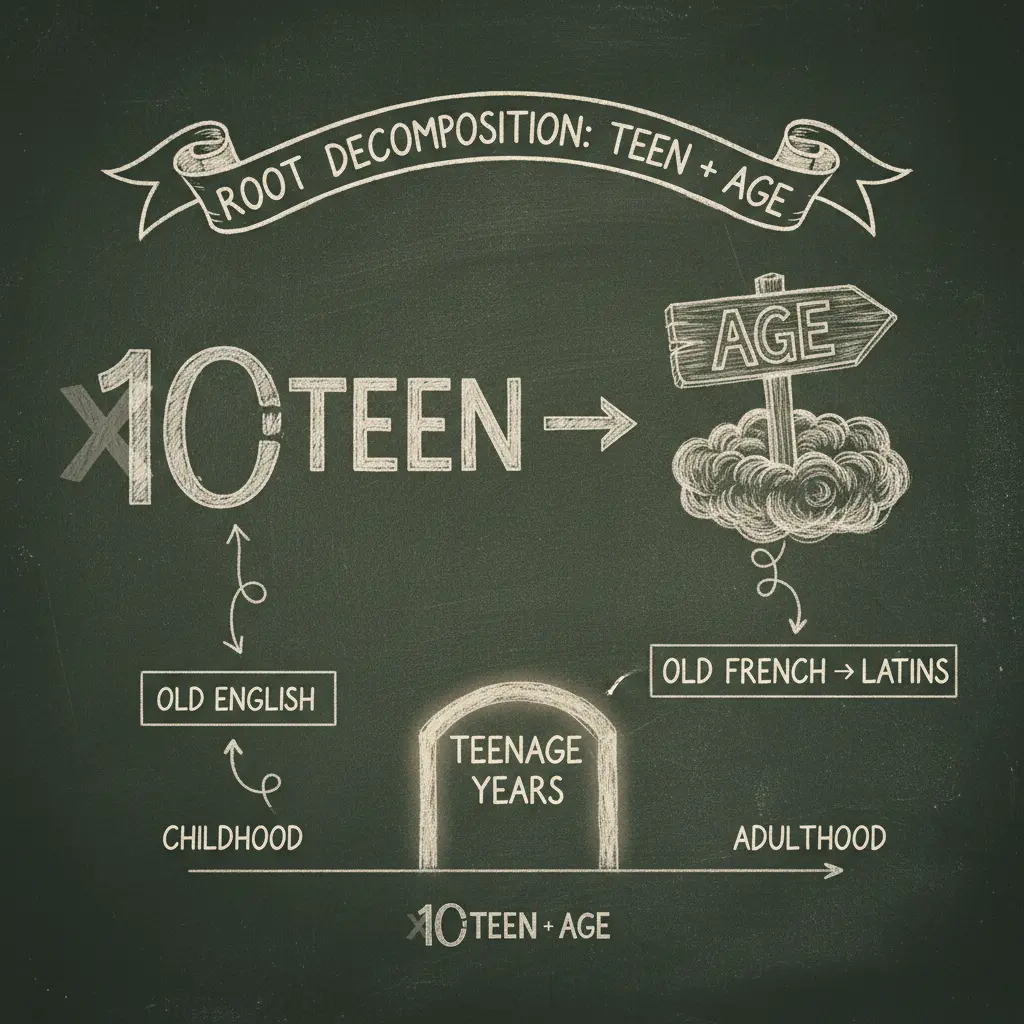
Root decomposition: teen + -age; the root teen is historically linked to ten, as in the teen numbers. Historical origin: from Old English, with the -age suffix from Old French via Latin aetas. Memory image: imagine a chalkboard where the number ten morphs into teen, and a sign reading age appears as you cross into the teenage years.
Note 1: These definitions and etymologies are not standard dictionary definitions, but extended explanations provided to help with memorization and understanding of the actual application of words. Through this background information, we strive to make words more vivid and easier to understand, and help you remember their meanings in real life.
Note 2: LexiTalk designs the learning flow around the linguistics principle of “Comprehensible Input.” When learners encounter material that is slightly above their level but still understandable from context, the brain naturally absorbs the language. That’s why we keep every word inside authentic contexts, using examples and associations to help you understand it and use it flexibly.
Read the FAQ explanation of Comprehensible InputI push the locker shut, pull my jacket tighter, and adjust the zipper as the hallway hums. The air shifts, a teenage energy slips into my chest, nudging me to test limits and choose my own path. I hold the decision for a beat, then set a plan for the afternoon with friends. The moment moves on, and I learn what it feels like to own a small piece of growing up.
Teenage describes things related to teenagers or adolescence. It is used as an adjective before nouns like 'years', 'energy', or 'fashion' to signal the teen years, roughly ages 13 to 19, or the youthful vibe of a person or idea. The word can also describe something that feels youthful or immature, as in 'teenage energy' or 'teenage optimism' even when used more broadly. In everyday usage, you will see phrases such as 'teenage years' and 'teenage angst' in both spoken and written English. Remember that 'teenage' focuses on the period or quality associated with teens, not the individuals themselves.
In English, teenage is a light, flexible adjective used with many nouns. Learners often confuse it with teenager (a noun) and may place it after verbs or as a noun phrase. Pay attention to collocations and the 13–19 age anchor when talking about years.
What is the meaning of the word 'teenage'?
In which sentence is 'teenage' used correctly?
Which word is an antonym of 'teenage'?
In what real-life context would you use the word 'teenage'?
Can you provide a sentence using the word 'teenage'?
Download LexiTalk app for personalized learning experience
Download AppCookies
We use cookies for essential site functions, analytics, and ads. You can accept, reject, or manage preferences. Privacy Policy