territory - Master This Word
Master this word with our 5-step learning method – Learn English in English
Train English Through Brain Routes, Not Translation.
This page helps you stop memorizing isolated translations and start understanding a word through its shared mental image, native-style thinking, and practical training steps.
Master this word with our 5-step learning method – Learn English in English
Example sentences are the start of understanding. Don't rush to memorize. First feel how the word works in a sentence.
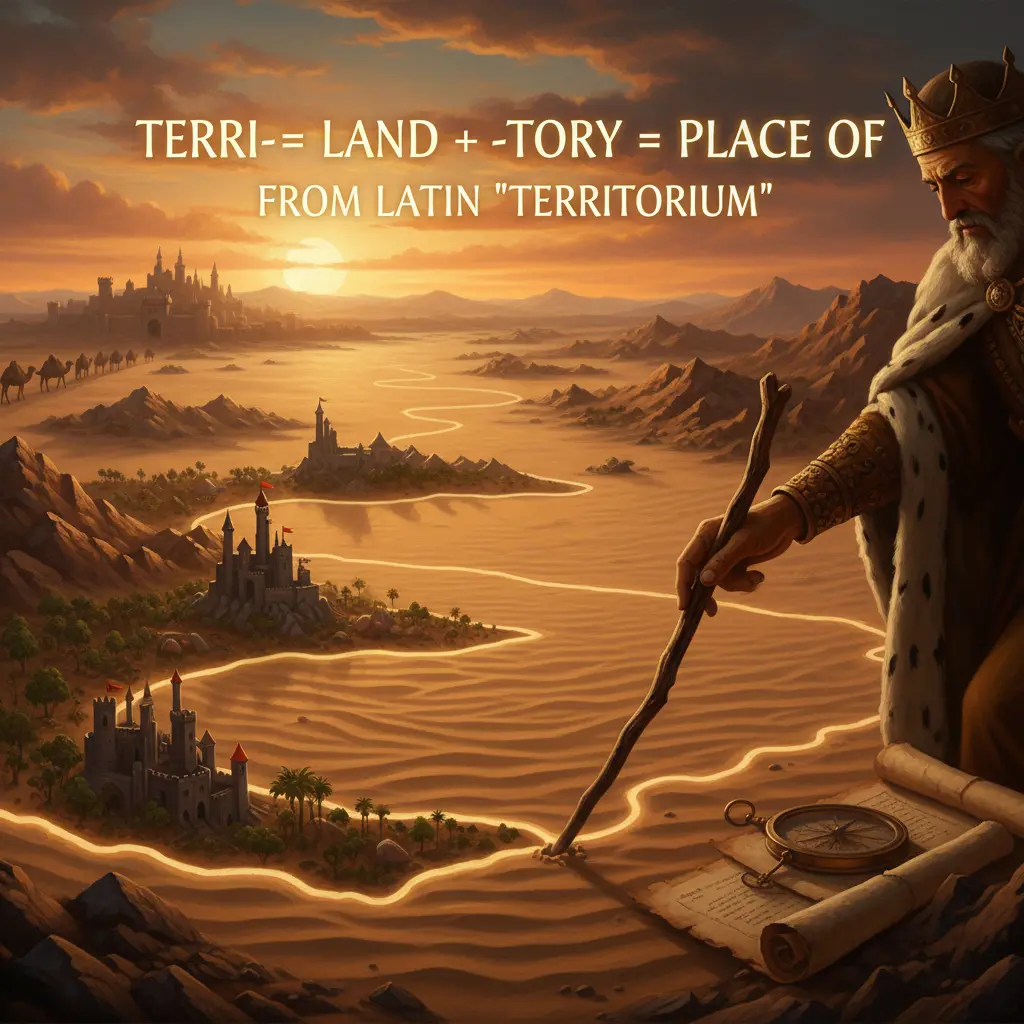
terri- = land + -tory = place of; from Latin 'territorium' meaning 'land around', evoking an image of a kingdom's borders drawn in the sand.
Note 1: These definitions and etymologies are not standard dictionary definitions, but extended explanations provided to help with memorization and understanding of the actual application of words. Through this background information, we strive to make words more vivid and easier to understand, and help you remember their meanings in real life.
Note 2: LexiTalk designs the learning flow around the linguistics principle of “Comprehensible Input.” When learners encounter material that is slightly above their level but still understandable from context, the brain naturally absorbs the language. That’s why we keep every word inside authentic contexts, using examples and associations to help you understand it and use it flexibly.
Read the FAQ explanation of Comprehensible InputI press my palm into the dirt and start tracing a line with my finger. I shift my weight, push and pull a little as the soil gives way, and the line finds its own rhythm. I adjust where I stand, set the edge, and keep my focus on what sits beyond it. In this small, practiced boundary, territory grows from action into a sense of responsibility.
Territory can refer to a defined area of land under the jurisdiction of a ruler or state, or to a region that an animal defends. It also appears in abstract phrases like the territory of science or the territory of a company, meaning a field of activity or knowledge. In political and legal writing, territory often implies borders and sovereignty; in ecology it means the space defended against rivals; in everyday use it can denote a broad region that someone considers theirs, such as a cultural territory. The etymology traces to Latin territorium, literally land around, highlighting the idea of a boundary drawn in space. Learners should note the concrete vs abstract senses and avoid mixing up with domain or area synonyms.
Territory often implies borders and sovereignty in English, but it also covers abstract domains like fields of study. Learners should notice the shift from concrete land to intangible areas and practice choosing words like field, domain, or realm when appropriate.
What is the meaning of the word 'territory'?
In which of the following sentences is 'territory' used correctly?
Which word is similar to 'territory'?
What is the opposite of 'territory'?
In what real-life context might you hear the word 'territory'?
Download LexiTalk app for personalized learning experience
Download AppCookies
We use cookies for essential site functions, analytics, and ads. You can accept, reject, or manage preferences. Privacy Policy