
troubadour - Master This Word
Master this word with our 5-step learning method – Learn English in English
Train English Through Brain Routes, Not Translation.
This page helps you stop memorizing isolated translations and start understanding a word through its shared mental image, native-style thinking, and practical training steps.
Master this word with our 5-step learning method – Learn English in English
Example sentences are the start of understanding. Don't rush to memorize. First feel how the word works in a sentence.
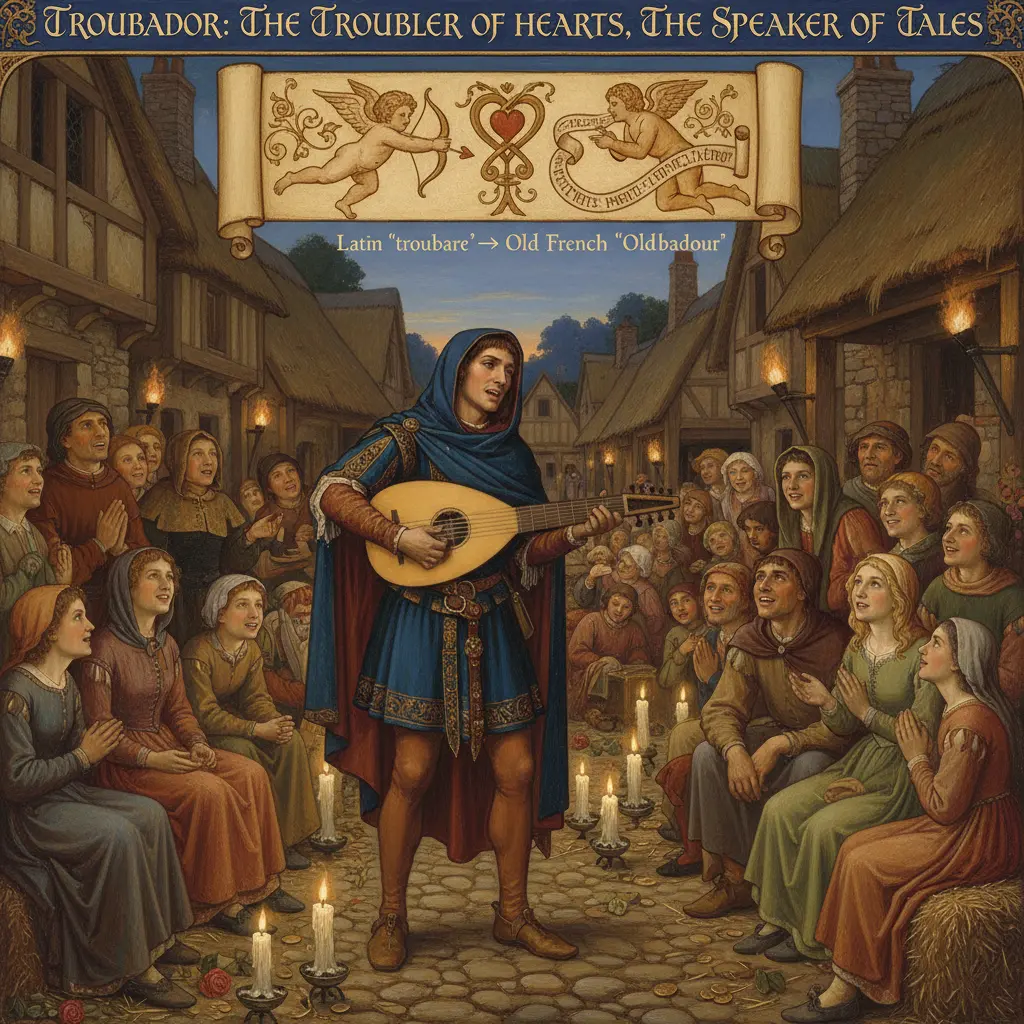
Root decomposition: 'troub-' (to trouble) + '-adour' (speaker). Historical origin: Latin 'troubare' → Old French 'troubadour' → English. Memory image: picture a medieval singer wandering through villages, reciting poems of love and adventure to enchanted audiences by candlelight, embodying both the troubler of hearts and the speaker of stories.
Note 1: These definitions and etymologies are not standard dictionary definitions, but extended explanations provided to help with memorization and understanding of the actual application of words. Through this background information, we strive to make words more vivid and easier to understand, and help you remember their meanings in real life.
Note 2: LexiTalk designs the learning flow around the linguistics principle of “Comprehensible Input.” When learners encounter material that is slightly above their level but still understandable from context, the brain naturally absorbs the language. That’s why we keep every word inside authentic contexts, using examples and associations to help you understand it and use it flexibly.
Read the FAQ explanation of Comprehensible InputA troubadour was a poet-musician of the medieval Occitan-speaking world, roaming from court to court and village to village to sing of love, chivalry, and adventure. They typically wrote and performed in the vernacular, shaping a tradition that fused lyric poetry with melody. The word traces back to a root meaning to create or speak, with the memory image of a candlelit courtyard where a wandering singer strums a lute and recites rhymed verses that move hearts and spark legends. In modern English, troubadour denotes a roving poet-musician, often associated with romantic or courtly themes and a spirit of storytelling that survives in metaphor today.
English speakers often picture a singular poet-singer; in many languages the troubadour is seen as a linked tradition of poets, musicians, and improvisers tied to courts and vernacular verse.
What is the meaning of 'troubadour'?
Select the sentence that uses the word 'troubadour' correctly:
Which word is most similar to 'troubadour'?
What is the opposite of 'troubadour'?
Can you think of a real-life context where a troubadour might perform?
Download LexiTalk app for personalized learning experience
Download AppCookies
We use cookies for essential site functions, analytics, and ads. You can accept, reject, or manage preferences. Privacy Policy