
unacceptable - Master This Word
Master this word with our 5-step learning method – Learn English in English
Train English Through Brain Routes, Not Translation.
This page helps you stop memorizing isolated translations and start understanding a word through its shared mental image, native-style thinking, and practical training steps.
Master this word with our 5-step learning method – Learn English in English
Example sentences are the start of understanding. Don't rush to memorize. First feel how the word works in a sentence.
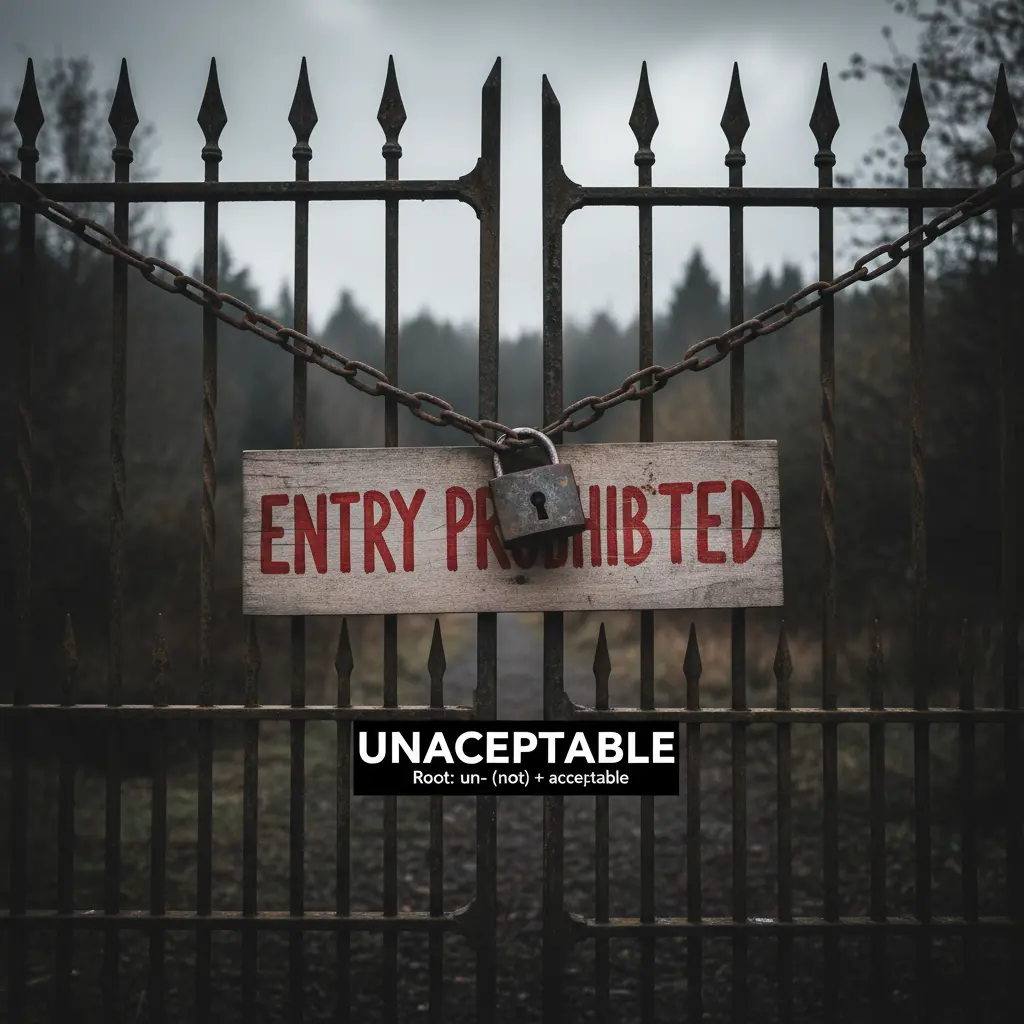
Root: un- (not) + acceptable (capable of being accepted). Historical origin: from Latin 'acceptabilis' → Old French 'acceptable' → English. Memory image: Imagine a gate marked 'entry prohibited' to visualize something that cannot be accepted.
Note 1: These definitions and etymologies are not standard dictionary definitions, but extended explanations provided to help with memorization and understanding of the actual application of words. Through this background information, we strive to make words more vivid and easier to understand, and help you remember their meanings in real life.
Note 2: LexiTalk designs the learning flow around the linguistics principle of “Comprehensible Input.” When learners encounter material that is slightly above their level but still understandable from context, the brain naturally absorbs the language. That’s why we keep every word inside authentic contexts, using examples and associations to help you understand it and use it flexibly.
Read the FAQ explanation of Comprehensible InputFirst I pause, then reach for a page and move it a fraction to compare the lines. I notice a section that feels off—unacceptable—and my attention tightens. I adjust my plan, set higher criteria in my head, and hold the moment, deciding to turn away from that option. The scene stays with me as I imagine how it would behave in real use.
Unacceptable describes something that cannot be accepted, either because it fails to meet required standards, breaks rules, or is socially or professionally inappropriate. In everyday use it commonly labels a proposal, behavior, or item as not suitable or out of bounds, but it often implies a formal judgment rather than a casual dislike. Learners should note the typical collocations like 'unacceptable behavior', 'unacceptable to the committee', and the common contrast with 'acceptable'. The sense can be strengthened by pairing with adjectives such as 'completely', 'totally', or 'globally' depending on severity.
In English, unacceptable often emphasizes a formal rejection or a breach of standards, which can feel very objective. Learners may overgeneralize it to mild disapproval or use it in casual conversation, diluting its force. Focus on contexts like policies, proposals, or conduct.
Which sentence uses 'unacceptable' correctly?
Which word is most similar to 'unacceptable'?
What is the opposite of 'unacceptable'?
Can you describe a situation where something was deemed 'unacceptable'?
Download LexiTalk app for personalized learning experience
Download AppCookies
We use cookies for essential site functions, analytics, and ads. You can accept, reject, or manage preferences. Privacy Policy