unlike - Master This Word
Master this word with our 5-step learning method – Learn English in English
Train English Through Brain Routes, Not Translation.
This page helps you stop memorizing isolated translations and start understanding a word through its shared mental image, native-style thinking, and practical training steps.
Master this word with our 5-step learning method – Learn English in English
Example sentences are the start of understanding. Don't rush to memorize. First feel how the word works in a sentence.
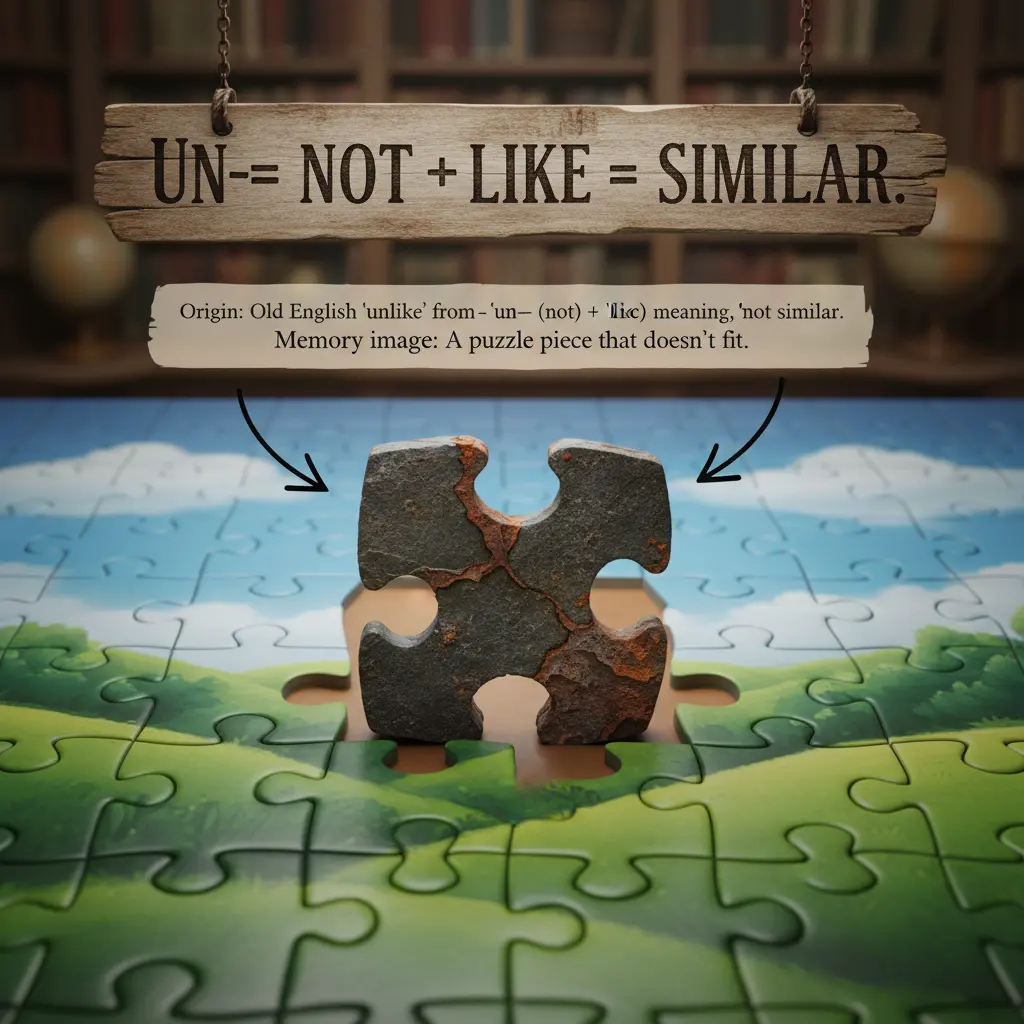
un- = not + like = similar. Origin: Old English 'unlike' from 'un-' (not) + 'lic' (like) meaning 'not similar'. Memory image: Imagine a puzzle piece that doesn't fit, contrasting sharply with its surroundings.
Note 1: These definitions and etymologies are not standard dictionary definitions, but extended explanations provided to help with memorization and understanding of the actual application of words. Through this background information, we strive to make words more vivid and easier to understand, and help you remember their meanings in real life.
Note 2: LexiTalk designs the learning flow around the linguistics principle of “Comprehensible Input.” When learners encounter material that is slightly above their level but still understandable from context, the brain naturally absorbs the language. That’s why we keep every word inside authentic contexts, using examples and associations to help you understand it and use it flexibly.
Read the FAQ explanation of Comprehensible InputI settle into my chair and move my hand toward a mug on the shelf. I compare two cups and notice how one feels heavier, unlike the other. I adjust my grip, shift my stance, and keep my focus as the scene changes in my mind. The moment arrives as a tiny decision: not about the cup itself, but about how I will use the word in my head—unlike what came before.
Unlike is a small but flexible word that helps you compare things by highlighting their differences. Used as a preposition or adverb, it signals that one thing is not similar to another or that a situation differs from what is expected. You can place unlike before a noun or noun phrase, or use it after a subject in a clause, as in 'Unlike most students, she finished early.' It often pairs with contrasts, exceptions, or surprising observations. Remember that unlike implies dissimilarity rather than simply being different in multiple ways. A memory cue: picture a puzzle piece that doesn’t fit, standing out from its surroundings and changing the whole picture.
English tends to allow flexible placement of unlike to mark direct contrasts, so learners must decide whether to pair it with a noun, a clause, or both. Common mistakes include overgeneralizing its use, confusing it with 'different from', and treating it as a purely formal or literary device. Practice with clear, everyday contrasts to feel where it sounds natural.
What is the meaning of the word 'unlike'?
In which of the following sentences is 'unlike' used correctly?
Which word is the opposite of 'unlike'?
Real-life context: In what situation would you use the word 'unlike'?
Can you come up with a sentence using the word 'unlike'?
Download LexiTalk app for personalized learning experience
Download AppCookies
We use cookies for essential site functions, analytics, and ads. You can accept, reject, or manage preferences. Privacy Policy