
wednesday - Master This Word
Master this word with our 5-step learning method – Learn English in English
Train English Through Brain Routes, Not Translation.
This page helps you stop memorizing isolated translations and start understanding a word through its shared mental image, native-style thinking, and practical training steps.
Master this word with our 5-step learning method – Learn English in English
Example sentences are the start of understanding. Don't rush to memorize. First feel how the word works in a sentence.
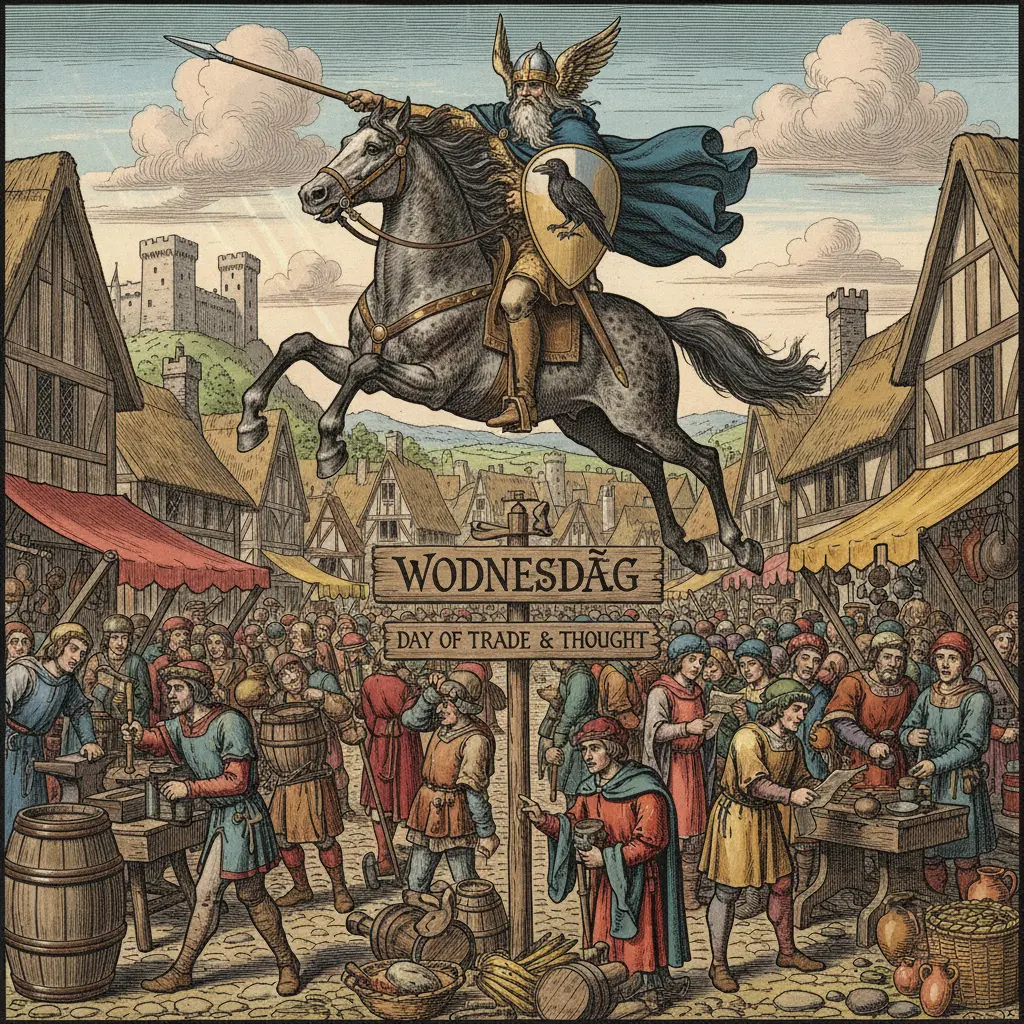
Root decomposition: 'Wodens' (Woden) + 'day'. Historical origin: Old English 'Wōdnesdæg' → Middle English 'Wednesdei' → Modern English 'Wednesday'. Memory image: Picture Woden, the Germanic god of wisdom and war, riding on a swift horse, overseeing a bustling marketplace on a Wednesday, a day of trade and thought.
Note 1: These definitions and etymologies are not standard dictionary definitions, but extended explanations provided to help with memorization and understanding of the actual application of words. Through this background information, we strive to make words more vivid and easier to understand, and help you remember their meanings in real life.
Note 2: LexiTalk designs the learning flow around the linguistics principle of “Comprehensible Input.” When learners encounter material that is slightly above their level but still understandable from context, the brain naturally absorbs the language. That’s why we keep every word inside authentic contexts, using examples and associations to help you understand it and use it flexibly.
Read the FAQ explanation of Comprehensible InputOn a Wednesday I start by sliding open my planner and turning the page to the middle of the week. I push aside old tasks and move my finger along the row for the day, feeling a small shift in my rhythm. I adjust my pace, keep one eye on deadlines and one on the morning light. When the schedule settles, I take a breath, let the plan hold steady, and step into the day with a clear, steady sense of purpose.
Wednesday is the middle day of the workweek in many English-speaking cultures and in most Western calendars. Its name comes from Old English Wōdnesdæg, after the god Woden (Odin), and from the ancient association with the planet Mercury—a link to communication, travel, and commerce. In modern use, Wednesday is often when workplaces schedule midweek meetings, project reviews, and events to keep momentum before the weekend. The memory image to help learners: Woden, a wise, warlike figure, riding to a busy marketplace on a Wednesday, symbolizing planning, trade, and thoughtful, steady progress.
Midweek is a universal concept in English, but learners often visualize it as a hard, exact middle or assume Wednesday is the only day with special meetings; in many cultures the week starts on Sunday or Monday, which shifts what 'middle' feels like.
Which sentence uses 'wednesday' correctly?
Which word is most similar to 'wednesday'?
What is the opposite of 'wednesday'?
Can you think of a real-life context for 'wednesday'?
Download LexiTalk app for personalized learning experience
Download AppCookies
We use cookies for essential site functions, analytics, and ads. You can accept, reject, or manage preferences. Privacy Policy