width - Master This Word
Master this word with our 5-step learning method – Learn English in English
Train English Through Brain Routes, Not Translation.
This page helps you stop memorizing isolated translations and start understanding a word through its shared mental image, native-style thinking, and practical training steps.
Master this word with our 5-step learning method – Learn English in English
Example sentences are the start of understanding. Don't rush to memorize. First feel how the word works in a sentence.
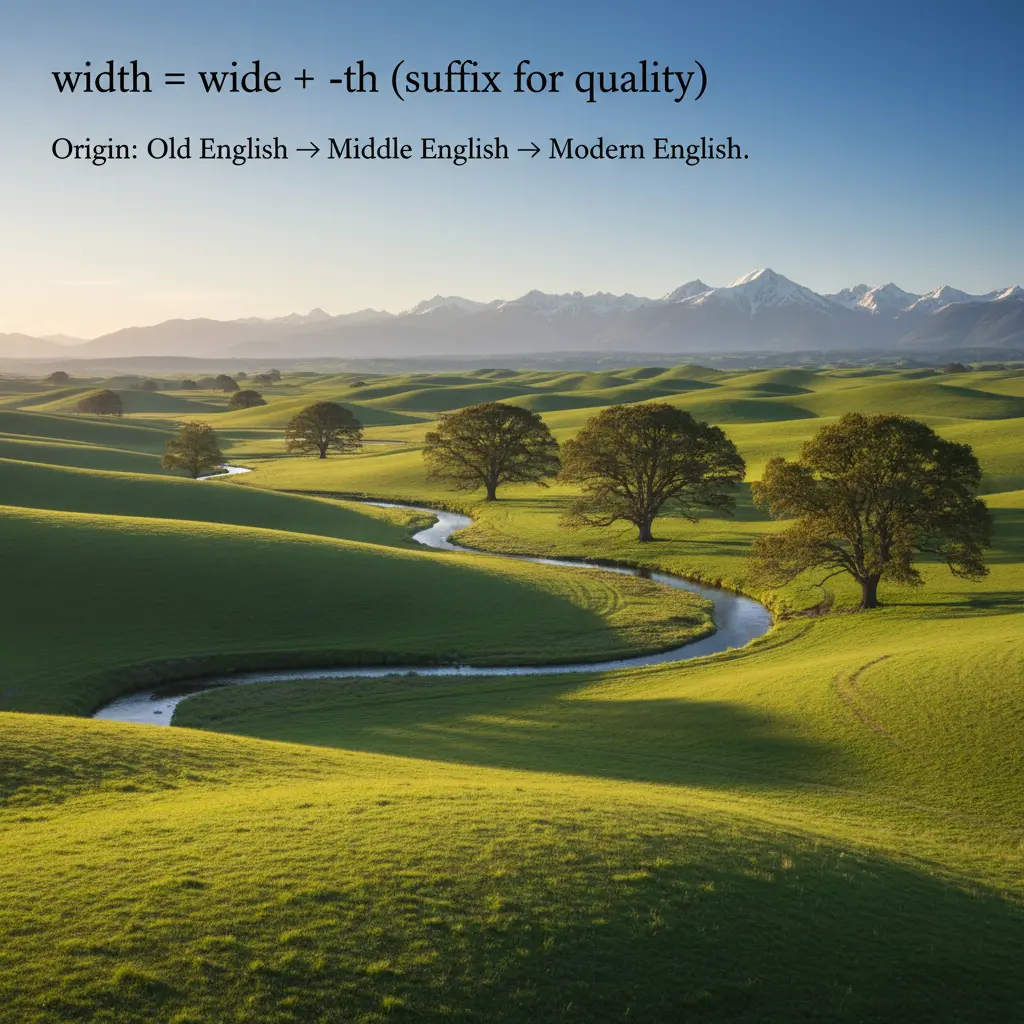
width = wide + -th (suffix for quality). Origin: Old English → Middle English → Modern English. Imagine a vast landscape stretching wide under a clear sky, symbolizing the extensive breadth of width.
Note 1: These definitions and etymologies are not standard dictionary definitions, but extended explanations provided to help with memorization and understanding of the actual application of words. Through this background information, we strive to make words more vivid and easier to understand, and help you remember their meanings in real life.
Note 2: LexiTalk designs the learning flow around the linguistics principle of “Comprehensible Input.” When learners encounter material that is slightly above their level but still understandable from context, the brain naturally absorbs the language. That’s why we keep every word inside authentic contexts, using examples and associations to help you understand it and use it flexibly.
Read the FAQ explanation of Comprehensible InputI place a hand on the doorway and push it open a crack, then pull it wider as I steady my stance. I move a tape along the frame, hold it taut, adjust my grip when it wobbles, and set the edge to two points. The space grows in my mind, and I feel how wide something is as I keep checking from side to side.
Width is the measurement of something from side to side, the extent of something between two points, and the quality of being broad or wide. It describes how wide an object or space appears when viewed front on, such as the width of a table, the width of a door opening, or the width of a screen. In usage, width is a physical dimension, separate from length (along the longest direction) and height (vertical). Learners often confuse width with distance, length, or area, especially for irregular shapes. Visualizing a landscape stretching wide helps remember breadth as the opposite of narrow.
In English, width is the horizontal dimension and is often contrasted with length and height; some learners translate width directly into other languages’ words for distance, causing errors about orientation.
What is the meaning of the word 'width'?
Which sentence uses 'width' correctly?
What is a synonym for 'width'?
What is an opposite word for 'width'?
In what real-life situation would you need to measure the width of something?
Download LexiTalk app for personalized learning experience
Download AppCookies
We use cookies for essential site functions, analytics, and ads. You can accept, reject, or manage preferences. Privacy Policy