worst - Master This Word
Master this word with our 5-step learning method – Learn English in English
Train English Through Brain Routes, Not Translation.
This page helps you stop memorizing isolated translations and start understanding a word through its shared mental image, native-style thinking, and practical training steps.
Master this word with our 5-step learning method – Learn English in English
Example sentences are the start of understanding. Don't rush to memorize. First feel how the word works in a sentence.
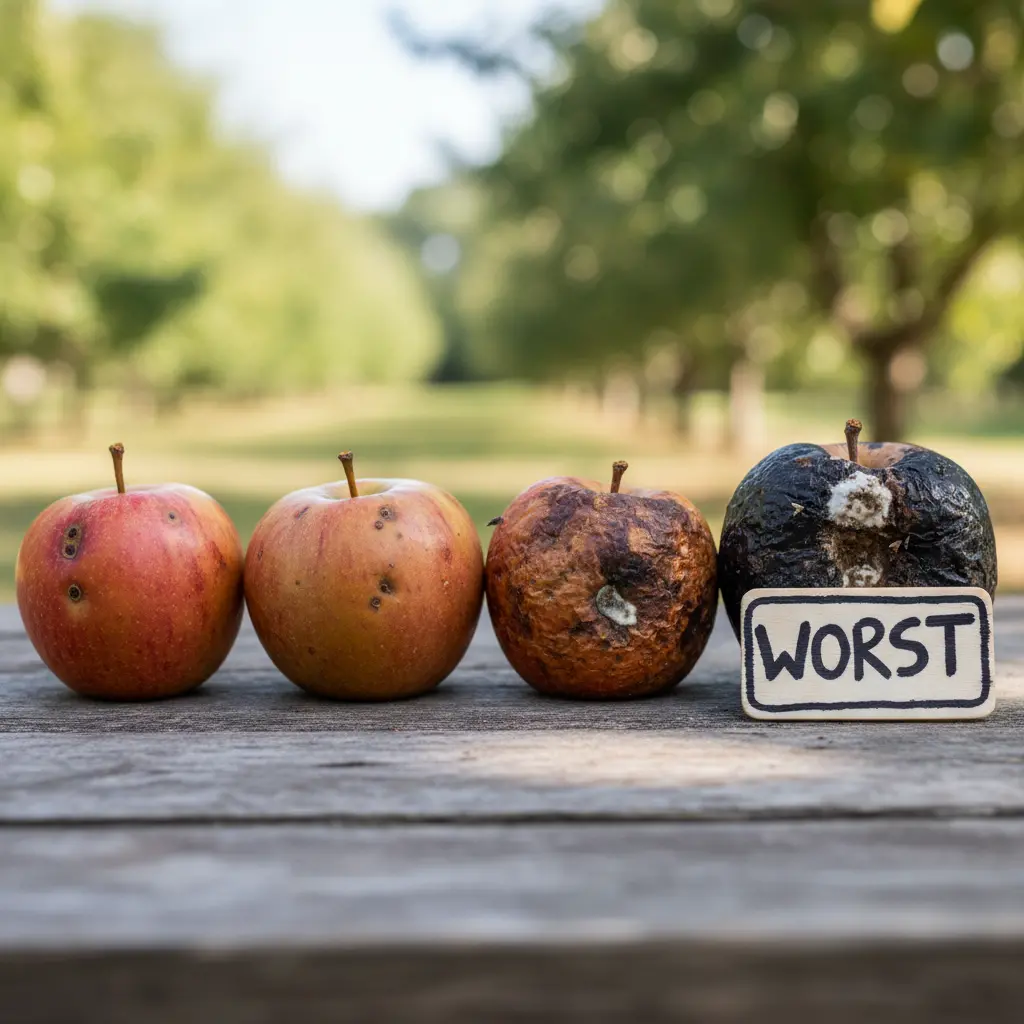
(a) Root decomposition: base adjective bad with suffix est forming the superlative; phonetic shift b to w and a to o yields worst. (b) Historical origin: from Old English wyrst/wyrste, via Proto-Germanic würstaz, a Germanic development rather than Latin or Greek. (c) Memory image: imagine a row of apples where the most rotten one is labeled worst to memorize the extreme sense of badness.
Note 1: These definitions and etymologies are not standard dictionary definitions, but extended explanations provided to help with memorization and understanding of the actual application of words. Through this background information, we strive to make words more vivid and easier to understand, and help you remember their meanings in real life.
Note 2: LexiTalk designs the learning flow around the linguistics principle of “Comprehensible Input.” When learners encounter material that is slightly above their level but still understandable from context, the brain naturally absorbs the language. That’s why we keep every word inside authentic contexts, using examples and associations to help you understand it and use it flexibly.
Read the FAQ explanation of Comprehensible InputI grip the door handle and turn, the latch groaning as the door opens a crack. I shift my weight, push a little harder, and steady myself against the draft. I adjust my stance again, keeping my eyes on the edge of the frame as I decide how far to go. In that small stretch of effort, the scene settles into a moment you could call the worst, the heavy point where a room or moment tests you and you know what you’re made of.
Worst is the superlative form of the adjective bad. It describes the highest degree of negativity, the lowest quality, or the most severe state. We use it with a noun to label something as the very lowest end, as in 'the worst movie' or 'the worst day.' It can also fix phrases like 'worst-case scenario' and 'do your worst,' where it signals an extreme situation or a challenge to someone to perform as badly as they can. In everyday speech, it often carries strong emotion, emphasis, or sarcasm, so tone matters. Remember that irregular comparisons use 'worse' for the comparative, but 'worst' for the superlative.
Explain to an English speaker: English uses the most extreme negative form with the superlative worst, often for emphasis or sarcasm; learners should be careful not to misuse with adjectives that already imply negative quality.
Which sentence uses the word 'worst' correctly?
Which word is most similar in meaning to 'worst'?
Which word is the opposite of 'worst'?
Choose the prompt where answering aloud would correctly use the word 'worst'. (Fill in the blank.)
English Learning Listening Content
Listen NowDownload LexiTalk app for personalized learning experience
Download AppCookies
We use cookies for essential site functions, analytics, and ads. You can accept, reject, or manage preferences. Privacy Policy