yet - Master This Word
Master this word with our 5-step learning method – Learn English in English
Train English Through Brain Routes, Not Translation.
This page helps you stop memorizing isolated translations and start understanding a word through its shared mental image, native-style thinking, and practical training steps.
Master this word with our 5-step learning method – Learn English in English
Example sentences are the start of understanding. Don't rush to memorize. First feel how the word works in a sentence.
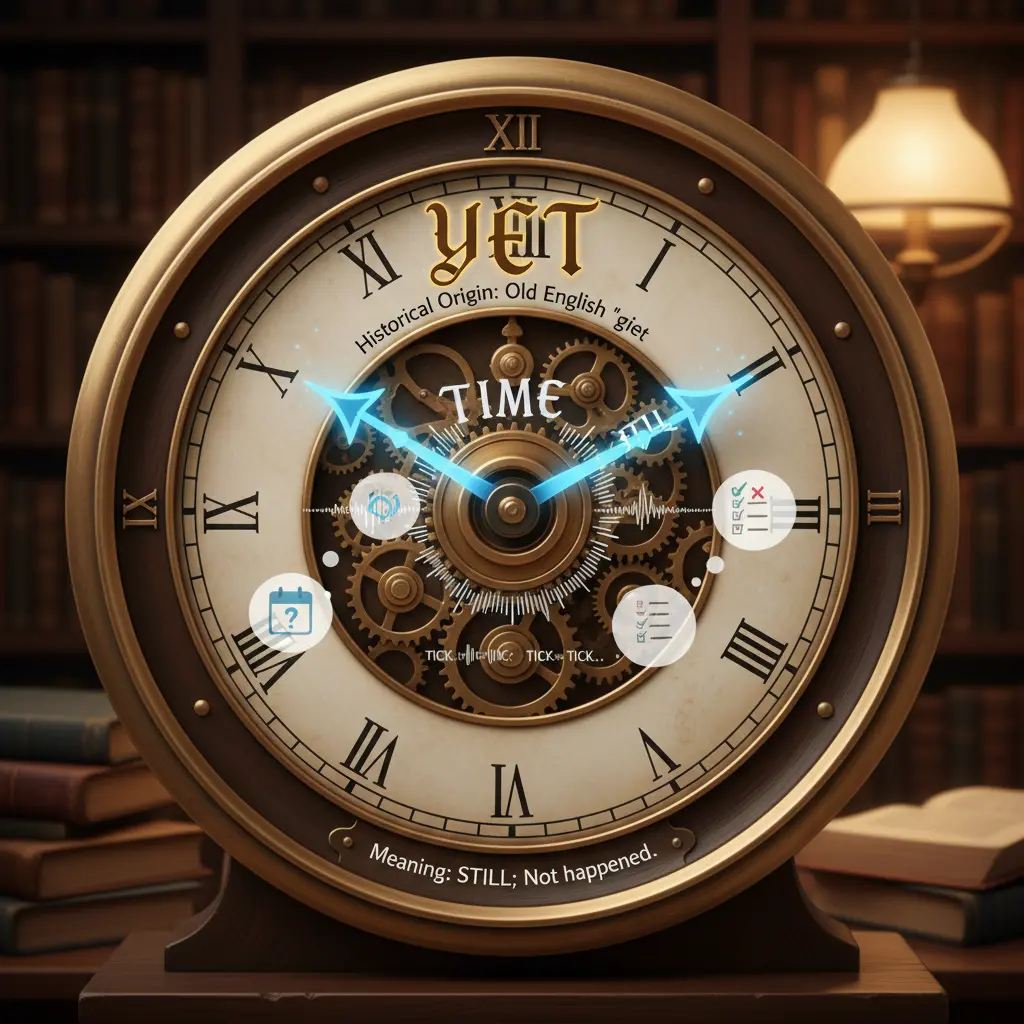
yet = still; Historical origin: Old English 'giet' → Middle English 'yet' → Modern English. Memory image: Imagine a clock ticking, reminding you that time is still moving, symbolizing something that hasn't happened yet.
Note 1: These definitions and etymologies are not standard dictionary definitions, but extended explanations provided to help with memorization and understanding of the actual application of words. Through this background information, we strive to make words more vivid and easier to understand, and help you remember their meanings in real life.
Note 2: LexiTalk designs the learning flow around the linguistics principle of “Comprehensible Input.” When learners encounter material that is slightly above their level but still understandable from context, the brain naturally absorbs the language. That’s why we keep every word inside authentic contexts, using examples and associations to help you understand it and use it flexibly.
Read the FAQ explanation of Comprehensible InputI reach for the light switch and my finger moves it to the on position. The room brightens, then settles into a steady glow I keep adjusting as I sit. Up until now the night has waited, and the quiet feels thick around me. Yet the glow holds, and I feel ready to move forward to whatever comes next.
Yet is a versatile English adverb used to refer to something that has not happened up to the present moment, or to introduce a contrast with expectations. It commonly appears in questions such as Have you finished yet? and in negative statements like I haven’t finished yet. It can also mean nevertheless when used to introduce a counterpoint, as in The plan failed, yet we continued. Yet is often placed at the end of a clause in informal speech for emphasis, or after a negative phrase to signal time has not progressed. Historically, yet comes from Old English giet, evolving through Middle English to Modern English.
English learners often confuse yet with still or with other time references. Yet tends to appear in negatives and questions about unfinished events, and it also signals a contrast. Students may place it too early or too late in a sentence, or overgeneralize to affirmative statements.
Which sentence uses 'yet' correctly?
Which word is most similar to 'yet'?
What is the opposite of 'yet'?
Can you think of a real-life context for using 'yet'?
Download LexiTalk app for personalized learning experience
Download AppCookies
We use cookies for essential site functions, analytics, and ads. You can accept, reject, or manage preferences. Privacy Policy