zero - Master This Word
Master this word with our 5-step learning method – Learn English in English
Train English Through Brain Routes, Not Translation.
This page helps you stop memorizing isolated translations and start understanding a word through its shared mental image, native-style thinking, and practical training steps.
Master this word with our 5-step learning method – Learn English in English
Example sentences are the start of understanding. Don't rush to memorize. First feel how the word works in a sentence.
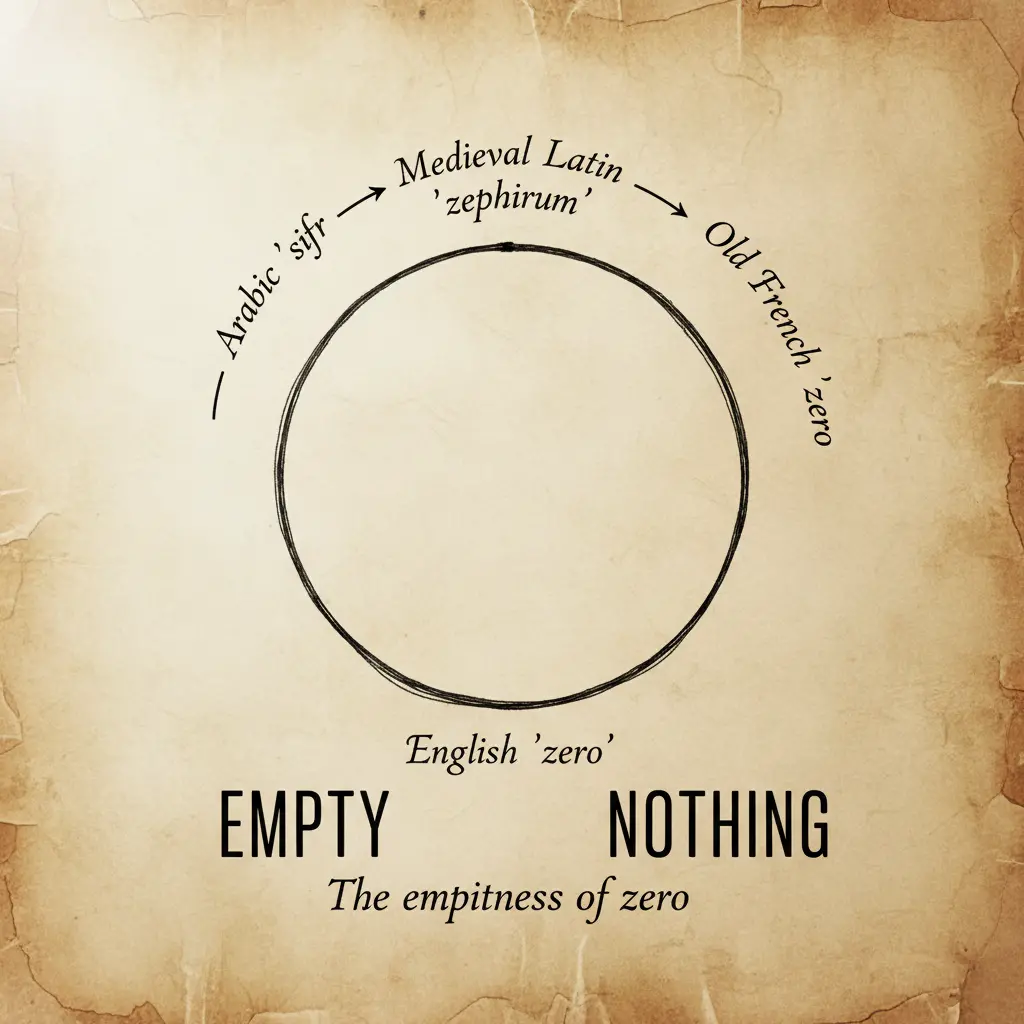
From Arabic 'sifr' (meaning 'empty' or 'nothing'), passing through Medieval Latin 'zephirum' to Old French 'zero' and then to English. Picture a round, empty circle, representing nothing or the emptiness of zero.
Note 1: These definitions and etymologies are not standard dictionary definitions, but extended explanations provided to help with memorization and understanding of the actual application of words. Through this background information, we strive to make words more vivid and easier to understand, and help you remember their meanings in real life.
Note 2: LexiTalk designs the learning flow around the linguistics principle of “Comprehensible Input.” When learners encounter material that is slightly above their level but still understandable from context, the brain naturally absorbs the language. That’s why we keep every word inside authentic contexts, using examples and associations to help you understand it and use it flexibly.
Read the FAQ explanation of Comprehensible InputI sit at the scale, breathe steady, and push the tare button as the numbers move toward zero. A quiet weight settles, a small shift in my shoulders as nothing else counts. I keep nudging the dial, turn it a notch, and the reading stays near zero, inviting me to trust this clean slate. It feels like choosing to begin again, to place everything back to zero and start from there.
Zero is the number that represents the absence of quantity. It serves as a placeholder in our counting system and as a starting point in arithmetic. In everyday language, zero can describe temperature, scores, or values in formulas, such as zero tolerance or zero degrees. As a verb, zero means to nullify or erase something, as in zeroing a debt or zeroing out data. People often forget that zero is a distinct concept, not a negative quantity, and that multiplying by zero makes any amount go to zero, not to a negative. Understanding zero helps you read charts, budgets, and programming more accurately.
Zero in English is a precise numeric concept and can function as a verb in phrases like zero out. Learners often treat zero as simply ‘nothing’ or confuse it with empty values, and they may overlook common fixed phrases that use zero to describe limits, temperatures, or states.
Which of the following sentences uses 'zero' correctly?
What is a synonym for 'zero'?
What is the opposite of 'zero'?
In what real-life context would you use the word 'zero'?
Download LexiTalk app for personalized learning experience
Download AppCookies
We use cookies for essential site functions, analytics, and ads. You can accept, reject, or manage preferences. Privacy Policy