acclimatise - Master This Word
Master this word with our 5-step learning method – Learn English in English
Train English Through Brain Routes, Not Translation.
This page helps you stop memorizing isolated translations and start understanding a word through its shared mental image, native-style thinking, and practical training steps.
Master this word with our 5-step learning method – Learn English in English
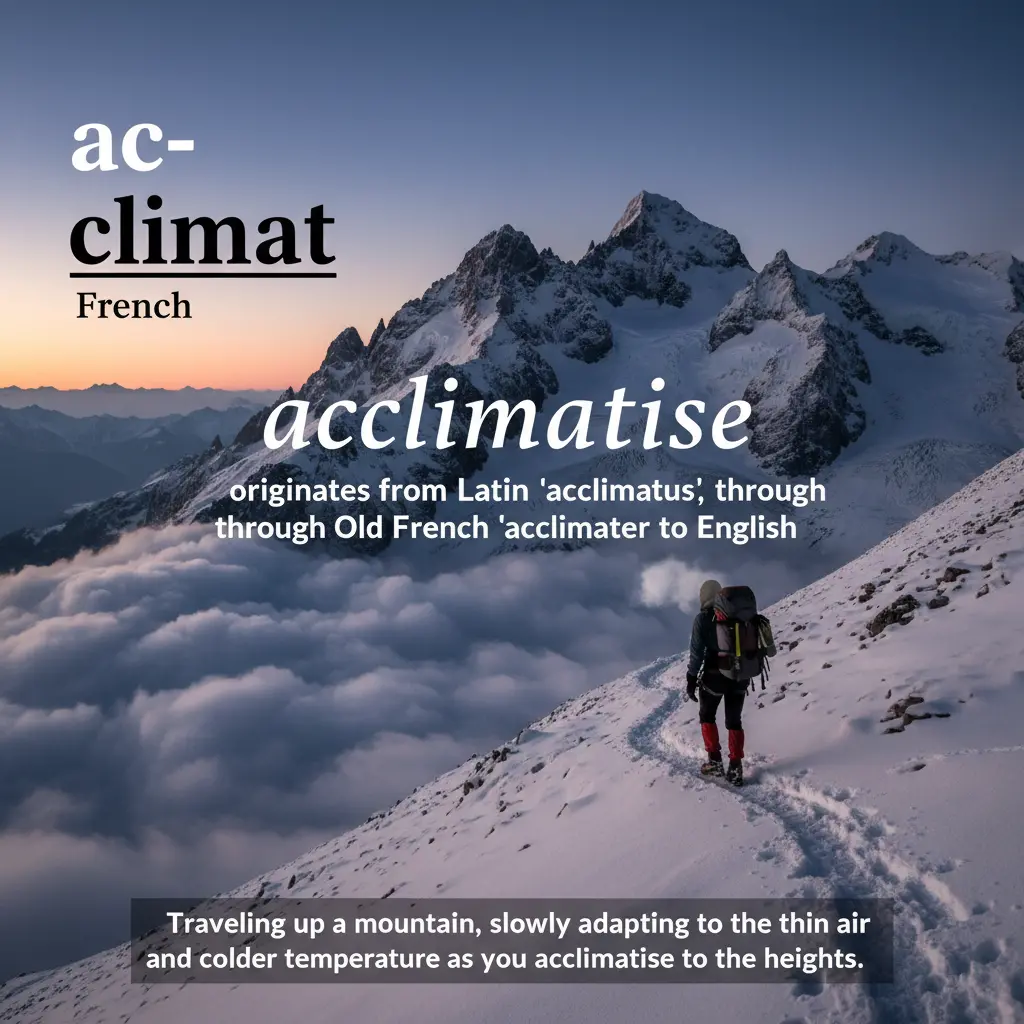
Example sentences are the start of understanding. Don't rush to memorize. First feel how the word works in a sentence.
(a) prefix 'ac-' + root 'climat' from French; (b) the word originates from Latin 'acclimatus', through Old French 'acclimater' to English; (c) Picture yourself traveling up a mountain, slowly adapting to the thin air and colder temperatures as you acclimatise to the heights.
Note 1: These definitions and etymologies are not standard dictionary definitions, but extended explanations provided to help with memorization and understanding of the actual application of words. Through this background information, we strive to make words more vivid and easier to understand, and help you remember their meanings in real life.
Note 2: LexiTalk designs the learning flow around the linguistics principle of “Comprehensible Input.” When learners encounter material that is slightly above their level but still understandable from context, the brain naturally absorbs the language. That’s why we keep every word inside authentic contexts, using examples and associations to help you understand it and use it flexibly.
Read the FAQ explanation of Comprehensible InputAcclimatise means to adjust gradually to a new climate or environment. It describes the process of becoming more comfortable as you adapt to different temperatures, humidity, altitude, or seasonal patterns. Physiologically, people may acclimate to high altitude by producing more red blood cells, while behaviorally you adjust clothing, routines, or outdoor activities to suit the conditions. The term is more common in British English, where acclimatise is preferred over acclimate in formal writing, though both spellings are understood. It can be transitive or intransitive depending on whether the subject acclimatises themselves or others do. The word derives from Latin acclimatus via Old French acclimater, with the prefix ac- linked to climat from French.
Explain to an English speaker that acclimatise emphasizes gradual, ongoing adaptation to climate or environment, highlighting that it can be physical or behavioral.
What is the meaning of acclimatise?
Choose the correct use of the word acclimatise in a sentence.
Which word is most similar to acclimatise?
What is the opposite of acclimatise?
Can you think of a real-life context where one might need to acclimatise?
Download LexiTalk app for personalized learning experience
Download AppCookies
We use cookies for essential site functions, analytics, and ads. You can accept, reject, or manage preferences. Privacy Policy