article - Master This Word
Master this word with our 5-step learning method – Learn English in English
Train English Through Brain Routes, Not Translation.
This page helps you stop memorizing isolated translations and start understanding a word through its shared mental image, native-style thinking, and practical training steps.
Master this word with our 5-step learning method – Learn English in English
Example sentences are the start of understanding. Don't rush to memorize. First feel how the word works in a sentence.
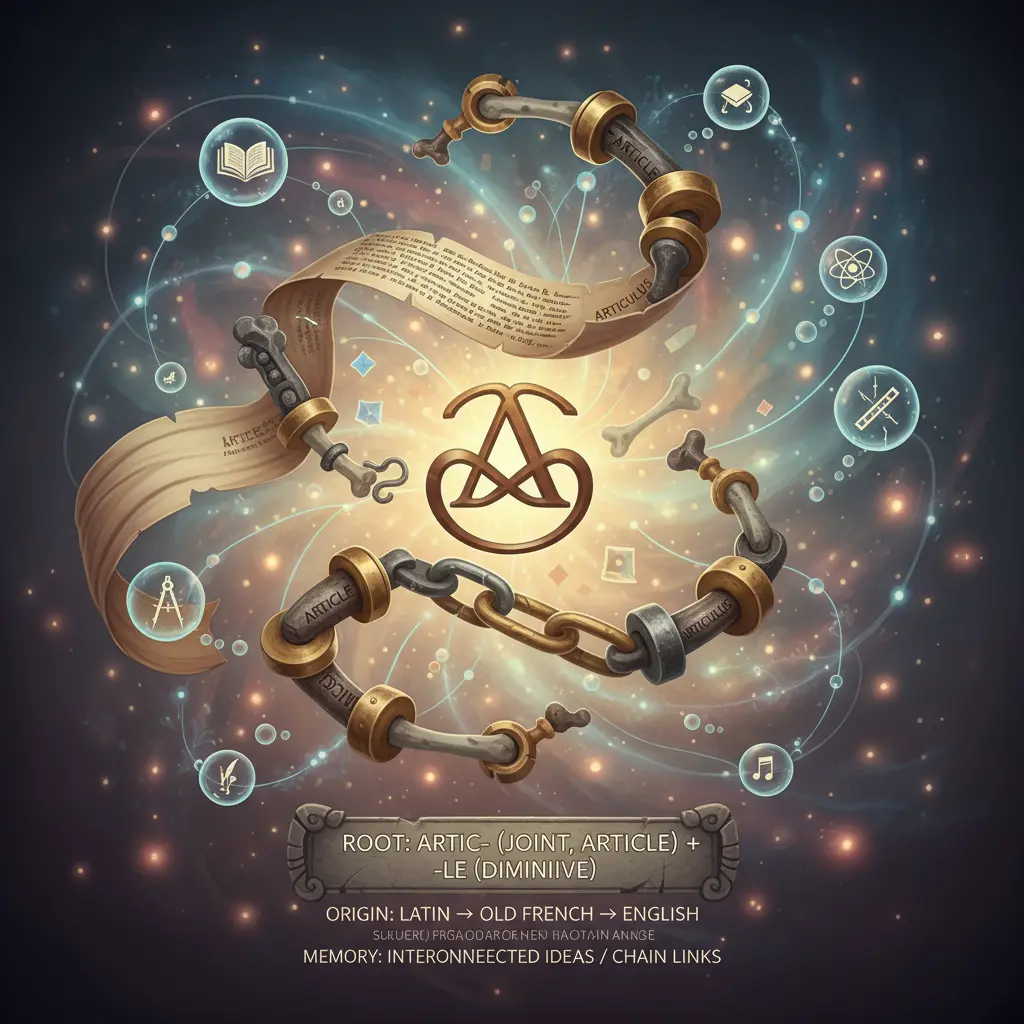
Root: artic- (from Latin articulus = 'joint, article') + -le (diminutive suffix). Origin: Latin → Old French → English. Memory: Imagine the connection of joints that are connected, like how articles connect ideas together; visualize links in a chain.
Note 1: These definitions and etymologies are not standard dictionary definitions, but extended explanations provided to help with memorization and understanding of the actual application of words. Through this background information, we strive to make words more vivid and easier to understand, and help you remember their meanings in real life.
Note 2: LexiTalk designs the learning flow around the linguistics principle of “Comprehensible Input.” When learners encounter material that is slightly above their level but still understandable from context, the brain naturally absorbs the language. That’s why we keep every word inside authentic contexts, using examples and associations to help you understand it and use it flexibly.
Read the FAQ explanation of Comprehensible InputI pick up the newspaper and slide the page toward me, then I move my gaze down the column. I turn a corner of the page and let the paragraph unfold like a small map of ideas. The more I hold the article in my hand, the more I feel the pull of its tempo and its voice guiding my attention through the page. When I close the paper, that little section still sits in my mind, ready to be pulled into a sentence or placed among other notes.
An article is a noun with multiple senses. It can mean a written work in a newspaper or magazine, such as a feature or opinion piece; it can also refer to a section of a document, like a numbered article in a contract or a law; and in grammar, an article is a determiner such as the, a, or an that accompanies a noun. Learners often mix up these senses, especially when reading headlines or legal texts. In everyday use, you will usually talk about 'an article' in a newspaper sense, or about 'an article' as a section of a document, while speaking about grammar in a different context. Understanding the context helps choose the right form.
For English speakers, articles are strictly tied to countability and specificity; learners often mix up 'the' with 'a/an' in contexts like contracts or headlines.
What is the meaning of the word 'article'?
How is the word 'article' typically used?
Which word is similar to 'article'?
What is the opposite of 'article'?
In what context would you come across an 'article'?
Download LexiTalk app for personalized learning experience
Download AppCookies
We use cookies for essential site functions, analytics, and ads. You can accept, reject, or manage preferences. Privacy Policy