capture - Master This Word
Master this word with our 5-step learning method – Learn English in English
Train English Through Brain Routes, Not Translation.
This page helps you stop memorizing isolated translations and start understanding a word through its shared mental image, native-style thinking, and practical training steps.
Master this word with our 5-step learning method – Learn English in English
Example sentences are the start of understanding. Don't rush to memorize. First feel how the word works in a sentence.
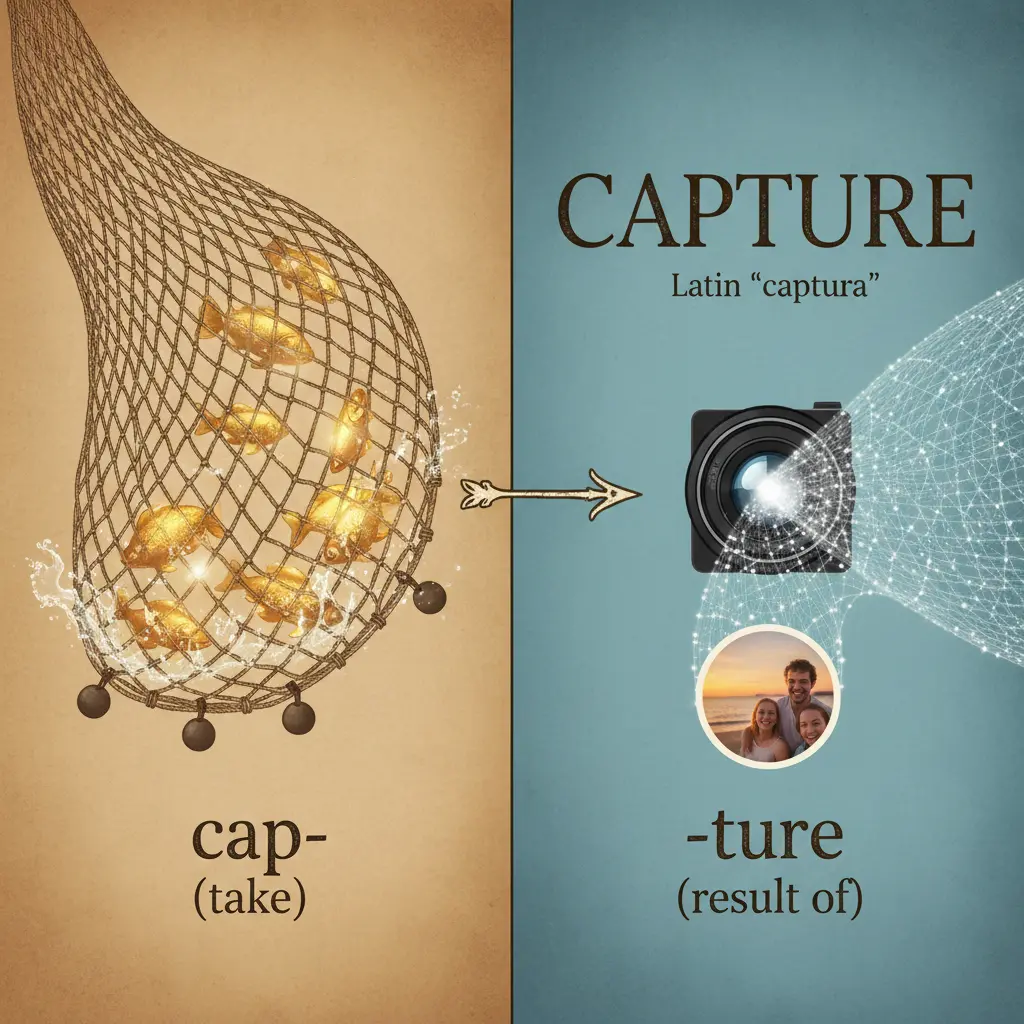
capture = cap- (take) + -ture (result of) from Latin 'captura'. The image of a net snaring something helps remember it, as does the idea of a photograph capturing a moment.
Note 1: These definitions and etymologies are not standard dictionary definitions, but extended explanations provided to help with memorization and understanding of the actual application of words. Through this background information, we strive to make words more vivid and easier to understand, and help you remember their meanings in real life.
Note 2: LexiTalk designs the learning flow around the linguistics principle of “Comprehensible Input.” When learners encounter material that is slightly above their level but still understandable from context, the brain naturally absorbs the language. That’s why we keep every word inside authentic contexts, using examples and associations to help you understand it and use it flexibly.
Read the FAQ explanation of Comprehensible InputI set my posture, tighten my grip, and push the shutter to wake the moment. The scene shifts as the lens changes focus and the picture starts to hold onto light. It feels like steering attention: I pull the frame toward me, I keep the subject in view, and the sense of effort sweeps through my shoulders. Later, I notice how this same pressure shows up when I capture a memory, a conversation, or a trend—I decide what to keep, what to let go, and what to show.
Capture has several closely related meanings in English. It can mean to take control of something by force or strategy, as in capturing a fortress or market share. It also means to record something carefully, as when a photographer captures a moment on film or a researcher captures data in a notebook. Finally, capture can describe attracting and holding attention, for example a striking image or a compelling idea can capture an audience. These senses share a core idea of taking hold, but the appropriate verb choice and collocations differ by context, so learners should note which sense fits each situation and which prepositions or objects accompany capture.
Capturing in English blends literal and metaphorical use; learners must map each sense to distinct verbs and collocations, which can feel odd when translating directly.
Which sentence uses the word 'capture' correctly?
Which word is most similar to 'capture'?
What is the opposite of 'capture'?
Can you give an example of a real-life scenario of 'capture'?
Download LexiTalk app for personalized learning experience
Download AppCookies
We use cookies for essential site functions, analytics, and ads. You can accept, reject, or manage preferences. Privacy Policy