chaos - Master This Word
Master this word with our 5-step learning method – Learn English in English
Train English Through Brain Routes, Not Translation.
This page helps you stop memorizing isolated translations and start understanding a word through its shared mental image, native-style thinking, and practical training steps.
Master this word with our 5-step learning method – Learn English in English
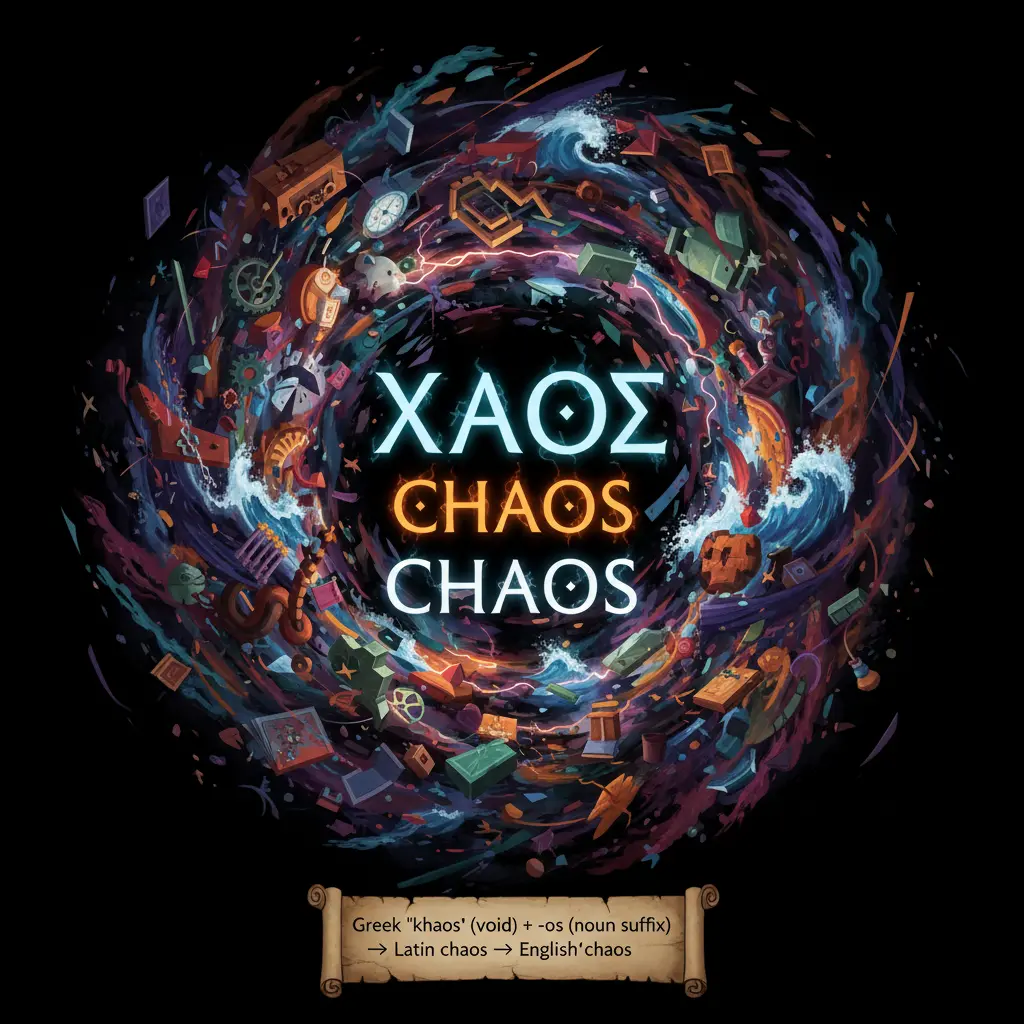
Example sentences are the start of understanding. Don't rush to memorize. First feel how the word works in a sentence.
chaos = chao- (from Greek 'khaos' meaning 'void') + -os (noun suffix). Historical origin: Greek → Latin 'chaos' → English. Memory image: Visualize a swirling vortex of mixed elements representing confusion and disorder.
Note 1: These definitions and etymologies are not standard dictionary definitions, but extended explanations provided to help with memorization and understanding of the actual application of words. Through this background information, we strive to make words more vivid and easier to understand, and help you remember their meanings in real life.
Note 2: LexiTalk designs the learning flow around the linguistics principle of “Comprehensible Input.” When learners encounter material that is slightly above their level but still understandable from context, the brain naturally absorbs the language. That’s why we keep every word inside authentic contexts, using examples and associations to help you understand it and use it flexibly.
Read the FAQ explanation of Comprehensible InputI start by moving a messy pile of papers on the desk, nudging some away and sliding others into a line. The papers push and pull against each other, and the clutter seems to twist as I adjust and place each item. I feel the effort rise as I keep my focus, deciding what to hold and what to set aside. Bit by bit the scene changes and the room feels calmer and usable, not perfect but ready for real tasks.
Chaos is a powerful English noun for total confusion and lack of order. It can describe a situation that spirals beyond control, a state of disorder, or the feeling of being overwhelmed by competing forces. In everyday speech we often say a scene is chaotic, but with chaos we refer to the concept rather than a single concrete event. The word has roots in Greek khaos meaning void, and it traveled into English via Latin. Although many people imagine chaos as a dramatic, cosmic force, it is commonly used for mundane messes, planning mishaps, or traffic jams that feel out of control. It also pairs with adjectives like complete, utter, or total to emphasize scale.
Chaos in English is an abstract mass noun that often elevates scale or intensity; learners should differentiate it from more concrete notions like disorder or confusion and prefer 'a chaotic situation' for a single event.
What is the meaning of the word 'chaos'?
Which of the following sentences uses 'chaos' correctly?
What is a synonym for 'chaos'?
In which situation would 'chaos' be most likely to occur?
How would you describe 'chaos' in real-life?
Download LexiTalk app for personalized learning experience
Download AppCookies
We use cookies for essential site functions, analytics, and ads. You can accept, reject, or manage preferences. Privacy Policy