circles - Master This Word
Master this word with our 5-step learning method – Learn English in English
Train English Through Brain Routes, Not Translation.
This page helps you stop memorizing isolated translations and start understanding a word through its shared mental image, native-style thinking, and practical training steps.
Master this word with our 5-step learning method – Learn English in English
Example sentences are the start of understanding. Don't rush to memorize. First feel how the word works in a sentence.
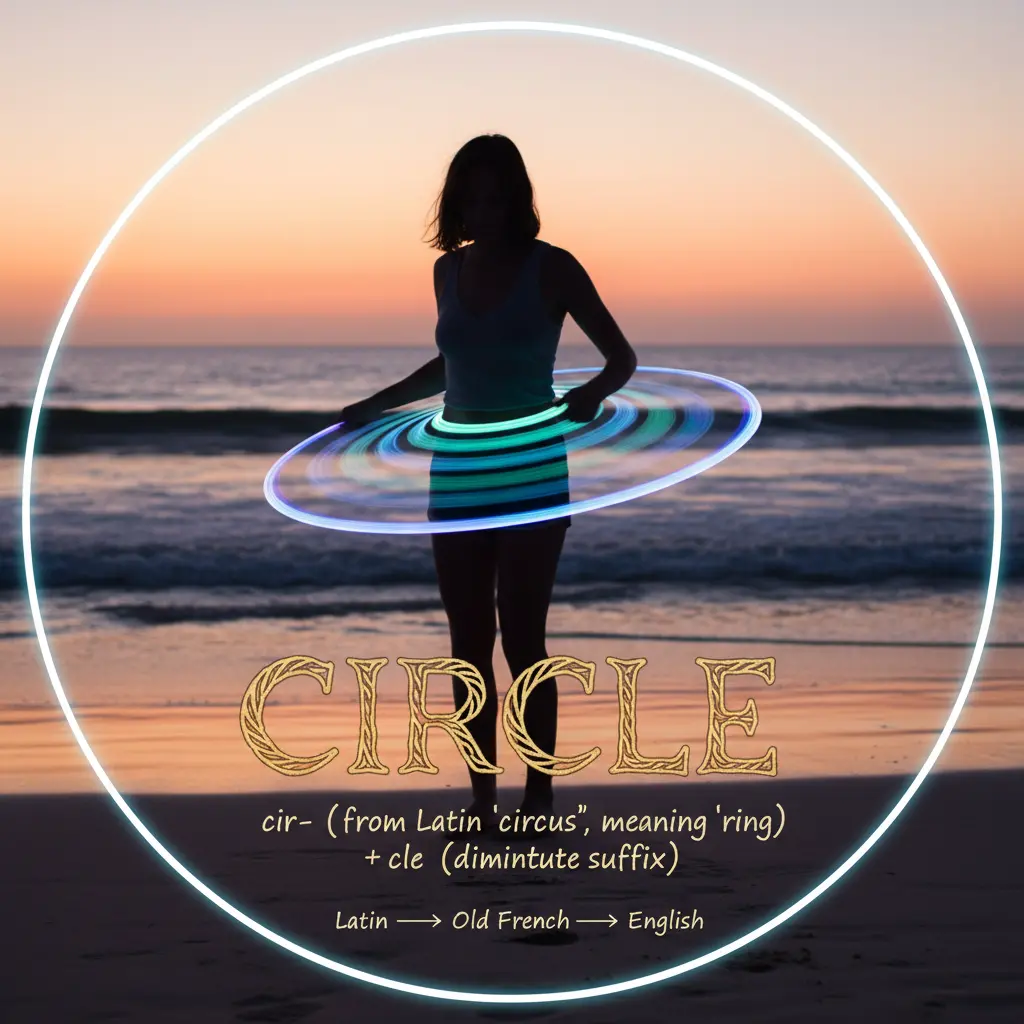
circle: cir- (from Latin 'circus', meaning 'ring') + cle (diminutive suffix). Originated from Latin → Old French → English. Picture a hula hoop, spinning around someone's waist, symbolizing the endless loop of a circle.
Note 1: These definitions and etymologies are not standard dictionary definitions, but extended explanations provided to help with memorization and understanding of the actual application of words. Through this background information, we strive to make words more vivid and easier to understand, and help you remember their meanings in real life.
Note 2: LexiTalk designs the learning flow around the linguistics principle of “Comprehensible Input.” When learners encounter material that is slightly above their level but still understandable from context, the brain naturally absorbs the language. That’s why we keep every word inside authentic contexts, using examples and associations to help you understand it and use it flexibly.
Read the FAQ explanation of Comprehensible InputI start by placing a pencil on the desk and giving it a small push to loosen my grip. I guide the pencil to move in a circle, watching the line smooth out as my wrist stays loose and steady. I adjust the speed, feeling the turn tighten when I slow, and the round edge emerges from the scratchy start. Soon the circle feels like more than a mark: it hints at a circle of friends who share a quiet interest, and I keep thinking how a name for that shape can also name a group of people.
Circle is a basic geometric shape defined by every point being the same distance from a center. It also appears in everyday speech: a social circle means the group of people you know; and to circle something means to move around it in a circular path or to surround it. You might hear circle used in business discussions (circle back to that point), in sports (a circle of players forming a huddle), or in math class (radius, diameter, circumference). The term carries a sense of wholeness, unity, and repetition. Learners should note the noun and verb senses differ in formality and typical collocations.
Native speakers tend to see circle as both a precise geometric figure and a social concept. Learners often confuse circle with round or ring, or misplace the verb sense, saying 'circle the topic' in contexts where 'return to' or 'surround' would be odd. English uses set phrases like circle back and circle of friends to convey specific ideas, which may not translate literally into other languages.
What does the word 'circles' mean?
Select the sentence that uses the word 'circles' correctly.
Which word is most similar to 'circles'?
What is the opposite of 'circles'?
Can you think of a real-life scenario that involves circles?
Download LexiTalk app for personalized learning experience
Download AppCookies
We use cookies for essential site functions, analytics, and ads. You can accept, reject, or manage preferences. Privacy Policy