
LexiTalk LexiTalk

Train English Through Brain Routes, Not Translation.

This page helps you stop memorizing isolated translations and start understanding a word through its shared mental image, native-style thinking, and practical training steps.

🎙️ Daily Listening📚 Example Sentences & Scenarios🧠 Vocabulary Learning

coagulation - Master This Word

Master this word with our 5-step learning method – Learn English in English
coagulation Word Meanings

  • the process of transforming a liquid into a solid or semi-solid state
  • the process of clot formation in blood
  • aggregation or clustering of particles
Illustration for this word

coagulation Example Sentences

Example sentences are the start of understanding. Don't rush to memorize. First feel how the word works in a sentence.

coagulation Phonetic & Pronunciation

Pronunciation
UK /kəʊægjʊˈleɪʃən/
US /koʊæɡjʊˈleɪʃən/
Syllables
coagulation

coagulation Word Etymology

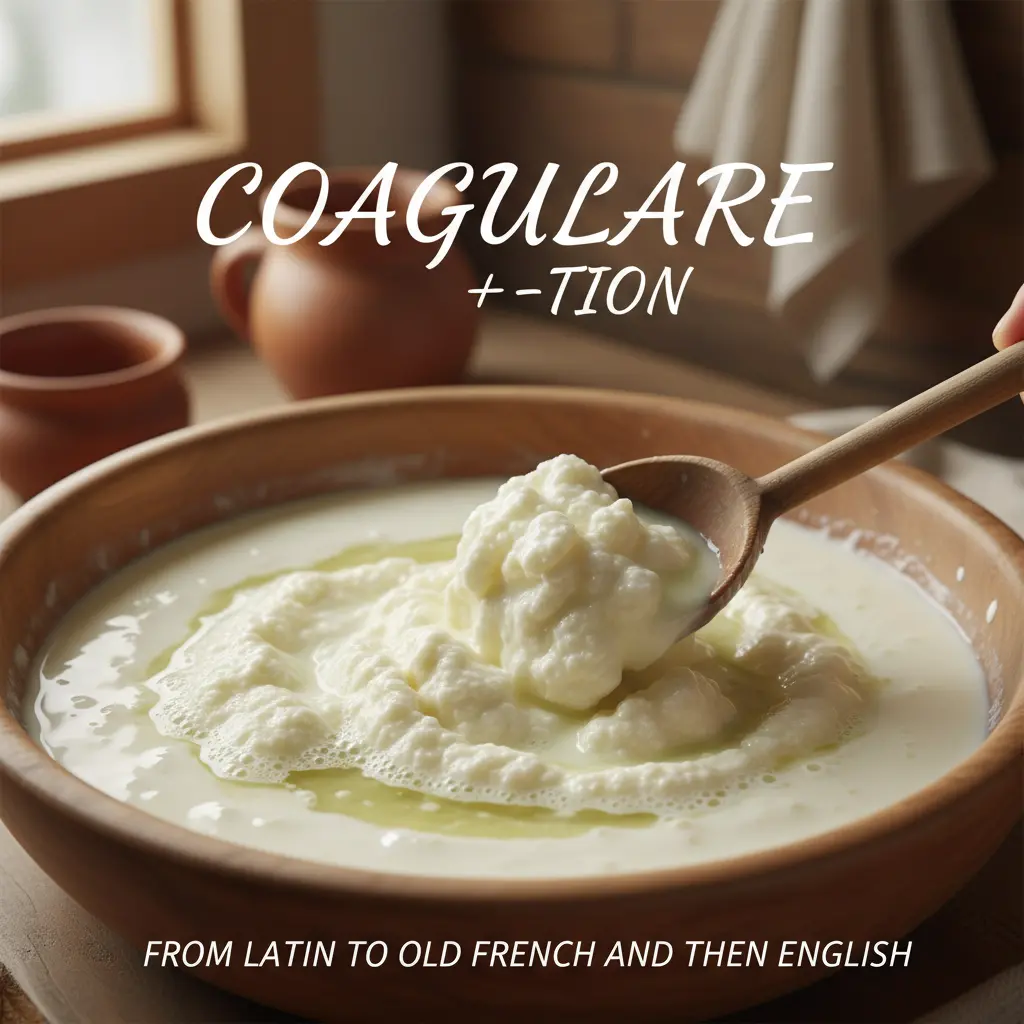
coagulation = coagulare (Latin for 'to curdle') + -tion (suffix for action/state); from Latin to Old French and then English. Imagine milk curdling to form cheese, representing how liquids solidify into structured forms.

Note 1: These definitions and etymologies are not standard dictionary definitions, but extended explanations provided to help with memorization and understanding of the actual application of words. Through this background information, we strive to make words more vivid and easier to understand, and help you remember their meanings in real life.

Note 2: LexiTalk designs the learning flow around the linguistics principle of “Comprehensible Input.” When learners encounter material that is slightly above their level but still understandable from context, the brain naturally absorbs the language. That’s why we keep every word inside authentic contexts, using examples and associations to help you understand it and use it flexibly.

Read the FAQ explanation of Comprehensible Input

Real Context

Coagulation is the process by which a liquid becomes solid or semi-solid, and in medicine it also refers to the formation of a blood clot. In everyday science, it describes how proteins in fluids interact to form a gel, such as milk curdling into cheese when heat or acid is applied. In materials science, coagulation can mean particles clumping together into larger aggregates to aid sedimentation or filtration. The term also appears in a broader sense to describe gelation or solidification of mixtures. When teaching or studying, keep straight the biological sense of blood clotting versus physical or chemical solidification, and watch for contexts that imply health risks from excessive coagulation.

Usage Reminders

  • Coagulation often involves proteins and factors that bind to form a solid or gel.
  • Remember the medical sense refers to blood clotting, not just any solidification.
  • A coagulation can be beneficial (stopping bleeding) or problematic (thrombosis).
  • In chemistry, coagulation describes particles clumping, not necessarily a phase change.
  • Use context clues (biology, medicine, or materials science) to choose the right meaning.

Common Misconceptions

  • Coagulation always means solidifying, not just gel formation.
  • Blood coagulation is always bad; it is essential to stopping bleeding.
  • Coagulation occurs instantly in any liquid with heat.
  • Coagulation and precipitation are the same process.
  • All coagulation refers to blood; it does not apply to other materials.

Thinking Differences

Explain to an English speaker (meta, keep short)

Learning Tips

  • Learn the biology/medical sense first (blood clotting) before the general solidification meaning.
  • Recognize keywords: blood, clot, gel, particle aggregation.
  • Watch for verbs: coagulate, coagulated, coagulating.
  • Use collocations: blood coagulation factors, coagulation cascade, coagulation tests.
  • Practice with contexts: medicine, chemistry, materials science.
  • Avoid confusing coagulation with freezing or melting terms.

5-Step Learning Method - Learn English in English

Step 1: Meaning

What is the definition of coagulation?

A.A term used to describe someone being quiet.
B.The process of a liquid becoming solid or semi-solid.
C.A method of cooking meat.
D.The act of running a marathon.
Step 2: Usage

Which sentence uses coagulation correctly?

A.After boiling the water, I noticed coagulation occurred as the pasta cooked.
B.The coagulation of the soup made it taste salty.
C.The artist's painting showed a beautiful coagulation of colors.
D.Coagulation happens when you leave bread out too long.
Step 3: Similar Words

Which word is most similar to coagulation?

A.Fluidity
B.Thickening
C.Dissolution
D.Separation
Step 4: Opposite Words

What is the opposite of coagulation?

A.Solidification
B.Fluidity
C.Consolidation
D.Aggregation
Step 5: Mastery

Can you think of a real-life context where coagulation is important?

A.After cutting your finger, the body starts forming a scab to prevent further bleeding.
B.In cooking, certain ingredients react and thicken, creating a desirable texture.
C.When you mix oil into the salad dressing, it remains clear.
D.When making ice cream, the cream must be boiled and then cooled.

Want to practice more words?

Download LexiTalk app for personalized learning experience

Download App

Cookies

We use cookies for essential site functions, analytics, and ads. You can accept, reject, or manage preferences. Privacy Policy

Support