coast - Master This Word
Master this word with our 5-step learning method – Learn English in English
Train English Through Brain Routes, Not Translation.
This page helps you stop memorizing isolated translations and start understanding a word through its shared mental image, native-style thinking, and practical training steps.
Master this word with our 5-step learning method – Learn English in English
Example sentences are the start of understanding. Don't rush to memorize. First feel how the word works in a sentence.
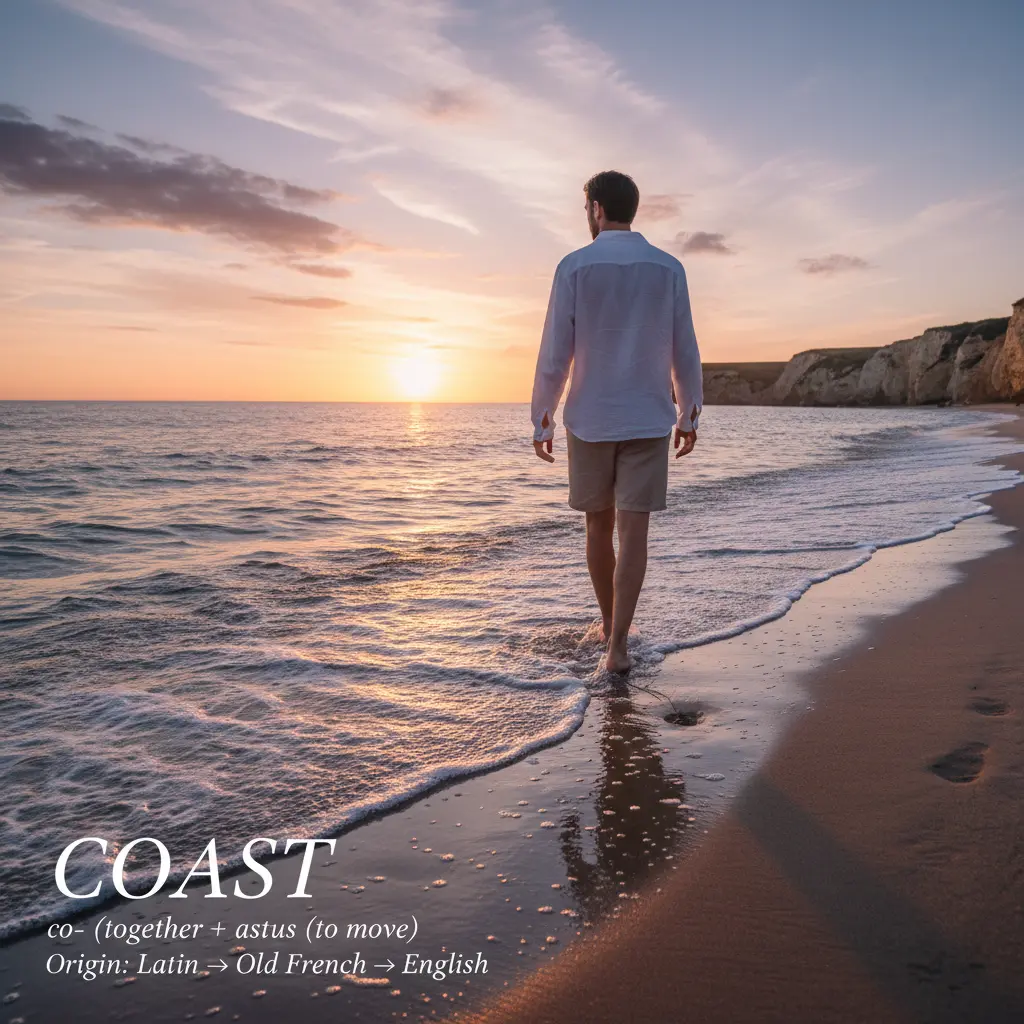
coast = co- (together) + astus (to move). Origin: Latin → Old French → English. Imagine walking along the edge of the sea, the waves gently touching your feet, as you move effortlessly along the shore.
Note 1: These definitions and etymologies are not standard dictionary definitions, but extended explanations provided to help with memorization and understanding of the actual application of words. Through this background information, we strive to make words more vivid and easier to understand, and help you remember their meanings in real life.
Note 2: LexiTalk designs the learning flow around the linguistics principle of “Comprehensible Input.” When learners encounter material that is slightly above their level but still understandable from context, the brain naturally absorbs the language. That’s why we keep every word inside authentic contexts, using examples and associations to help you understand it and use it flexibly.
Read the FAQ explanation of Comprehensible InputI push off the curb and settle into a light glide. The street hums softly while I shift a hair on the bars to keep my balance. Breath stays steady as I adjust my posture to the wind's changing pace. Soon I coast along, letting the momentum carry me with just enough effort to feel in control.
Coast is a versatile English word with two main senses. As a noun, it means the land along the sea—the shore you might walk on at sunrise. As a verb, coast describes moving or acting with little or no power or effort, such as a car that continues to roll after you take your foot off the pedal, or a cyclist who barely pedals and still progresses. In phrases like coast along or coast to a stop, the idea emphasizes ease or inertia. The word’s history traces back to Latin roots via Old French, and the image of the shore helps remember its first sense.
For English learners, coast often surfaces as two linked ideas (shore edge vs inertia). Learners may overgeneralize the idea of ease to all situations or confuse coast with coastline. Thinking about how collocations like coast along or coast to a stop pair with verbs and adverbs helps avoid misuses.
What is the meaning of 'coast'?
In which sentence is 'coast' used correctly?
Which word is a synonym of 'coast'?
In which situation would you use the word 'coast'?
Create a sentence using the word 'coast'.
Download LexiTalk app for personalized learning experience
Download AppCookies
We use cookies for essential site functions, analytics, and ads. You can accept, reject, or manage preferences. Privacy Policy