colour - Master This Word
Master this word with our 5-step learning method – Learn English in English
Train English Through Brain Routes, Not Translation.
This page helps you stop memorizing isolated translations and start understanding a word through its shared mental image, native-style thinking, and practical training steps.
Master this word with our 5-step learning method – Learn English in English
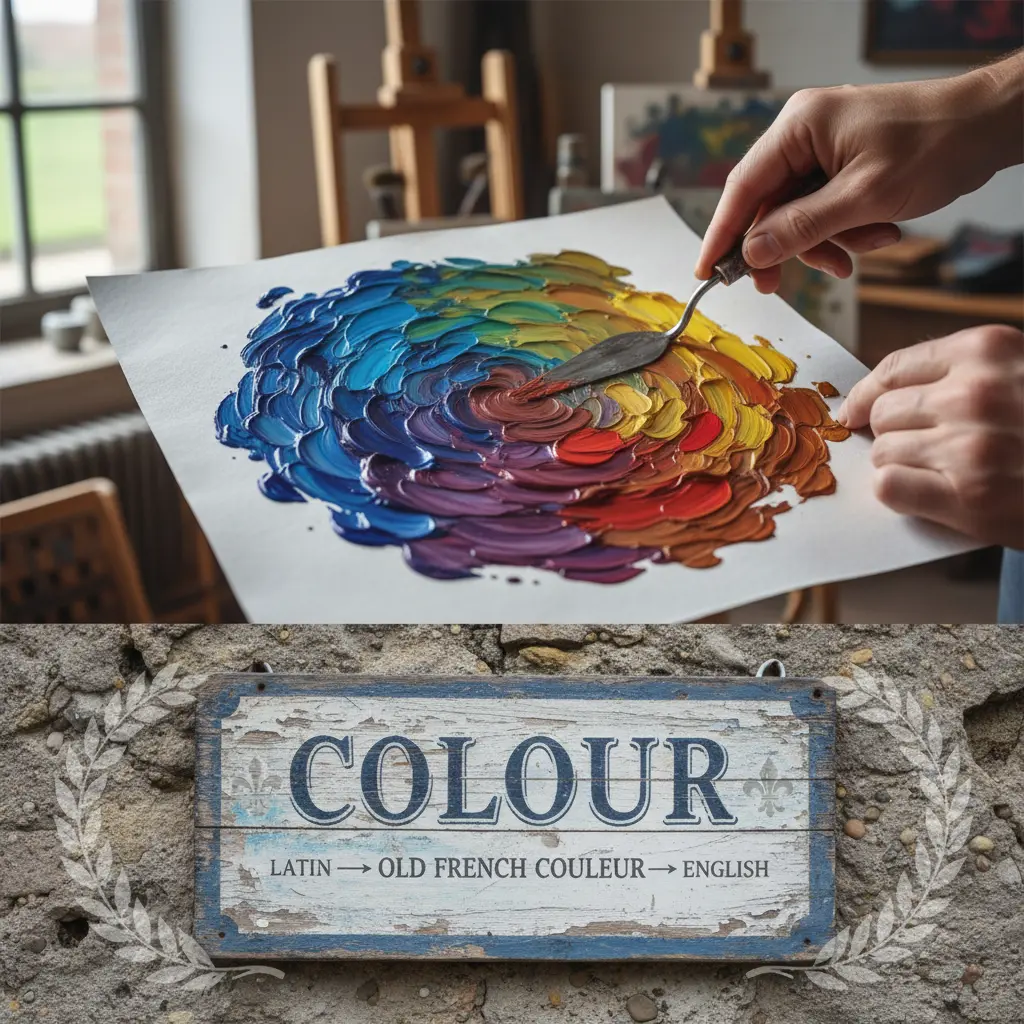
Example sentences are the start of understanding. Don't rush to memorize. First feel how the word works in a sentence.
Root decomposition: root color, with the British suffix -our marking the spelling. Historical origin: Latin color → Old French couleur → English colour. Memory image: a painter mixing pigments on white paper; the word colour appears on a British sign, recalling its French lineage.
Note 1: These definitions and etymologies are not standard dictionary definitions, but extended explanations provided to help with memorization and understanding of the actual application of words. Through this background information, we strive to make words more vivid and easier to understand, and help you remember their meanings in real life.
Note 2: LexiTalk designs the learning flow around the linguistics principle of “Comprehensible Input.” When learners encounter material that is slightly above their level but still understandable from context, the brain naturally absorbs the language. That’s why we keep every word inside authentic contexts, using examples and associations to help you understand it and use it flexibly.
Read the FAQ explanation of Comprehensible InputI stand at the wall, I move my hand along the edge of a swatch and push the light to see how it glows. As I turn a small knob, the room settles into a warmer colour and the shade seems to fall into place. I keep watching, adjust the brightness, and the wall holds a mood I can feel as colour. The moment feels like choosing a note for the room, letting the colour guide how I feel about the space.
Colour is the British spelling for color, and in English it guards three broad senses. First, colour refers to the property of objects that gives them hue or shade. Second, colour can name a particular hue, such as red or blue. Third, colour also means the act of coloring something or tinting it, and in figurative use it can describe bias or influence on a viewpoint. Learners often confuse colour with color, forgetting the noun versus the verb forms and the contexts where the British spelling appears in schools, libraries, or formal writing. Remember the underlying idea is perception, not a fixed pigment.
Explain to an English speaker: British colour emphasizes hue as a perception and style cue, with strong ties to art, fashion, and literature; learners often stumble over noun/verb forms and US spelling in academic writing.
What is the meaning of colour?
Choose the sentence that uses colour correctly in context.
Which word is most similar to colour?
What is the opposite of colour?
Can you think of a real-life context? Describe an everyday situation where colour would be part of your description.
Download LexiTalk app for personalized learning experience
Download AppCookies
We use cookies for essential site functions, analytics, and ads. You can accept, reject, or manage preferences. Privacy Policy