entertainment - Master This Word
Master this word with our 5-step learning method – Learn English in English
Train English Through Brain Routes, Not Translation.
This page helps you stop memorizing isolated translations and start understanding a word through its shared mental image, native-style thinking, and practical training steps.
Master this word with our 5-step learning method – Learn English in English
Example sentences are the start of understanding. Don't rush to memorize. First feel how the word works in a sentence.
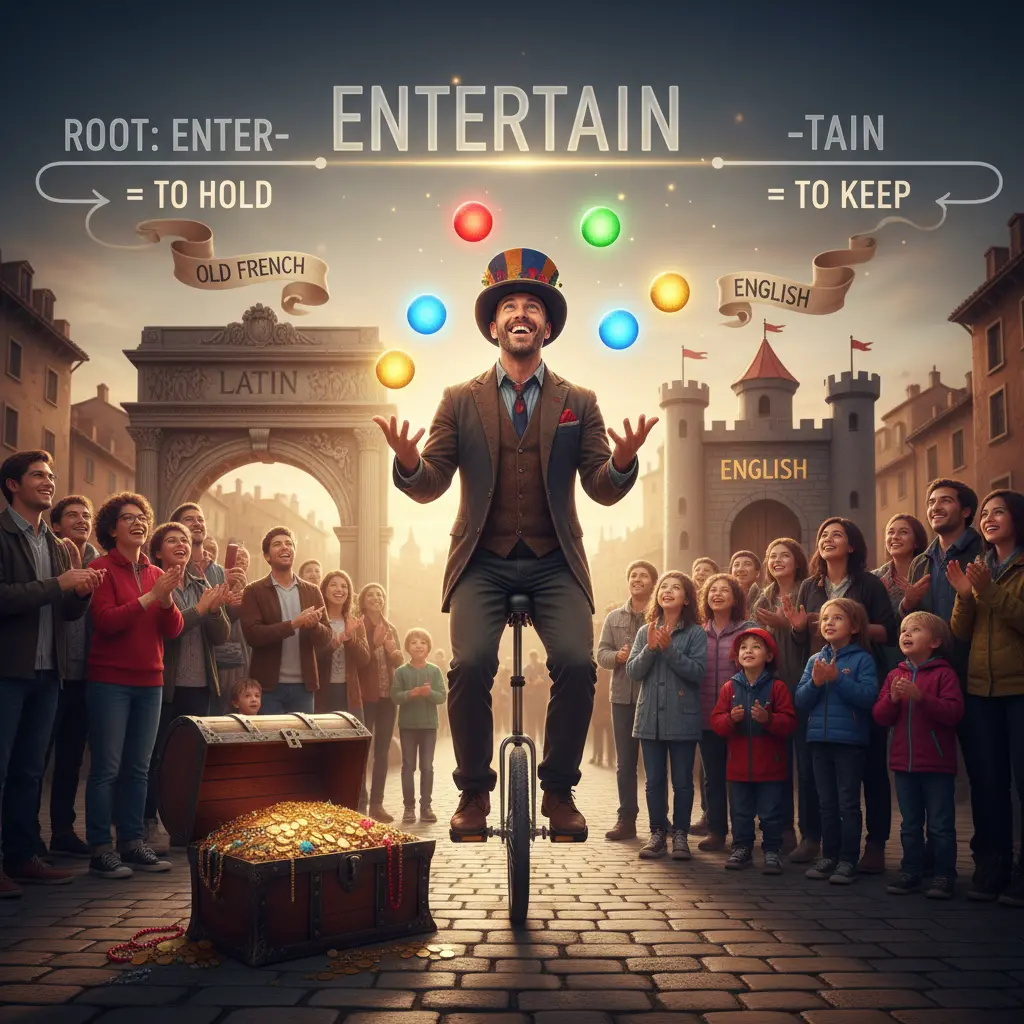
Root: enter- = to hold, tain = to keep. Historical origin: Latin → Old French → English. Memory image: Picture an entertainer keeping the audience's attention, like a juggler holding and balancing multiple balls.
Note 1: These definitions and etymologies are not standard dictionary definitions, but extended explanations provided to help with memorization and understanding of the actual application of words. Through this background information, we strive to make words more vivid and easier to understand, and help you remember their meanings in real life.
Note 2: LexiTalk designs the learning flow around the linguistics principle of “Comprehensible Input.” When learners encounter material that is slightly above their level but still understandable from context, the brain naturally absorbs the language. That’s why we keep every word inside authentic contexts, using examples and associations to help you understand it and use it flexibly.
Read the FAQ explanation of Comprehensible InputI lean back and press play, letting the screen glow warm against my face. I move the attention from task to scene, a gentle shift as music rises and falls. I adjust the volume and choose what to stay with, feeling a small sense of control over the mood. Through that choice, this becomes entertainment—a space where my day can pause, breathe, and drift.
Entertainment refers to activities and productions that provide enjoyment, escape, or amusement. It spans a wide range from movies, music, theater, and sports to games, festivals, and concerts. People seek entertainment to relax after work, socialize with friends, or share cultural experiences. The word also describes the broader industry responsible for creating such experiences, including producers, venues, media, and performers. While entertainment is often seen as light, it can carry serious artistry, nuance, or social commentary. Learners should note that entertainment is mostly uncountable when referring to the concept, but a festival or program can be counted as a form of entertainment.
Entertainment is a broad, flexible term in English that covers both enjoyable activities and the industry that produces them. Learners often mix it with amusement or fun and assume it always refers to glamorous media, ignoring local forms of entertainment like sports or festivals. The word can be countable when referring to specific events but usually uncountable when speaking about the idea.
What is the meaning of the word 'entertainment'?
Which sentence uses the word 'entertainment' correctly?
Which word is most similar to 'entertainment'?
What is the opposite of 'entertainment'?
Can you give an example of a real-life scenario involving enjoyment and relaxation?
Download LexiTalk app for personalized learning experience
Download AppCookies
We use cookies for essential site functions, analytics, and ads. You can accept, reject, or manage preferences. Privacy Policy