entirely - Master This Word
Master this word with our 5-step learning method – Learn English in English
Train English Through Brain Routes, Not Translation.
This page helps you stop memorizing isolated translations and start understanding a word through its shared mental image, native-style thinking, and practical training steps.
Master this word with our 5-step learning method – Learn English in English
Example sentences are the start of understanding. Don't rush to memorize. First feel how the word works in a sentence.
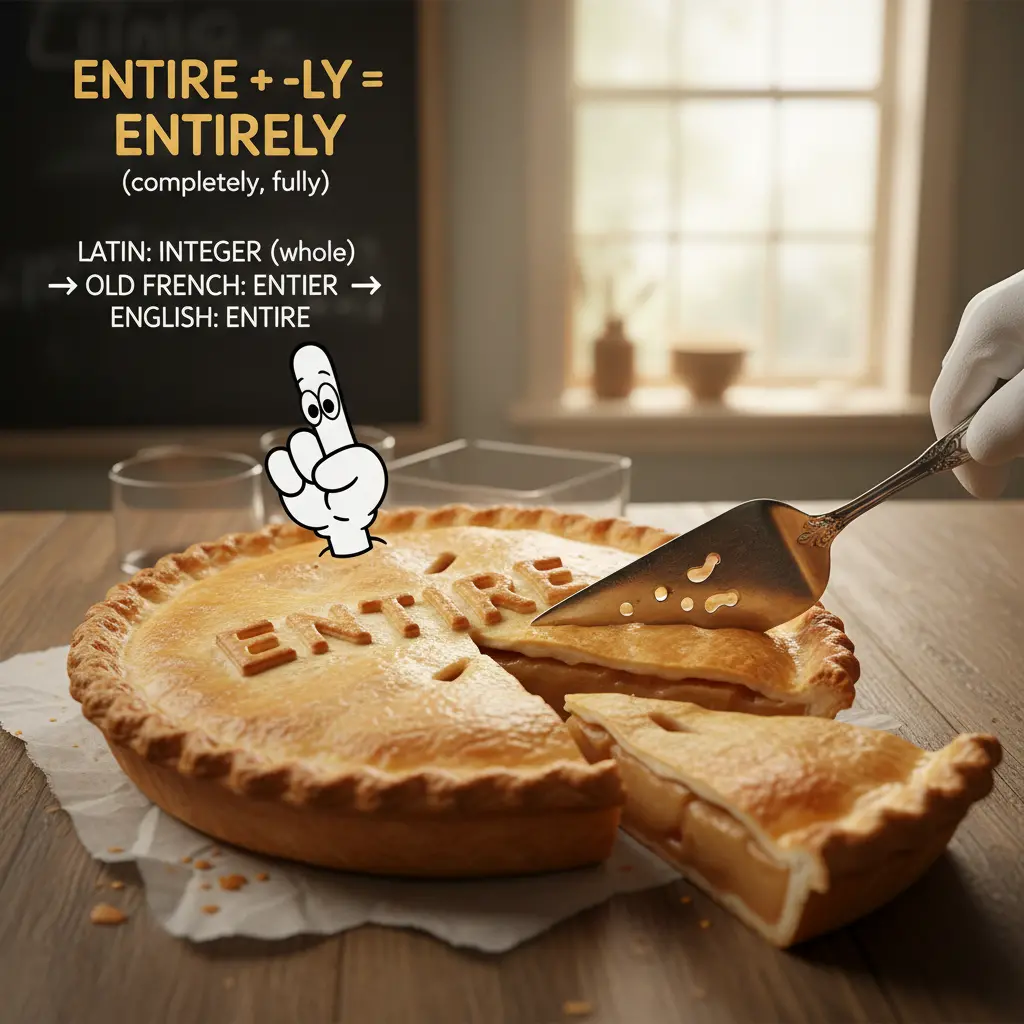
Root decomposition: entire + -ly forming the adverb entirely. Historical origin: from Latin integer meaning whole, via Old French entier into English. Memory image: picture a whole pie labeled entire being sliced and each piece counted, with nothing left.
Note 1: These definitions and etymologies are not standard dictionary definitions, but extended explanations provided to help with memorization and understanding of the actual application of words. Through this background information, we strive to make words more vivid and easier to understand, and help you remember their meanings in real life.
Note 2: LexiTalk designs the learning flow around the linguistics principle of “Comprehensible Input.” When learners encounter material that is slightly above their level but still understandable from context, the brain naturally absorbs the language. That’s why we keep every word inside authentic contexts, using examples and associations to help you understand it and use it flexibly.
Read the FAQ explanation of Comprehensible InputFirst I grip the kettle and move it toward the stove, watching the steam rise. I adjust the flame, push the knob, and set the rhythm of the boil. A small shift in heat makes the water taste suddenly entirely different to my tongue, and I realize the pot is not just wet but entirely alive with scent. I keep watching, hold steady, and let the moment expand, until the whole kitchen feels entirely under my sense of control.
Entirely is an adverb that strengthens the meaning of 'complete' or 'total' in English. It often follows adjectives or verbs for emphasis, as in entirely different or done entirely by hand, and it can also modify nouns in some fixed phrases (an entirely new approach). The etymology traces to whole or complete, via older forms, and the sense has kept a strong focus on wholeness and absence of omissions. Learners should note that entirely is stronger than 'completely' in many contexts, but both are normally interchangeable when the emphasis is total extent. In negative or contrastive statements, entirely can sound dramatic.
English tends to reserve extremely strong emphasis for entirely; learners should watch for overuse and prefer it when totality is truly intended.
Which sentence uses 'entirely' correctly?
What is a similar word to 'entirely'?
What is the opposite of 'entirely'?
Can you give an example of a real-life scenario of 'entirely'?
Download LexiTalk app for personalized learning experience
Download AppCookies
We use cookies for essential site functions, analytics, and ads. You can accept, reject, or manage preferences. Privacy Policy