equivocate - Master This Word
Master this word with our 5-step learning method – Learn English in English
Train English Through Brain Routes, Not Translation.
This page helps you stop memorizing isolated translations and start understanding a word through its shared mental image, native-style thinking, and practical training steps.
Master this word with our 5-step learning method – Learn English in English
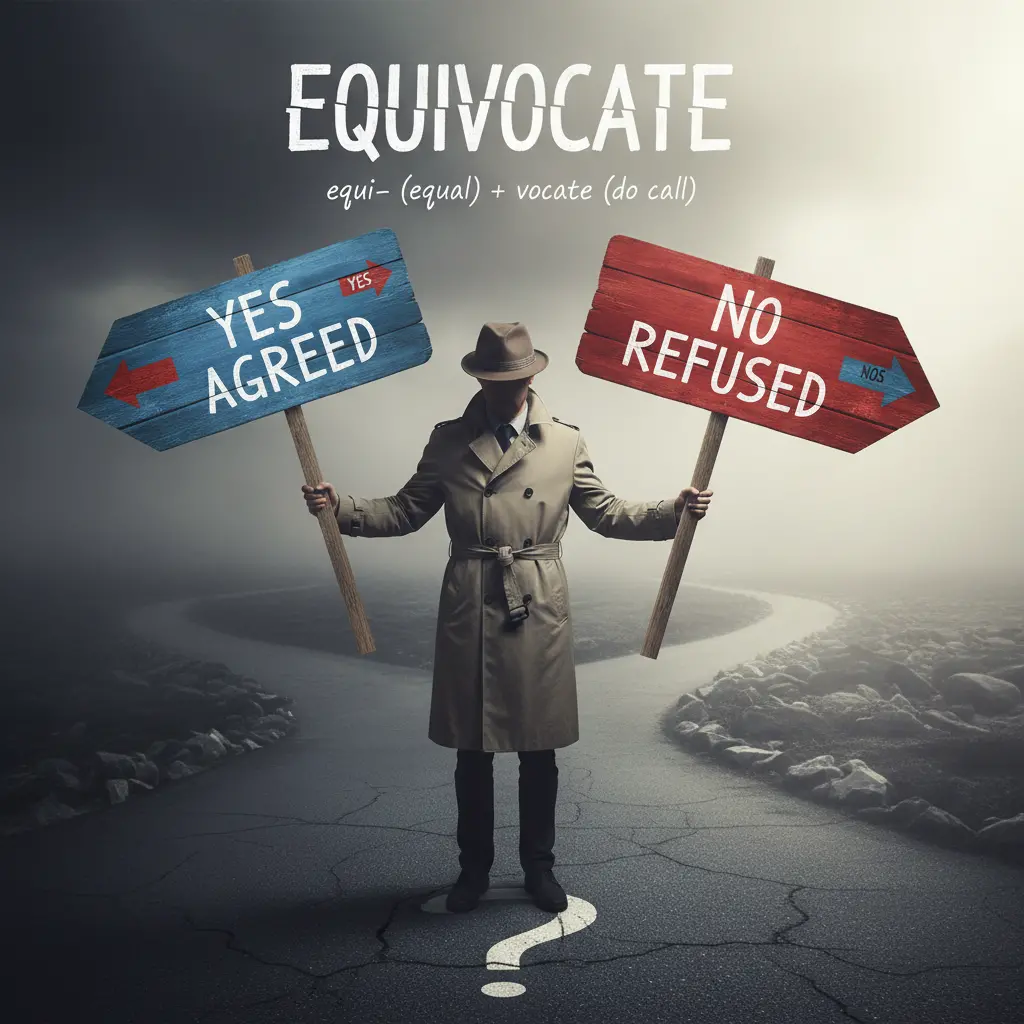
Example sentences are the start of understanding. Don't rush to memorize. First feel how the word works in a sentence.
equivocate = equi- (equal) + vocate (to call) → Late Latin (aequivocare) → Old French (équivoque) → English. Imagine someone standing with two signs, each pointing in different directions; this illustrates the confusion and ambiguity in equivocation, especially when trying to please everyone.
Note 1: These definitions and etymologies are not standard dictionary definitions, but extended explanations provided to help with memorization and understanding of the actual application of words. Through this background information, we strive to make words more vivid and easier to understand, and help you remember their meanings in real life.
Note 2: LexiTalk designs the learning flow around the linguistics principle of “Comprehensible Input.” When learners encounter material that is slightly above their level but still understandable from context, the brain naturally absorbs the language. That’s why we keep every word inside authentic contexts, using examples and associations to help you understand it and use it flexibly.
Read the FAQ explanation of Comprehensible InputEquivocate means to avoid giving a direct answer by using vague language, ambiguity, or shifting between different interpretations. People do it to avoid committing to a position, to please conflicting audiences, or to keep options open. In conversations, an equivocal response might sound careful, but it can also frustrate listeners who seek clarity. Recognizing when someone is equivocating helps you ask targeted questions and push for specifics without sounding confrontational. The word traces to Latin roots equi- vocare, through Late Latin aequivocare and Old French équivoque, and in modern English it often carries a critical nuance, implying dodging responsibility rather than prudent diplomacy. In professional settings, frequent equivocation erodes trust, so learners should practice turning hedged statements into clear, concrete commitments when appropriate.
Equivocation in English is often seen as evasive or indecisive; learners should distinguish it from diplomacy and be aware that frequent hedging reduces clarity.
What is the meaning of 'equivocate'?
In which sentence is 'equivocate' used correctly?
Which word is a synonym of 'equivocate'?
Which word is an antonym of 'equivocate'?
When can someone use 'equivocate' in real life?
Download LexiTalk app for personalized learning experience
Download AppCookies
We use cookies for essential site functions, analytics, and ads. You can accept, reject, or manage preferences. Privacy Policy