
eternal - Master This Word
Master this word with our 5-step learning method – Learn English in English
Train English Through Brain Routes, Not Translation.
This page helps you stop memorizing isolated translations and start understanding a word through its shared mental image, native-style thinking, and practical training steps.
Master this word with our 5-step learning method – Learn English in English
Example sentences are the start of understanding. Don't rush to memorize. First feel how the word works in a sentence.
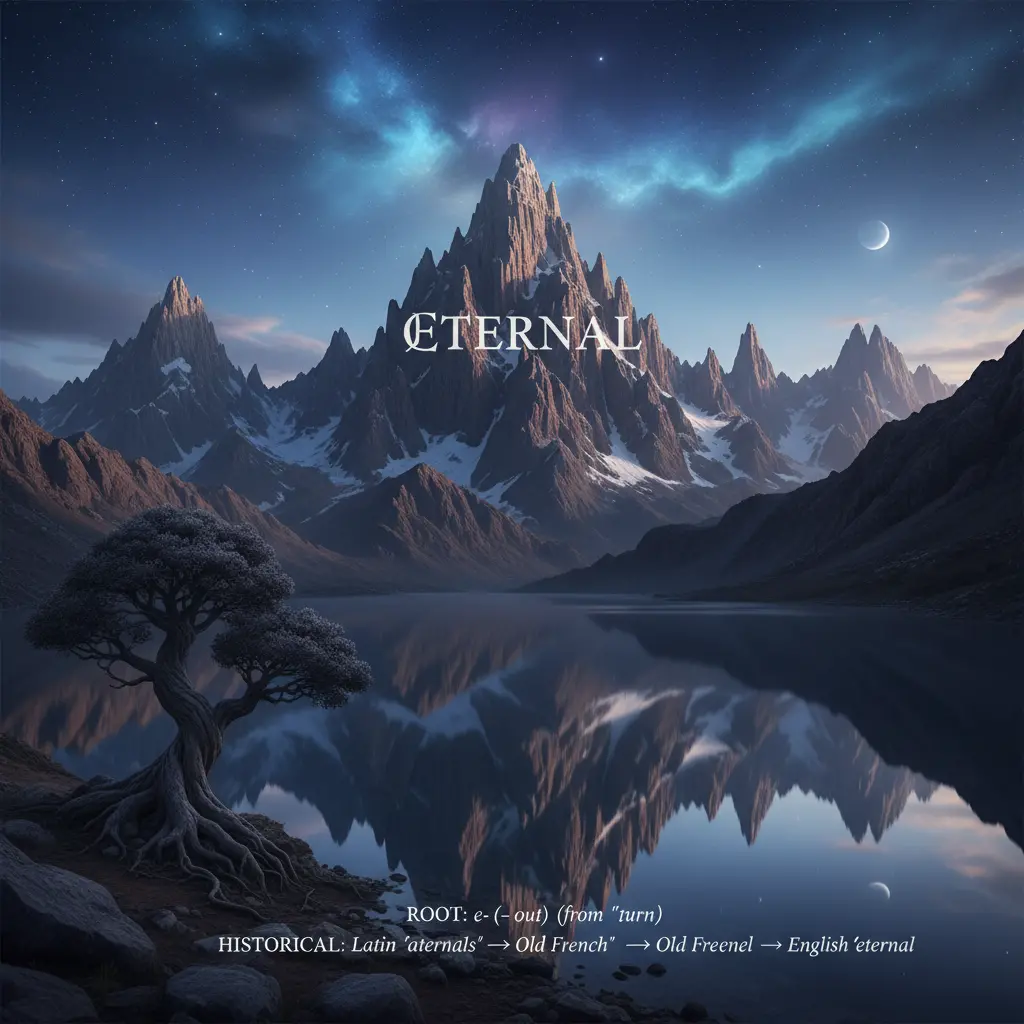
Root: e- (out) + ternal (from 'turn') → Historical: Latin 'aeternalis' → Old French 'eternel' → English 'eternal'. Memory image: Imagine a majestic mountain that stands unchanged through the ages, symbolizing eternal stability.
Note 1: These definitions and etymologies are not standard dictionary definitions, but extended explanations provided to help with memorization and understanding of the actual application of words. Through this background information, we strive to make words more vivid and easier to understand, and help you remember their meanings in real life.
Note 2: LexiTalk designs the learning flow around the linguistics principle of “Comprehensible Input.” When learners encounter material that is slightly above their level but still understandable from context, the brain naturally absorbs the language. That’s why we keep every word inside authentic contexts, using examples and associations to help you understand it and use it flexibly.
Read the FAQ explanation of Comprehensible InputMove a finger along the rim of a warm cup and watch steam rise. I adjust the tilt of the cup to keep the steam curling in a steady line. The room slows; the moment feels eternal as it holds itself in the air. In ordinary life, you learn to keep small routines, and they stretch on without end.
eternal describes something lasting forever or without end, and it can also convey timelessness beyond the normal flow of time. It appears in religious, philosophical, and literary contexts to evoke grand permanence. Its roots go from Latin aeternalis to Old French eternel, then into English eternal, reflecting a long historical journey. A memory image is a majestic mountain that remains unchanged through the ages. In everyday speech you may hear phrases like eternal love or eternal flame, usually in a poetic or emphatic sense; for ordinary, finite things, use permanent or lasting. The distinction from timeless is that eternal emphasizes duration, while timeless highlights classic quality that transcends fashion.
English speakers often connect eternal with grand, formal, or religious contexts. Learners may overgeneralize to all long-lasting things or misread it as meaning absolutely infinite in everyday use.
Which of the following sentences uses 'eternal' correctly?
Choose the synonym of 'eternal'.
What is the opposite of 'eternal'?
In what real-life context might you use the word 'eternal'?
Download LexiTalk app for personalized learning experience
Download AppCookies
We use cookies for essential site functions, analytics, and ads. You can accept, reject, or manage preferences. Privacy Policy