gestures - Master This Word
Master this word with our 5-step learning method – Learn English in English
Train English Through Brain Routes, Not Translation.
This page helps you stop memorizing isolated translations and start understanding a word through its shared mental image, native-style thinking, and practical training steps.
Master this word with our 5-step learning method – Learn English in English
Example sentences are the start of understanding. Don't rush to memorize. First feel how the word works in a sentence.
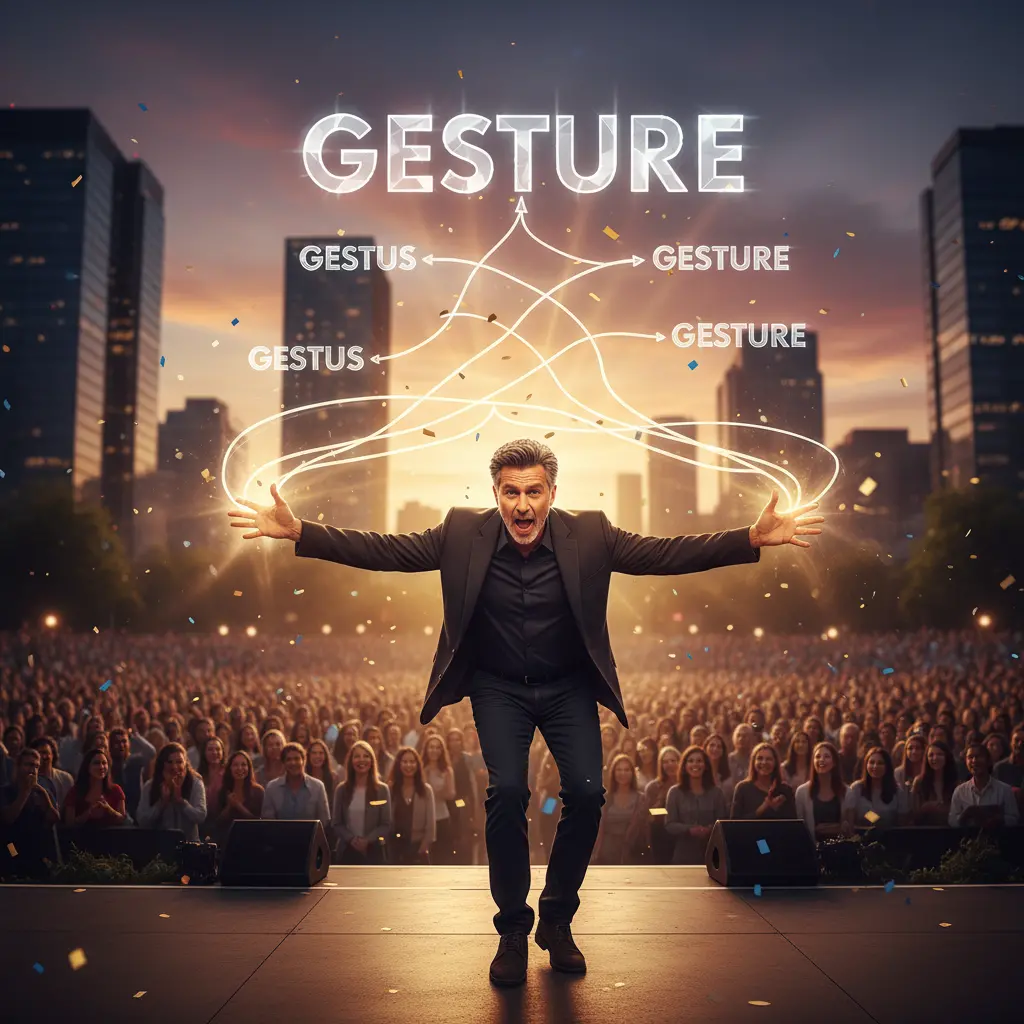
gesture = gest- (to carry) + -ure (action) / Latin 'gestus' → Old French 'gesture' → English. Imagine someone making a grand movement with their arms to communicate an idea clearly.
Note 1: These definitions and etymologies are not standard dictionary definitions, but extended explanations provided to help with memorization and understanding of the actual application of words. Through this background information, we strive to make words more vivid and easier to understand, and help you remember their meanings in real life.
Note 2: LexiTalk designs the learning flow around the linguistics principle of “Comprehensible Input.” When learners encounter material that is slightly above their level but still understandable from context, the brain naturally absorbs the language. That’s why we keep every word inside authentic contexts, using examples and associations to help you understand it and use it flexibly.
Read the FAQ explanation of Comprehensible InputFirst I lift my hand, a quiet move that starts in the shoulder and travels to the fingers. I hold it there, then shift and turn a bit to catch the room’s eye, watching the lines of my hand settle into a message. It feels like choosing a dial on your own body—tension loosening as I adjust, control returning as I let the moment guide the pace. That small sequence becomes how I speak without words, a gesture that others read as invitation, apology, or thanks.
Gestures are movements of the body, especially the hands and arms, used to express thoughts or feelings when words aren’t enough. In everyday speech, people use gestures to emphasize points, signal agreement, or greet others, such as a wave or a thumbs-up. In formal settings, gestures can complement spoken language but should be natural and culturally appropriate; overusing them or using the wrong gesture can distract or confuse. The verb gesture means to make such movements intentionally to convey a message, and the noun can refer to a single movement or a symbolic action, like a peace sign as a gesture of goodwill.
Gestures are culturally specific; English learners should focus on world‑facing gestures (wave, nod, smile) but also learn regionally common signs. Misunderstandings often arise when a gesture translates to a different meaning in English-speaking contexts.
What is the meaning of 'gestures'?
Which sentence correctly uses the word 'gestures'?
Which word is most similar to 'gestures'?
What is the opposite of 'gestures'?
Can you think of a real-life context where gestures are important?
English Learning Listening Content
Listen NowDownload LexiTalk app for personalized learning experience
Download AppCookies
We use cookies for essential site functions, analytics, and ads. You can accept, reject, or manage preferences. Privacy Policy