
herbivore - Master This Word
Master this word with our 5-step learning method – Learn English in English
Train English Through Brain Routes, Not Translation.
This page helps you stop memorizing isolated translations and start understanding a word through its shared mental image, native-style thinking, and practical training steps.
Master this word with our 5-step learning method – Learn English in English
Example sentences are the start of understanding. Don't rush to memorize. First feel how the word works in a sentence.
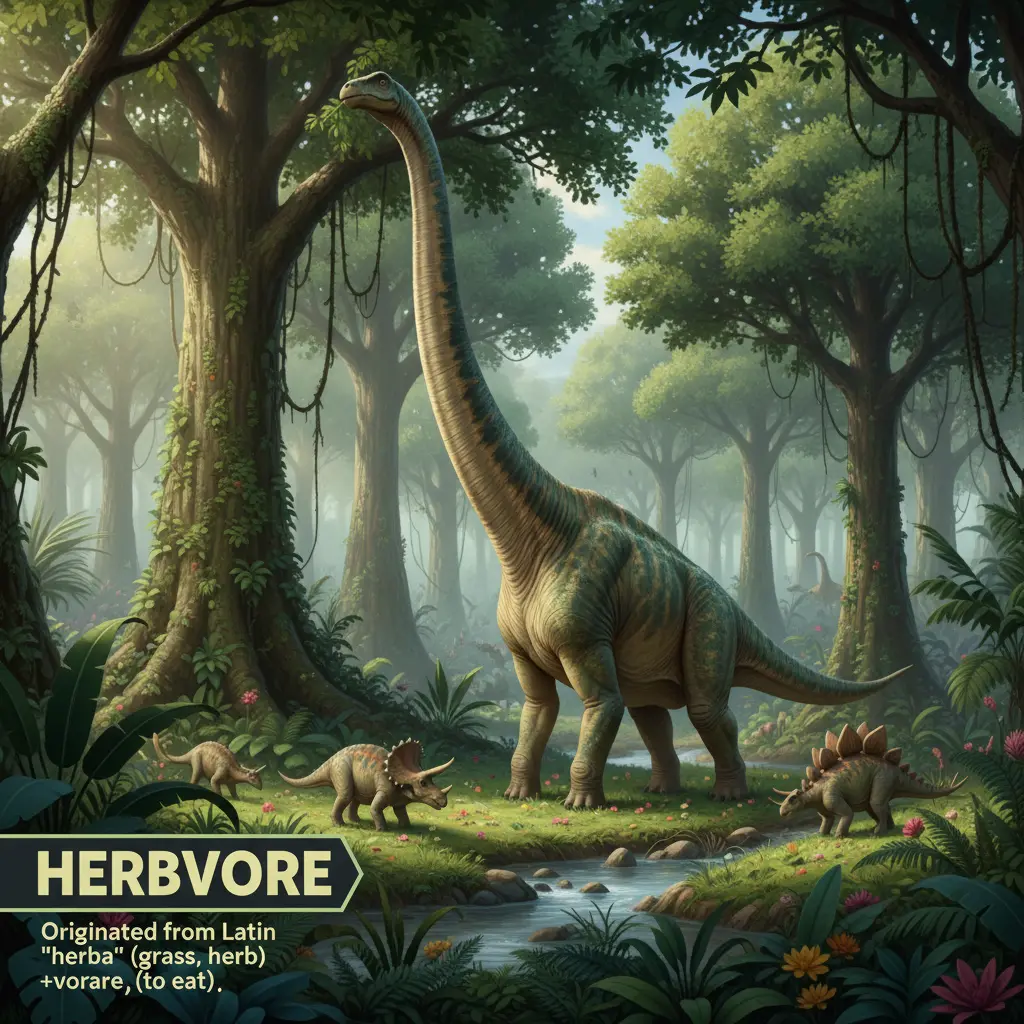
(herb- + -ivore); Originated from Latin 'herba' meaning 'grass, herb' and '-vore' from Latin 'vorare' meaning 'to eat.' Imagine a large, gentle dinosaur peacefully munching on leaves in a lush, green forest, representing how herbivores sustain themselves on plant life.
Note 1: These definitions and etymologies are not standard dictionary definitions, but extended explanations provided to help with memorization and understanding of the actual application of words. Through this background information, we strive to make words more vivid and easier to understand, and help you remember their meanings in real life.
Note 2: LexiTalk designs the learning flow around the linguistics principle of “Comprehensible Input.” When learners encounter material that is slightly above their level but still understandable from context, the brain naturally absorbs the language. That’s why we keep every word inside authentic contexts, using examples and associations to help you understand it and use it flexibly.
Read the FAQ explanation of Comprehensible InputHerbivores are animals that primarily eat plants. They include cows, deer, rabbits, and horses, among many others. In ecology, herbivores occupy the second trophic level, serving as a crucial link between producers such as grasses and leafy vegetation, and higher level consumers like carnivores. Some herbivores browse shrubs, while others graze vast grasslands, and some eat fruits or seeds. Their digestive systems are adapted to break down tough plant material, often using specialized stomachs or gut microbes for fermentation. Humans may choose plant-based diets, but in nature a true herbivore relies on plants for energy and nutrients. Picture a gentle dinosaur calmly munching leaves in a lush forest to visualize this plant-eating lifestyle.
English learners often anchor the term to a peaceful image of plant-eaters, and may default to nature documentaries for context. The challenge is distinguishing ecological roles from diet choices humans make; keep herbivore as a biological category, not a personal diet label.
What does the word 'herbivore' mean?
Choose the correct usage of the word 'herbivore' in a sentence.
Which word is most similar to 'herbivore'?
What is the opposite of the word 'herbivore'?
Can you think of a real-life context where a 'herbivore' might be relevant?
Download LexiTalk app for personalized learning experience
Download AppCookies
We use cookies for essential site functions, analytics, and ads. You can accept, reject, or manage preferences. Privacy Policy