
huffy - Master This Word
Master this word with our 5-step learning method – Learn English in English
Train English Through Brain Routes, Not Translation.
This page helps you stop memorizing isolated translations and start understanding a word through its shared mental image, native-style thinking, and practical training steps.
Master this word with our 5-step learning method – Learn English in English
Example sentences are the start of understanding. Don't rush to memorize. First feel how the word works in a sentence.
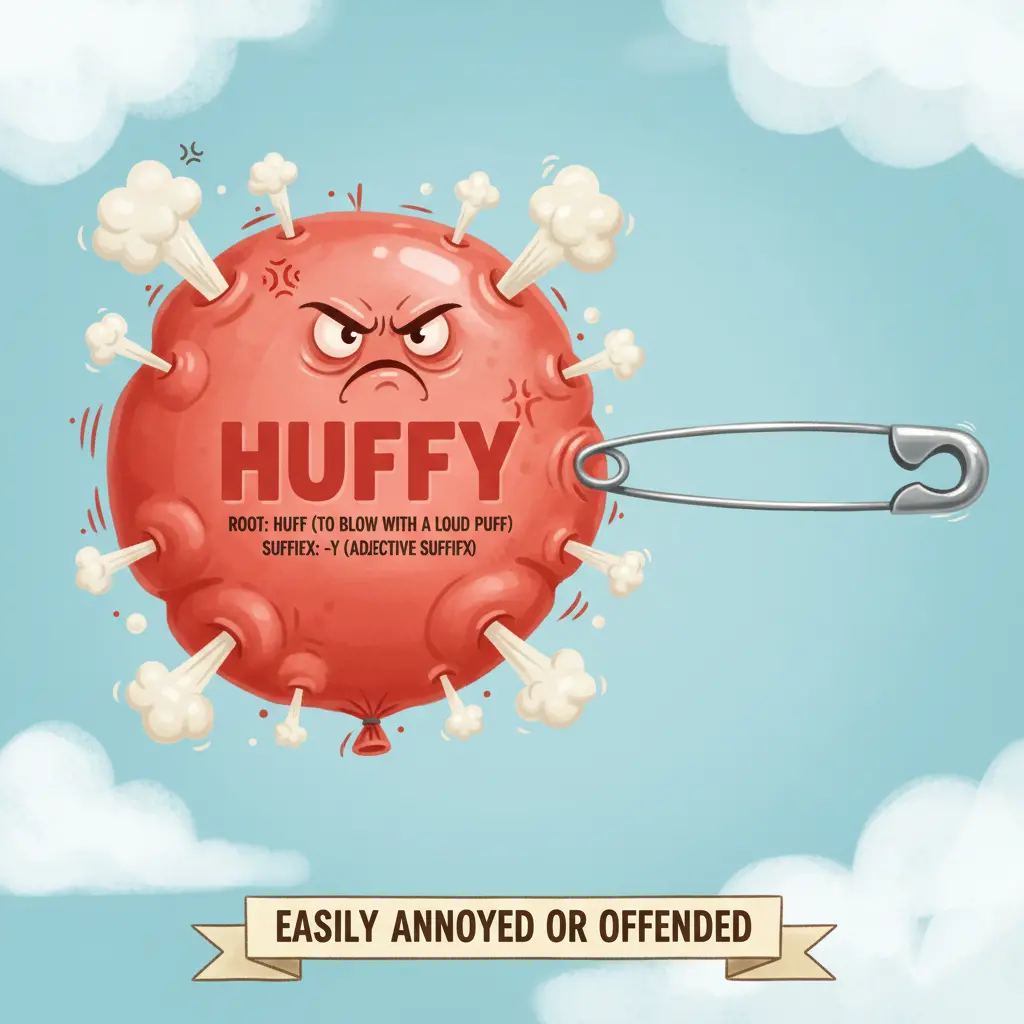
Root decomposition: huff (to blow with a loud puff) + -y (adjective suffix). Historical origin: Middle English huffe (to puff) → Early Modern English huffy. Memory image: Imagine a balloon that keeps puffing up when it's angry, easily bursting when pricked.
Note 1: These definitions and etymologies are not standard dictionary definitions, but extended explanations provided to help with memorization and understanding of the actual application of words. Through this background information, we strive to make words more vivid and easier to understand, and help you remember their meanings in real life.
Note 2: LexiTalk designs the learning flow around the linguistics principle of “Comprehensible Input.” When learners encounter material that is slightly above their level but still understandable from context, the brain naturally absorbs the language. That’s why we keep every word inside authentic contexts, using examples and associations to help you understand it and use it flexibly.
Read the FAQ explanation of Comprehensible InputHuffy describes a person who is easily offended or annoyed, often sulking or pouting when something unsettles them. In everyday English, it signals a light, temporary mood rather than loud anger. Someone who is huffy may demand an apology or time to calm down, but the offense is usually minor. The phrase emphasizes attitude and ego more than a real insult, and it sounds informal or playful in some contexts. It is not appropriate for formal writing or serious disputes. Understanding the nuance helps you hear when a speaker hints at hurt pride or a petty grievance rather than a straightforward anger.
For English learners, huffy sits between sulky and irritable. It signals a short lived, self focused mood rather than a plan to argue. Learners often confuse it with being just angry or with being grumpy all the time. Remember that this term is informal and tied to a specific incident that wounds pride, not to a major offense.
What does the word 'huffy' mean?
Which of the following sentences uses 'huffy' correctly?
Which word is most similar to 'huffy'?
What is the opposite of 'huffy'?
Can you think of a real-life context where someone might feel huffy?
Download LexiTalk app for personalized learning experience
Download AppCookies
We use cookies for essential site functions, analytics, and ads. You can accept, reject, or manage preferences. Privacy Policy