impossible - Master This Word
Master this word with our 5-step learning method – Learn English in English
Train English Through Brain Routes, Not Translation.
This page helps you stop memorizing isolated translations and start understanding a word through its shared mental image, native-style thinking, and practical training steps.
Master this word with our 5-step learning method – Learn English in English
Example sentences are the start of understanding. Don't rush to memorize. First feel how the word works in a sentence.
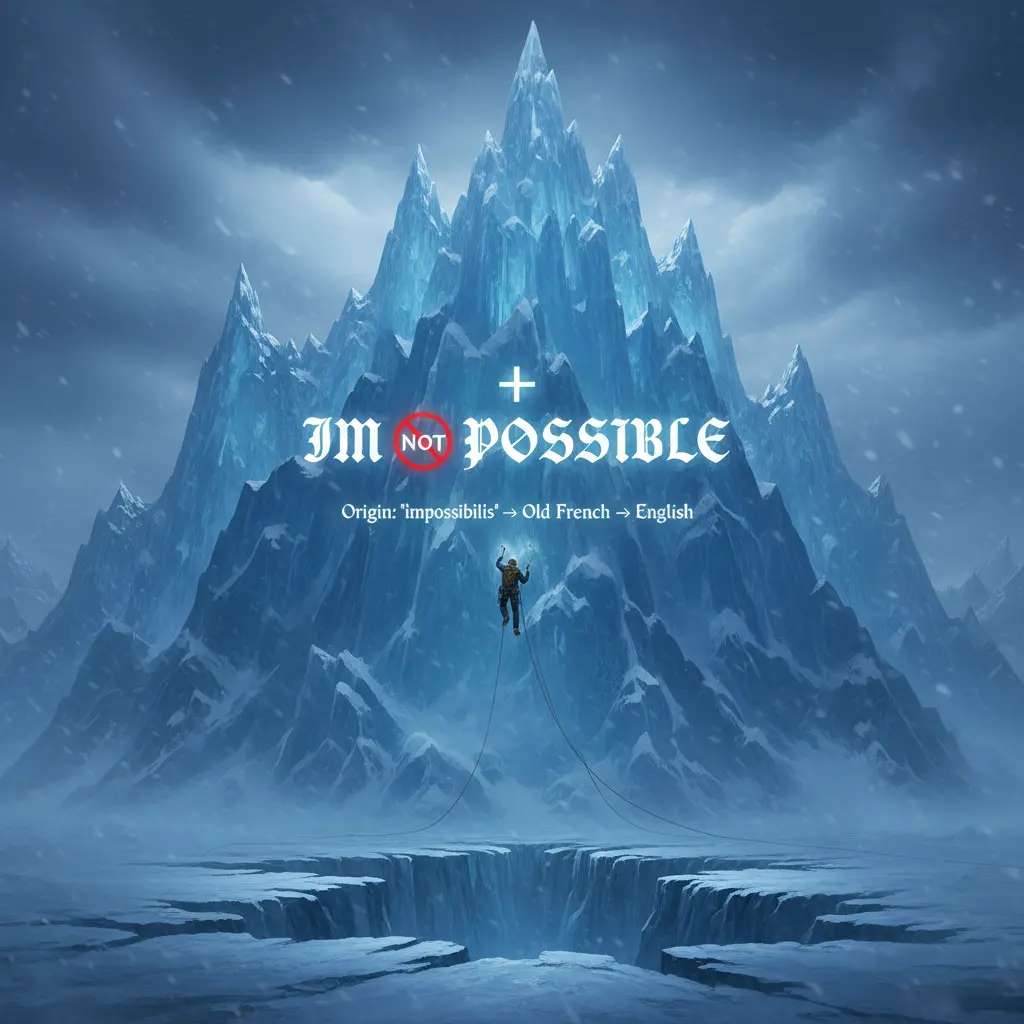
im- (not) + possible (able to be done). Origin: Latin 'impossibilis' → Old French → English. Memory image: Imagine trying to climb a mountain made of pure ice; it's absolutely impossible.
Note 1: These definitions and etymologies are not standard dictionary definitions, but extended explanations provided to help with memorization and understanding of the actual application of words. Through this background information, we strive to make words more vivid and easier to understand, and help you remember their meanings in real life.
Note 2: LexiTalk designs the learning flow around the linguistics principle of “Comprehensible Input.” When learners encounter material that is slightly above their level but still understandable from context, the brain naturally absorbs the language. That’s why we keep every word inside authentic contexts, using examples and associations to help you understand it and use it flexibly.
Read the FAQ explanation of Comprehensible InputHands on the door handle, I turn it, then push, then pull, watching the metal resist and the pane creak. I adjust my stance, lean in, and keep at it, feeling the effort in my arms and chest. The door staying stubborn makes the moment feel impossible, like a wall I cannot move, even with all my moves. Eventually I set aside the push-and-pull and choose another path, letting the choice show when something truly cannot be done.
Impossible is an adjective describing something that cannot happen or be done, or that is extremely difficult to achieve. It can express a simple negative reality, as in a plan that cannot succeed, or a speaker’s strong doubt or disappointment about a future outcome. The word signals more than mere doubt: it implies that the obstacle is insurmountable or beyond reasonable expectation. Etymology: im- (not) + possible (able to be done). It comes from Latin impossibilis, through Old French into English. A vivid memory image is trying to climb a mountain made of pure ice; slipping and sliding makes it feel completely impossible.
For English speakers, 'impossible' often conveys strong emotion or emphasis beyond a simple negative fact. Learners may overgeneralize it to any unlikely event or confuse it with 'not possible' in casual speech.
What is the meaning of the word 'impossible'?
Which sentence below uses the word 'impossible' correctly?
Which word is most similar to 'impossible'?
What is the opposite of 'impossible'?
Can you think of a real-life scenario of 'impossible'?
Download LexiTalk app for personalized learning experience
Download AppCookies
We use cookies for essential site functions, analytics, and ads. You can accept, reject, or manage preferences. Privacy Policy