judgement - Master This Word
Master this word with our 5-step learning method – Learn English in English
Train English Through Brain Routes, Not Translation.
This page helps you stop memorizing isolated translations and start understanding a word through its shared mental image, native-style thinking, and practical training steps.
Master this word with our 5-step learning method – Learn English in English
Example sentences are the start of understanding. Don't rush to memorize. First feel how the word works in a sentence.
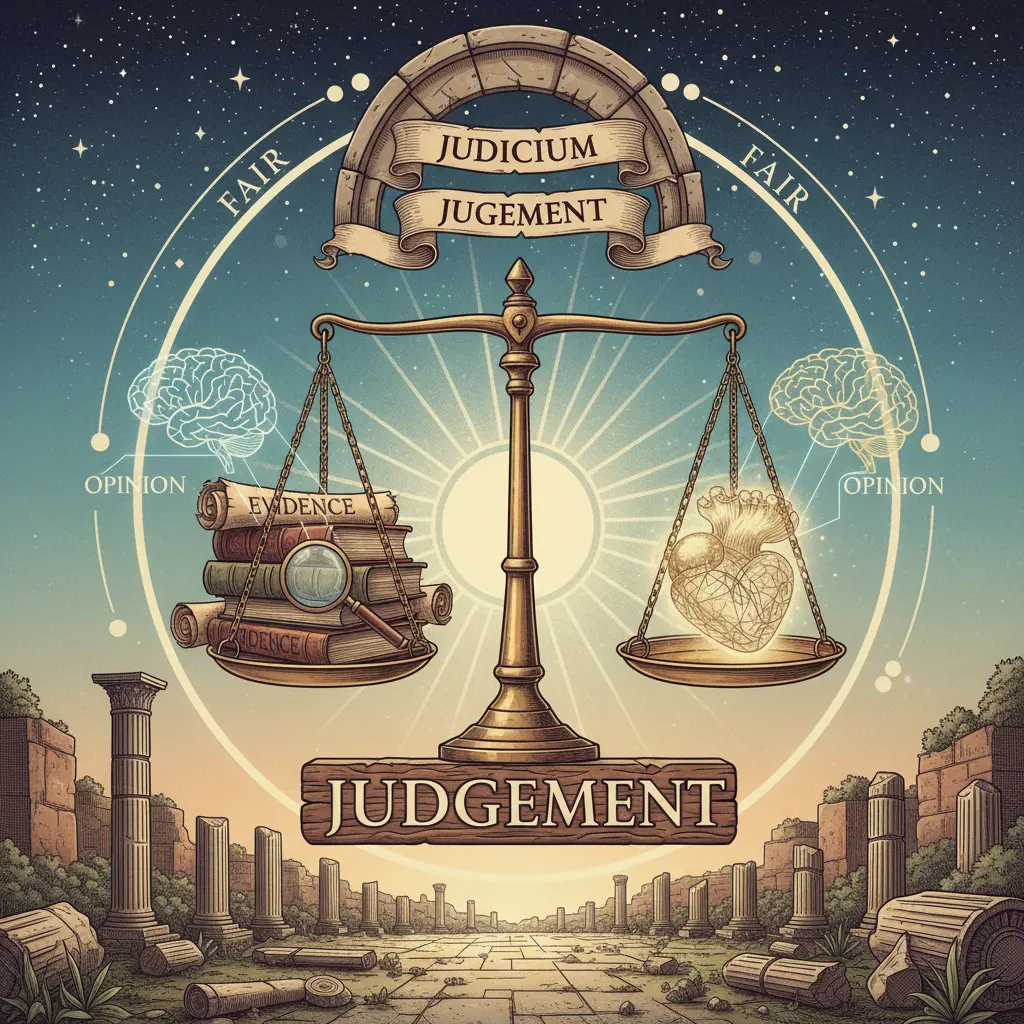
Root: 'judge' (to form an opinion) + suffix '-ment' (the process of). Historical Origin: From Latin 'judicium' → Old French 'jugement' → English 'judgement'. Memory Image: Imagine a scale of justice, balancing evidence and opinion, culminating in a fair judgement.
Note 1: These definitions and etymologies are not standard dictionary definitions, but extended explanations provided to help with memorization and understanding of the actual application of words. Through this background information, we strive to make words more vivid and easier to understand, and help you remember their meanings in real life.
Note 2: LexiTalk designs the learning flow around the linguistics principle of “Comprehensible Input.” When learners encounter material that is slightly above their level but still understandable from context, the brain naturally absorbs the language. That’s why we keep every word inside authentic contexts, using examples and associations to help you understand it and use it flexibly.
Read the FAQ explanation of Comprehensible InputI start with a soft breath, place my palm on the table and move my eyes from one option to another. I push against a nagging doubt, adjust my posture, and my internal compass shifts as I hold back a snap conclusion. The scene in my mind settles into a quiet judgement, like a hand turning a dial to a gentler setting. I keep looking, then set my mind on what feels right, ready to act.
Judgement is a noun that refers to forming an opinion or decision after considering evidence. It covers the act of deciding, the outcome or conclusion itself, and the general ability to make sensible, careful choices. In British English, the common spelling is judgement; American readers often use judgment. Learners should note that judgement emphasizes the process of evaluating evidence rather than a specific verdict, though both senses can apply. The word often collocates with words like sound, good or bad to describe the quality of the decision, as in a sound judgement. When writing, choose the spelling that matches your variant of English.
British spelling judgement with -ment mirrors older conventions; learners often mix with judgment, especially when American material is encountered. Conceptually, English encodes judgement as both the mental process and the resulting verdict, which can be tricky for learners who want a single word for every sense.
What is the definition of the word 'judgement'?
Which sentence uses the word 'judgement' correctly?
Which word is most similar to 'judgement'?
What is the opposite of 'judgement'?
Can you think of a real-life scenario where a decision must be made carefully?
Download LexiTalk app for personalized learning experience
Download AppCookies
We use cookies for essential site functions, analytics, and ads. You can accept, reject, or manage preferences. Privacy Policy