
limitation - Master This Word
Master this word with our 5-step learning method – Learn English in English
Train English Through Brain Routes, Not Translation.
This page helps you stop memorizing isolated translations and start understanding a word through its shared mental image, native-style thinking, and practical training steps.
Master this word with our 5-step learning method – Learn English in English
Example sentences are the start of understanding. Don't rush to memorize. First feel how the word works in a sentence.
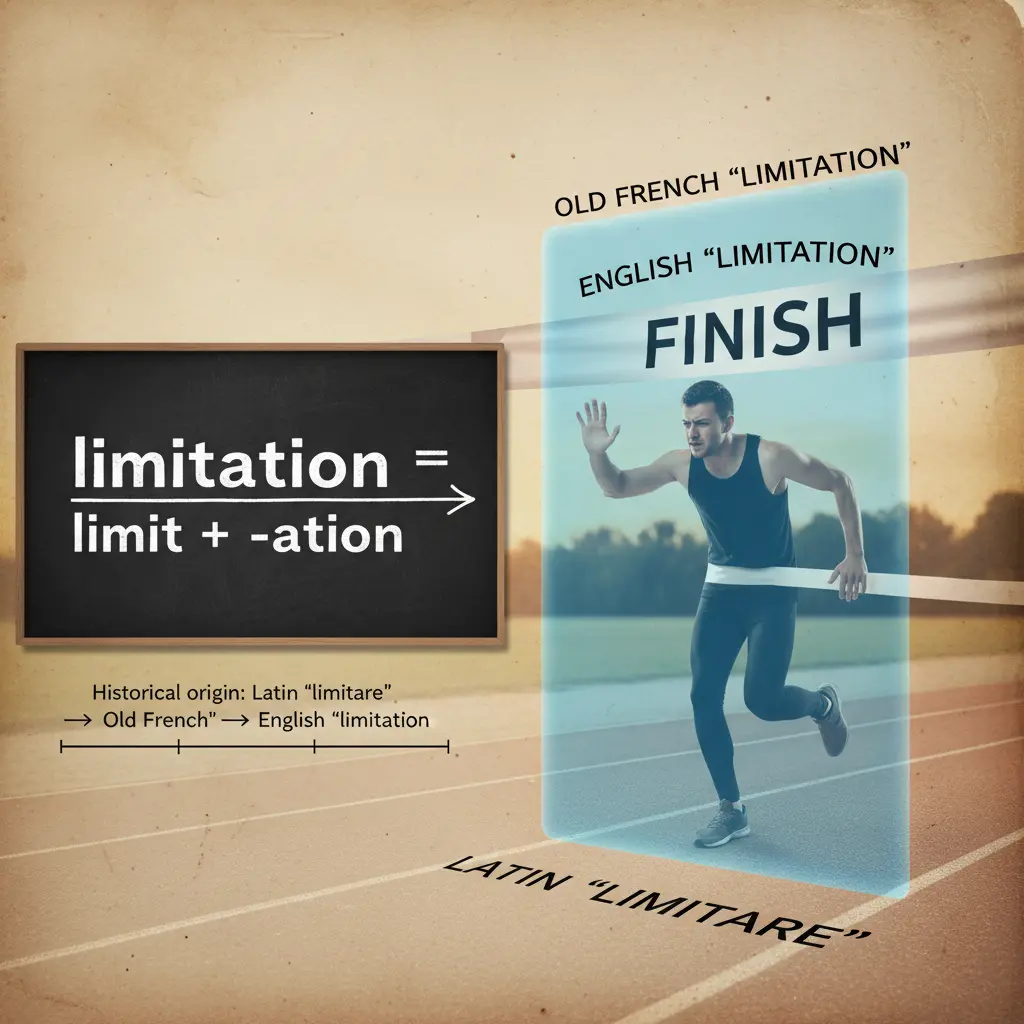
limitation = limit + -ation; Historical origin: Latin 'limitare' → Old French 'limiter' → English 'limitation'. Memory image: Imagine a person trying to reach a finish line but being held back by a barrier, symbolizing constraints.
Note 1: These definitions and etymologies are not standard dictionary definitions, but extended explanations provided to help with memorization and understanding of the actual application of words. Through this background information, we strive to make words more vivid and easier to understand, and help you remember their meanings in real life.
Note 2: LexiTalk designs the learning flow around the linguistics principle of “Comprehensible Input.” When learners encounter material that is slightly above their level but still understandable from context, the brain naturally absorbs the language. That’s why we keep every word inside authentic contexts, using examples and associations to help you understand it and use it flexibly.
Read the FAQ explanation of Comprehensible InputYour hand moves to turn down the music, the dial clicking as you set a new limit. As the volume falls, the room quiets and you feel space to think widening. It’s a quiet push and pull inside you: you hold back a little, adjust your pace, and stay on track. That moment of limitation travels with you into work and study, guiding what you choose to do and what you skip.
Limitation refers to a boundary or constraint that restricts what is possible. It can describe a formal rule, a physical cap, or a practical boundary that shapes decisions. In everyday language we talk about time, budget, scope, capacity, or permissions as limitations. The word often appears when discussing problems, risks, or planning where certain options are blocked by outside rules or finite resources. In law, policy, or project work, recognizing limitations is essential to set realistic goals and communicate clearly about what can and cannot be done. Learners should note subtle distinctions between limitation, restriction, constraint, and bound, and choose the most precise one for the context.
In English, limitation is a formal noun used in planning and analysis to mark external or internal bounds. Learners tend to over- or under-specify the source of the limit and may confuse it with 'restriction' or 'constraint' depending on context.
What does the word 'limitation' mean?
In which of the following sentences is 'limitation' used correctly?
Which word is similar to 'limitation'?
Which word is the opposite of 'limitation'?
How would you describe a real-life context where 'limitation' plays a significant role?
Download LexiTalk app for personalized learning experience
Download AppCookies
We use cookies for essential site functions, analytics, and ads. You can accept, reject, or manage preferences. Privacy Policy