scenes - Master This Word
Master this word with our 5-step learning method – Learn English in English
Train English Through Brain Routes, Not Translation.
This page helps you stop memorizing isolated translations and start understanding a word through its shared mental image, native-style thinking, and practical training steps.
Master this word with our 5-step learning method – Learn English in English
Example sentences are the start of understanding. Don't rush to memorize. First feel how the word works in a sentence.
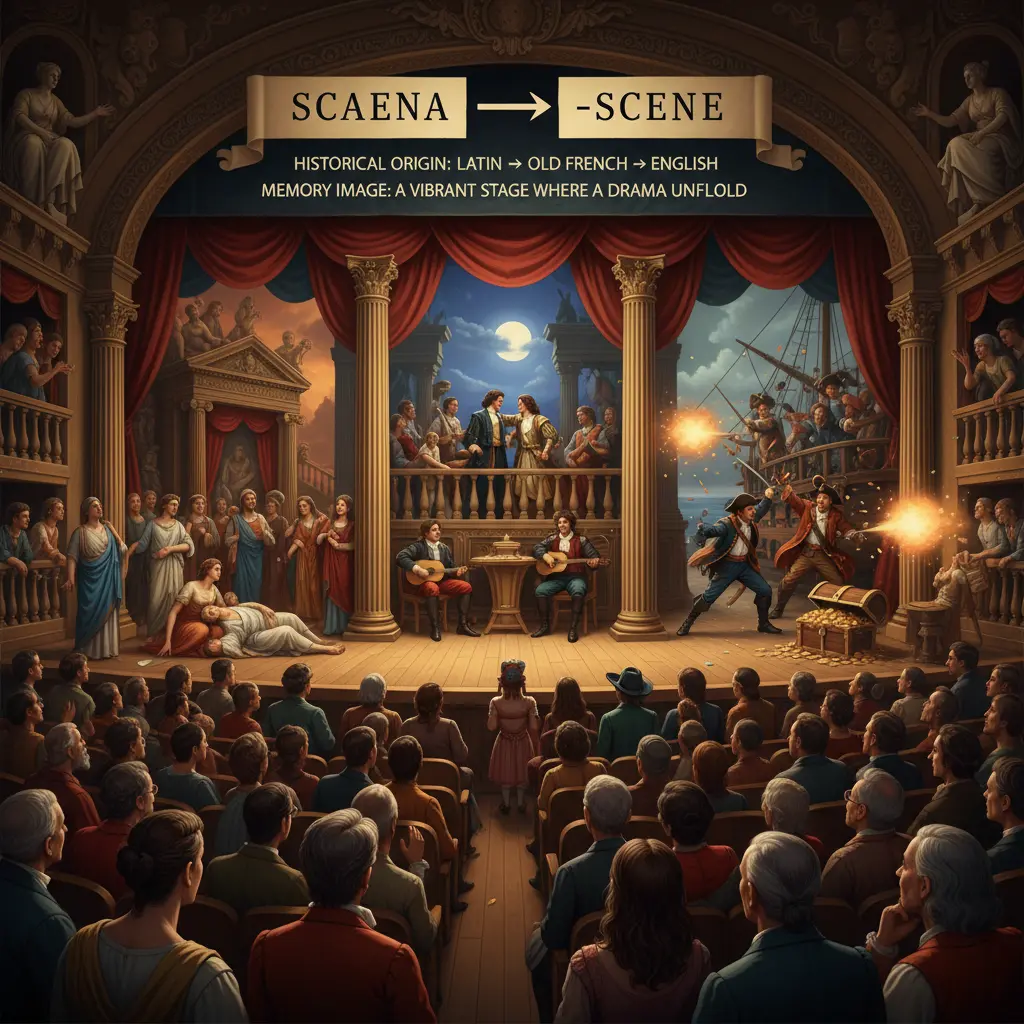
scene = scaena (Latin for stage) + -scene (suffix). Historical origin: Latin → Old French → English. Memory image: Picture a vibrant stage where a drama unfolds, captivating the audience with each scene's uniqueness.
Note 1: These definitions and etymologies are not standard dictionary definitions, but extended explanations provided to help with memorization and understanding of the actual application of words. Through this background information, we strive to make words more vivid and easier to understand, and help you remember their meanings in real life.
Note 2: LexiTalk designs the learning flow around the linguistics principle of “Comprehensible Input.” When learners encounter material that is slightly above their level but still understandable from context, the brain naturally absorbs the language. That’s why we keep every word inside authentic contexts, using examples and associations to help you understand it and use it flexibly.
Read the FAQ explanation of Comprehensible InputI push the curtain aside and feel the room wake as light spills in. I step toward the window, move my eyes across the street, and the scene outside begins to move with the people and leaves. I adjust my stance, keep my breath steady, and watch how the picture shifts as a passerby glances up. In that moment, the scene stops feeling abstract and feels like a small doorway to a larger story, something I can hold in memory.
Scene, as a noun, can mean a specific place where an event happens, a view or picture, or a division of a play or film. It highlights a moment in time and a setting, from a bustling street scene to a quiet kitchen scene. The word comes from Latin scaena via Old French, with English adopting the -scene suffix to form a broad family of terms. When teaching learners, it helps to distinguish scene from scenery (the general landscape) and from stage (the place of performance). A vivid memory image to recall is a vibrant stage where a drama unfolds, with each scene presenting a new mood, characters, and action.
For an English speaker, scene often signals a distinct unit within a larger narrative and is frequently used in phrases like opening scene or final scene. Learners may overgeneralize to mean just any visual or place, and may confuse it with scenery or stage.
Download LexiTalk app for personalized learning experience
Download AppCookies
We use cookies for essential site functions, analytics, and ads. You can accept, reject, or manage preferences. Privacy Policy